
Incident-based debugging
Each challenge presents a production incident with logs, code, docs, architecture, and clues so you can reconstruct the failure from evidence instead of guesswork.

The Incident Challenge is a bi-weekly production incident challenge for developers and engineers. Participants inspect logs, code, docs, architecture, and clues to identify the issue and submit the fastest correct fix.
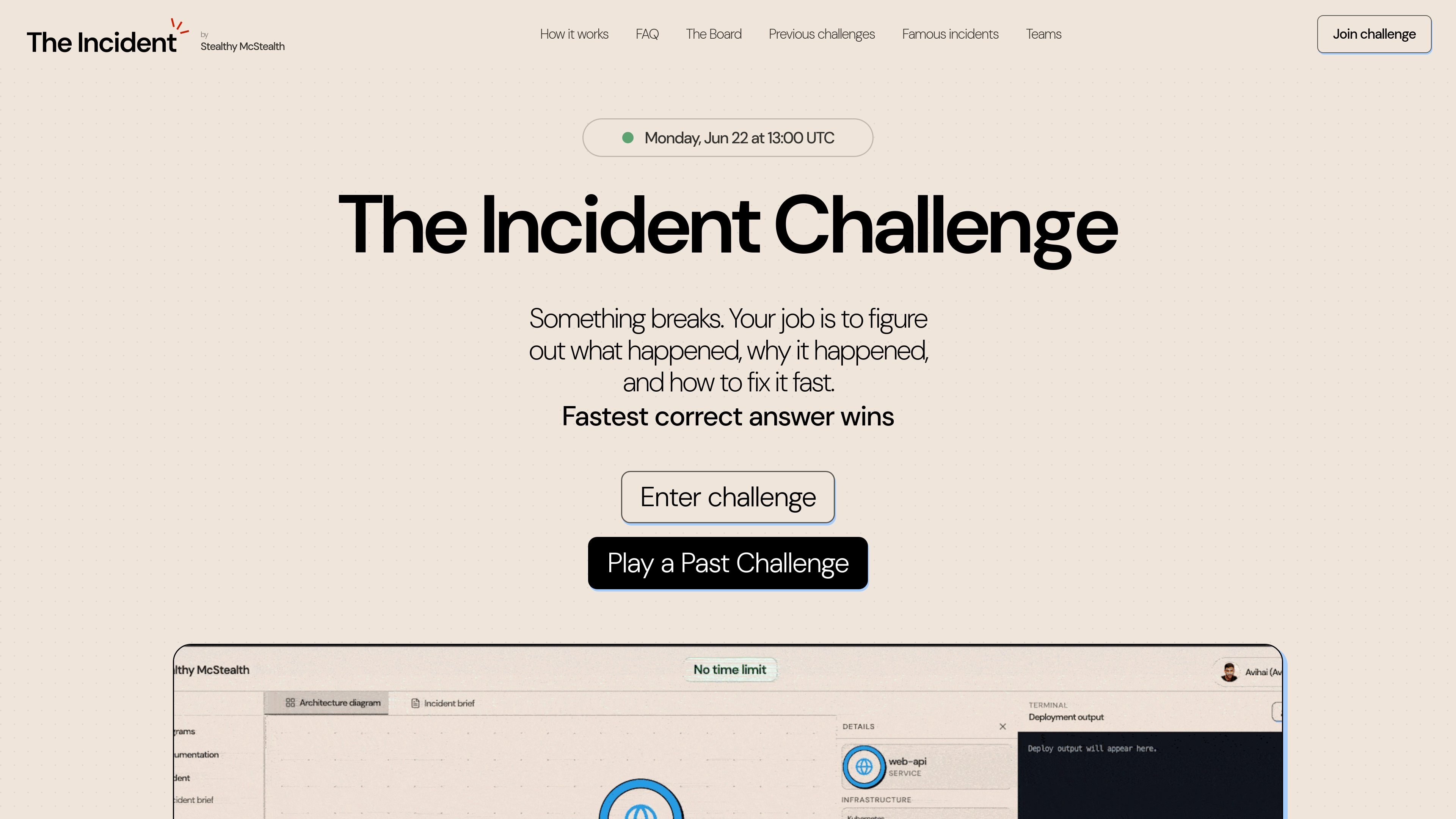
The Incident Challenge is a bi-weekly production incident challenge built around debugging a realistic system under time pressure. Each round asks participants to figure out what happened, why it happened, and how to fix it fast.
The experience is organized around evidence: players read logs, code, docs, architecture, and clues, then submit an answer before the 24-hour window closes. The site positions it as a practical exercise for engineers who enjoy troubleshooting messy systems and validating conclusions with data.
Each challenge presents a production incident with logs, code, docs, architecture, and clues so you can reconstruct the failure from evidence instead of guesswork.
You work under time pressure: a new incident opens every second Monday and stays available for 24 hours.
The challenge is scored around speed and correctness, with the fastest correct answer taking the win.
Winners are announced on The Incident Challenge’s page, making outcomes visible after each round.
The site encourages both reading the system and explaining the fix, which makes the workflow more than just spotting an error.
Use it to practice diagnosing a production-style outage from incomplete signals and trace the path from symptoms to root cause.
Use it as a timed exercise for engineers who want to work through logs, code, and architecture under pressure.
Use it to benchmark reasoning skills against other participants through a fastest-correct-answer format.
Use it as a structured way to test whether your debugging process depends on evidence rather than instinct.
The site describes it as a bi-weekly production incident challenge where you read the system, identify what happened, why it happened, and how to fix it.
A new incident drops every second Monday, and each incident opens for 24 hours.
The fastest correct answer wins.
The site says it is for people who like untangling messy systems, trust evidence over instinct, and enjoy finding signal in noise.
The site frames the challenge around reading logs, code, docs, architecture, and clues. It does not state pricing details or team rules in the source provided.

GameGrad turns PDF study material into quiz questions that appear inside arcade games, so users can practice active recall while they play. It offers a free tier with one PDF and a Pro plan with more uploads, more questions, and answer explanations.

DailyPlay.ai is a behavioral growth platform that uses AI site scanning and micro-games to help brands improve engagement and conversion. It supports web, mobile, and other digital touchpoints, with a one-line script setup and a free engagement scan.

PixelForge turns a single photo into a game-ready 2D character sprite pack, including a 4×4 sheet, transparent frames, direction strips, and looping walk GIFs. It is designed for engine-ready use in Godot, Unity, Phaser, GameMaker, and web games.

FixMyCWV is a web-based Core Web Vitals audit tool that produces developer-focused recommendations for improving LCP, INP, and CLS. It works across many site stacks and claims to handle sites with bot protection.

PromptLayer is an LLM operations platform for versioning, testing, and monitoring prompts and agents. It helps AI engineering teams and domain experts collaborate on prompt workflows without working directly in code.

MacYaps est une app de barre des menus pour macOS qui joue des clips audio amusants quand des événements système se produisent. Packs vocaux, audio personnalisé et licence à vie.