
Intent-driven tests as code
Describe a journey in plain English and Blop turns it into a browser test backed by Playwright. The resulting `.blop.ts` file lives in your repo and can be reviewed with the rest of your code.

blop is a QA agent that turns plain-English browser journeys into Playwright-backed tests stored in your repository, runs them in GitHub Actions, and returns results in pull requests. It also clusters repeated failures and can schedule tests as recurring journey probes.
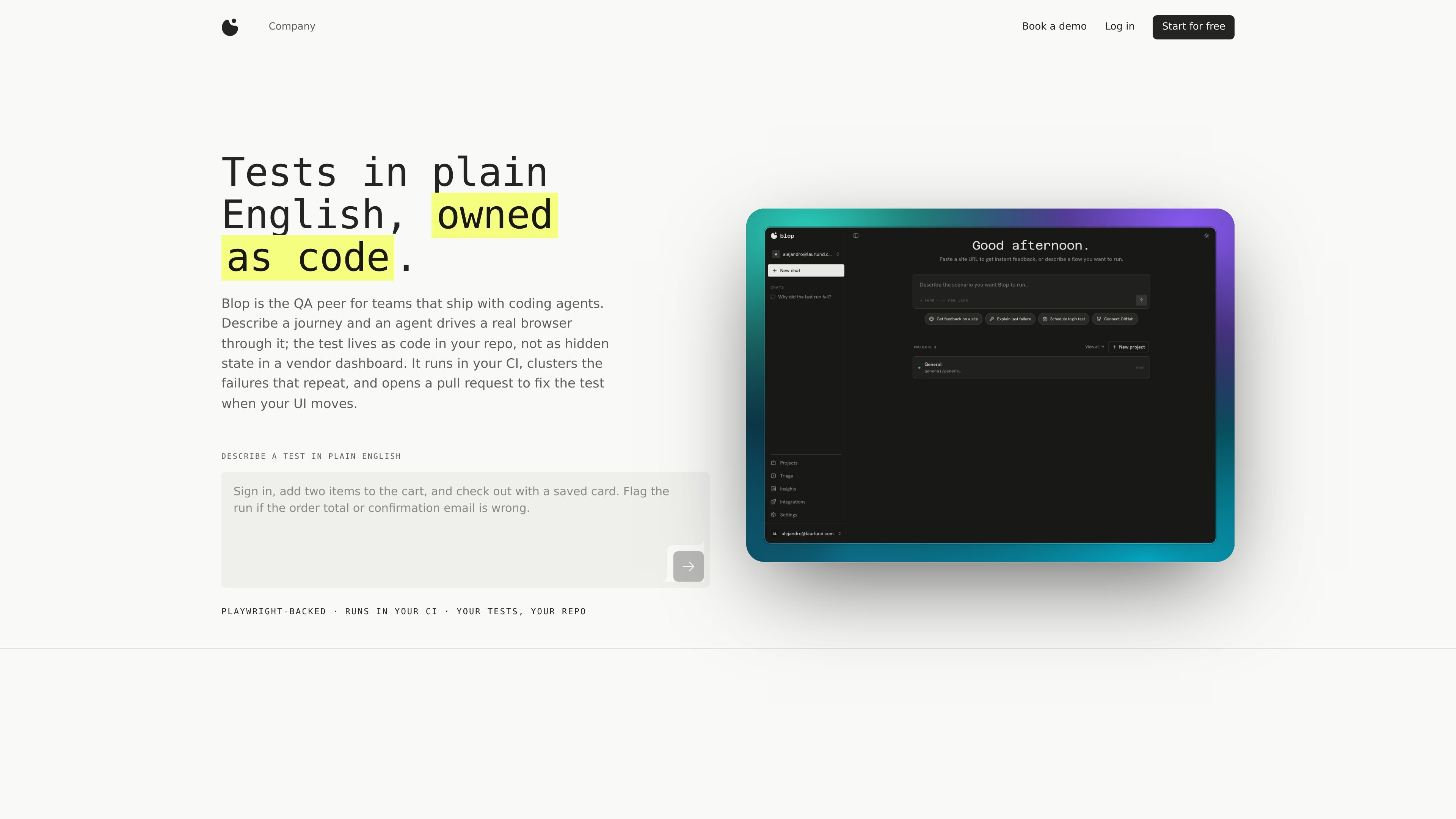
blop is a QA agent for browser testing that keeps tests as code in your repository. It turns a plain-English journey description into a Playwright-backed test, runs that test in your CI, and returns results as reviewable code and pull requests rather than hidden dashboard state.
The product is built for teams that ship with coding agents and want QA to fit the same workflow. It supports GitHub repository connections, pull-request feedback, failure clustering, and scheduled journey probes so teams can use the same test artifact for both active QA and ongoing production checks.
Describe a journey in plain English and Blop turns it into a browser test backed by Playwright. The resulting `.blop.ts` file lives in your repo and can be reviewed with the rest of your code.
Blop runs tests in your existing GitHub Actions setup rather than hosting separate runners. It authenticates with a per-project key held by your workflow.
Runs post back to the originating pull request with pass counts, failure clusters, and artifact links such as traces, console output, and screenshots. The reviewer sees results in the same place the change is being discussed.
Repeated failures are merged into clusters so the same underlying issue does not appear as a long flat list. You can mark a cluster known or link it to GitHub or Linear.
When enabled, the agent can open a pull request that fixes a failing test and verifies it green before you review it. The source notes this auto-fix flow is in early access and limited to allowlisted paths.
Any test can also be scheduled as a recurring synthetic check for production journeys, with uptime and p95 duration shown alongside pass and fail status.
A team can describe a checkout, signup, or other user journey in plain English and have Blop generate a browser test that lives in the repo and runs in CI.
When a UI change breaks the same selector or flow across multiple runs, Blop groups the failures into a single cluster so engineers can triage one issue instead of many duplicate entries.
Product teams can schedule an existing test as a recurring probe against production to watch uptime, journey completion, and p95 duration for important flows.
When a test fails, the result lands back on the triggering pull request with traces, console logs, screenshots, and known-failure context so reviewers can decide whether to ship or revise.
Teams that use GitHub Actions and Playwright can keep their QA workflow close to their existing delivery process instead of managing a separate test runner stack.
Blop stores tests in your repository as `.blop.ts` files. They are version-controlled and can be edited or deleted like other code.
Every plan starts with a 7 day free trial, no credit card is required to start, and the trial gives full access to the plan you choose.
No. Blop runs through your existing GitHub Actions runners, including cloud or self-hosted runners.
Playwright is the runtime today and is first-class. The source also says adapters for other frameworks are planned.
When a run fails, the agent inspects the failure, trace, and diff, then opens a pull request with a fix scoped to allowlisted paths and runs a verification build before review. Auto-fix is in early access.

ByteAsk is a terminal-first AI coding agent for C and C++ that edits repositories and verifies changes with the real compiler, debugger, sanitizers, and tests before showing a diff. It offers a free tier plus paid plans, with editor connectors and zero-retention handling described in the source.

Manta AI is an autonomous web app testing tool for teams that want to map application behavior, catch regressions, and generate tests without writing scripts or maintaining selectors. It works from a URL and supports plain-English test flows, run results with screenshots, and scheduled or deployment-triggered checks.

CreateOS Sandbox is an isolated compute environment for running code and agent workloads inside Firecracker micro-VMs. It is designed for workflows that need machine-level isolation, private networking between sandboxes, and programmatic control through SDK, CLI, or MCP.

hob is an independent workspace for coding agents that keeps agent sessions, terminals, history, and follow-up work organized around the tools and providers you already use. It is aimed at developers who want local control over routing, history, and workspace structure rather than a bundled model stack.

SonOf connects to your repo and PM tool, audits the codebase and surrounding product context, and turns approved work into shipped tickets with senior engineering review. It is aimed at founders and engineering leaders who need backlog help without hiring a full team immediately.

Ghost è un assistente AI da terminale per chattare, generare codice ed eseguire task da riga di comando. Include modelli gratuiti, supporta Linux, macOS e Windows, ed è open source.