

Clayzo
Clayzo helps product teams prototype and review directly on their real codebase with instant sandboxes, element-level feedback, and AI engineer handoff.
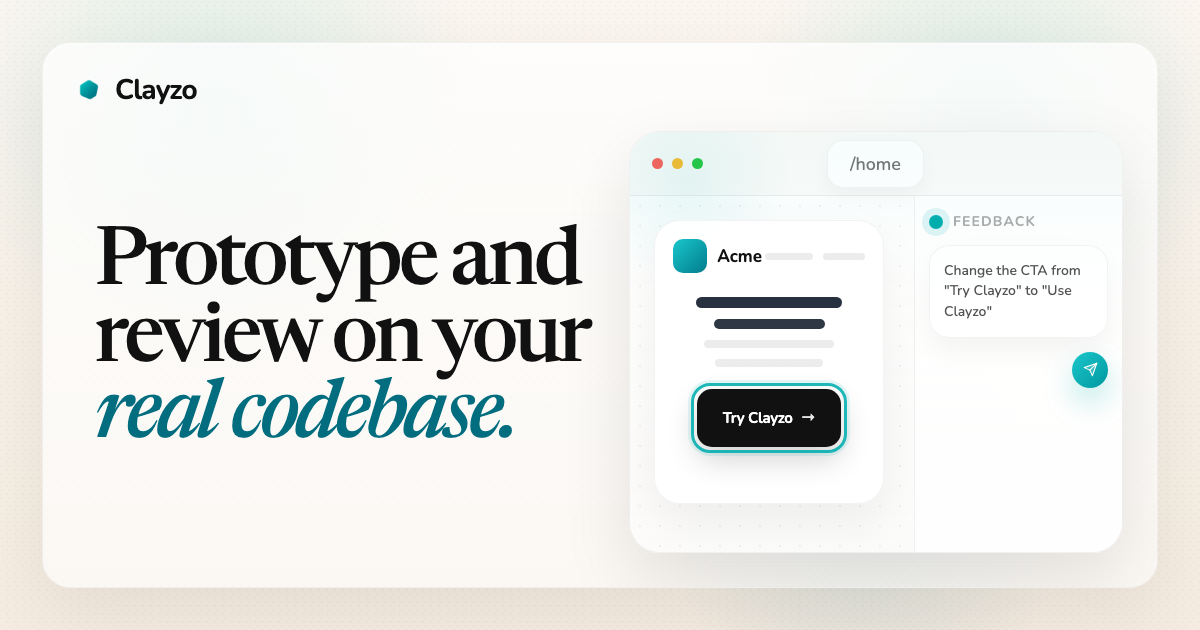
What is Clayzo?
Clayzo helps product teams prototype and review directly on their real codebase with instant sandboxes, element-level feedback, and AI engineer handoff.
Instead of working in a separate mock environment, Clayzo focuses on producing reviewable changes that run on the team’s own codebase, with feedback aimed at specific UI elements and an AI-supported engineer handoff.
Key Features
- Instant sandboxes on your real codebase: Generate environments tied to the actual application so prototypes and reviews can reflect real integration points.
- Element-level feedback: Capture feedback at a more granular level than broad comments, targeting specific UI elements.
- AI-powered engineer handoff: Use AI to support the transfer of review outcomes toward implementation work.
- Prototype and review workflow in one place: Combine prototyping and review activities against the same underlying codebase context.
How to Use Clayzo
- Start from your existing product codebase so Clayzo can base the sandbox on your real application.
- Create a prototype within that codebase context.
- Share the prototype for review and collect element-level feedback.
- Use the AI-powered engineer handoff to translate the review results into the next engineering steps.
Use Cases
- Product team prototyping with real UI context: A team validates a proposed experience while keeping the prototype grounded in the current application implementation.
- Design/UX feedback at the component level: Stakeholders review specific elements and provide targeted comments that are easier for engineering to interpret.
- Cross-functional reviews without leaving the codebase: Product and engineering coordinate around prototypes that run as part of the same system being built.
- Iterative refinement based on structured feedback: Teams loop through prototype updates by incorporating element-level feedback.
- Preparing engineering work from review outputs: After review, the team uses the AI-powered handoff to support implementation planning.
FAQ
How is Clayzo different from reviewing static mockups? Clayzo is designed to prototype and review products on your real codebase, enabling review feedback tied to the actual application context rather than a detached mock.
What does “element-level feedback” mean? The site describes feedback focused on specific elements, which helps reviewers comment on particular UI components instead of only providing high-level notes.
What is the purpose of the AI-powered engineer handoff? It is used to support the transfer from review feedback to engineering execution, helping bridge the gap between what was reviewed and what needs to be built next.
Do I need my own codebase for Clayzo to work? Yes. The product is explicitly described as working on “your real codebase,” and its sandboxes are created directly from it.
Is Clayzo intended for prototyping, reviewing, or both? Both: the description emphasizes that Clayzo supports prototypes and reviews within the workflow on your codebase.
Alternatives
- Standalone prototyping tools: Tools focused on creating UI prototypes outside the primary codebase. These often require additional effort to translate mock feedback into implementation.
- Component-driven UI preview environments: Approaches that let teams preview UI elements in isolation (for example, in component documentation/preview systems). They can support granular review but may not reflect full product behavior tied to the complete codebase workflow.
- Code-focused review workflows: Review processes built directly around code changes (e.g., pull-request-centric workflows). They can keep feedback close to implementation, but typically don’t offer the same dedicated sandboxing/prototyping flow described for Clayzo.
- AI-assisted ticketing or spec generation: Systems that translate product feedback into engineering tasks using AI. These may help handoff, but they may not provide codebase-backed sandbox prototypes and element-level review as described for Clayzo.
Alternatives

MakerLoft
MakerLoft is an AI app builder for non-developers that connects to your GitHub repo to generate working apps with auth, payments, files, jobs.

Ably Chat
Ably Chat is a chat API and SDKs for building custom realtime chat apps, with reactions, presence, and message edit/delete.

ClawTick
ClawTick is a CLI-first AI agent automation platform for scheduling webhook tasks on cron with monitoring, alerts, retries, and execution logs.

Falconer
Falconer is a self-updating knowledge platform for high-speed teams to write, share, and find reliable internal documentation and code context in one place.

OpenFlags
OpenFlags is an open source, self-hosted feature flag system with a control plane and typed SDKs for progressive delivery and safe rollouts.

AakarDev AI
AakarDev AI is a powerful platform that simplifies the development of AI applications with seamless vector database integration, enabling rapid deployment and scalability.