

Imagine
Imagine is an AI-coding tool that builds real apps with the backend included—describe your idea in natural language to deploy.
What is Imagine?
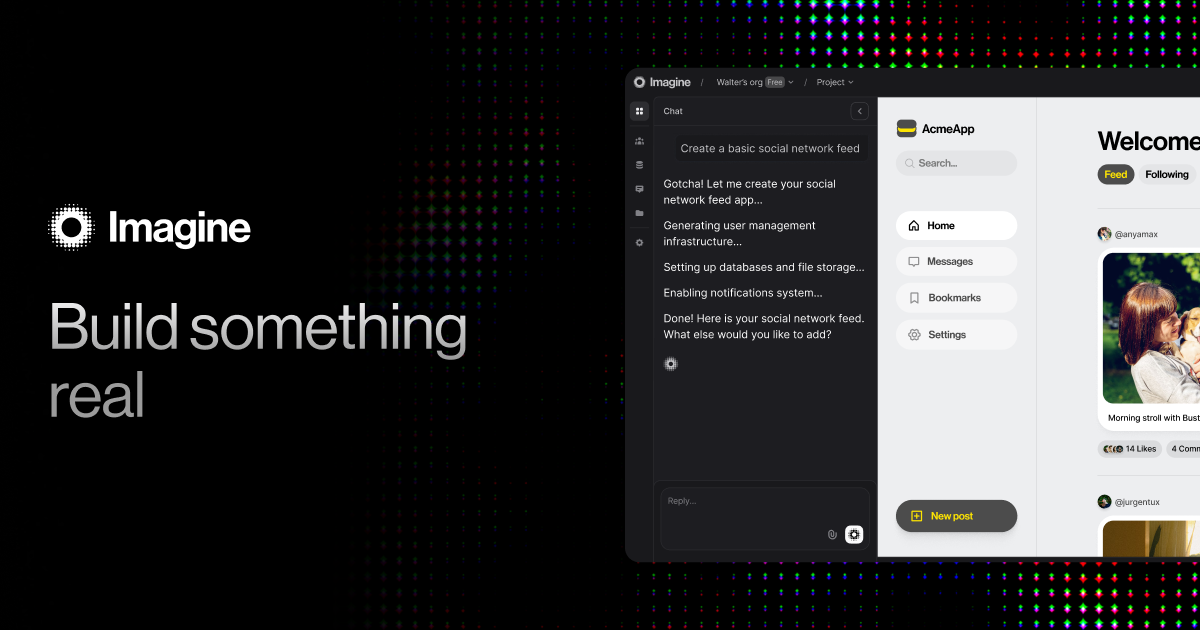
Imagine is an AI-coding tool that helps you build real applications with the backend included, not just prototypes. You describe what you want to create in natural language, and it generates the implementation so the app can run in a production-style setup.
The platform includes core building blocks such as authentication, databases, storage, hosting for domains and frontend code, and tools for notifications. The goal is to let you move from an idea—like a portfolio, internal tool, or SaaS—toward a working application.
Key Features
- AI app generation from natural language: Describe the product you want to build, and the system handles the technical implementation.
- Authentication options: Supports user login methods including Email/Password, SMS, OAuth, Anonymous, and Magic URLs.
- Databases backed by preferred technologies: Provides scalable, robust database functionality (presented as a products/category-style data model).
- Secure storage with transformations: Stores files with compression, encryption, and image transformations.
- Hosting for domains and frontend code: Host and maintain website domains and frontend code, with hosting described as integrated with other Appwrite products.
- Security-first protections and compliance support: Includes DDoS mitigation, encryption in transit and at rest, abuse protection for APIs, data migrations, and references to GDPR, SOC-2, HIPAA, and CCPA.
How to Use Imagine
- Start a project and submit a description of the app you want (e.g., a dashboard, booking system, or portfolio).
- Use the generated app components and configure the included building blocks (authentication, databases, storage, and hosting) as needed for your use case.
- Deploy/host your app using the platform’s hosting capabilities so the frontend and domain work together.
Use Cases
- Portfolio or landing pages: Generate a public website experience for a personal project or business, then host it on a custom domain.
- Internal tools and admin dashboards: Build authenticated dashboards (for example, expense tracking or appointment management) that connect to underlying data and storage.
- SaaS MVPs: Create a first version of a subscription-style product with core backend components like auth, database-backed features, and hosted frontend.
- Client and CRM-style workflows: Produce a structured application for managing client data and related activities, backed by the platform’s database and authentication.
- Applications needing media and file handling: Build features that require secure uploads with compression, encryption, and image transformations.
FAQ
-
Do I need coding experience to use Imagine? No. The product is designed so you can describe what you want in natural language and the AI handles the technical implementation.
-
How does Imagine generate production-ready code? Imagine describes an AI agent architecture intended to replicate team workflows, using Anthropic models to generate code and align it with industry standards and best practices.
-
Can I export my code and deploy it elsewhere? Not currently. The export-to-other-hosting feature is stated as “coming soon,” so deployment outside the platform is not available yet.
-
Is my data secure on Imagine? Imagine states it uses a security-first approach with protections including DDoS mitigation, encryption in transit and at rest, abuse protection, and access permissions.
-
Is there a free plan? Yes. A free plan is listed for personal passion projects and non-commercial use, with limits for credits per day and storage/bandwidth.
Alternatives
- No-code/low-code app builders: These can help you assemble apps with less or no code, but the workflow may rely more on templates/visual editors rather than AI-generated implementation from natural language.
- Traditional full-stack frameworks plus managed backend services: You can build real apps by pairing a frontend framework with services for auth, database, storage, and hosting; this typically requires more setup and engineering time than an AI “build from description” workflow.
- Backend-as-a-service platforms (BaaS): Platforms that provide authentication, databases, and storage can reduce infrastructure work, though you would still need to create the app logic and UI rather than using a single AI-driven builder experience.
Alternatives

MakerLoft
MakerLoft is an AI app builder for non-developers that connects to your GitHub repo to generate working apps with auth, payments, files, jobs.

ClawTick
ClawTick is a CLI-first AI agent automation platform for scheduling webhook tasks on cron with monitoring, alerts, retries, and execution logs.

Falconer
Falconer is a self-updating knowledge platform for high-speed teams to write, share, and find reliable internal documentation and code context in one place.

OpenFlags
OpenFlags is an open source, self-hosted feature flag system with a control plane and typed SDKs for progressive delivery and safe rollouts.

skills-janitor
Audit, track usage, and compare your Claude Code skills with skills-janitor—nine focused slash commands and zero dependencies.

Devin
Devin is an AI coding agent that helps software teams complete code migrations and large refactoring by running subtasks in parallel.