
Modern frontend stack
Built on Next.js 16 App Router, React 19, and TypeScript strict mode, with an RSC-first approach and client components only where needed.

Next Elite is a frontend-first, API-driven Next.js 16 boilerplate with auth, RBAC, i18n, forms, and env validation ready to go.
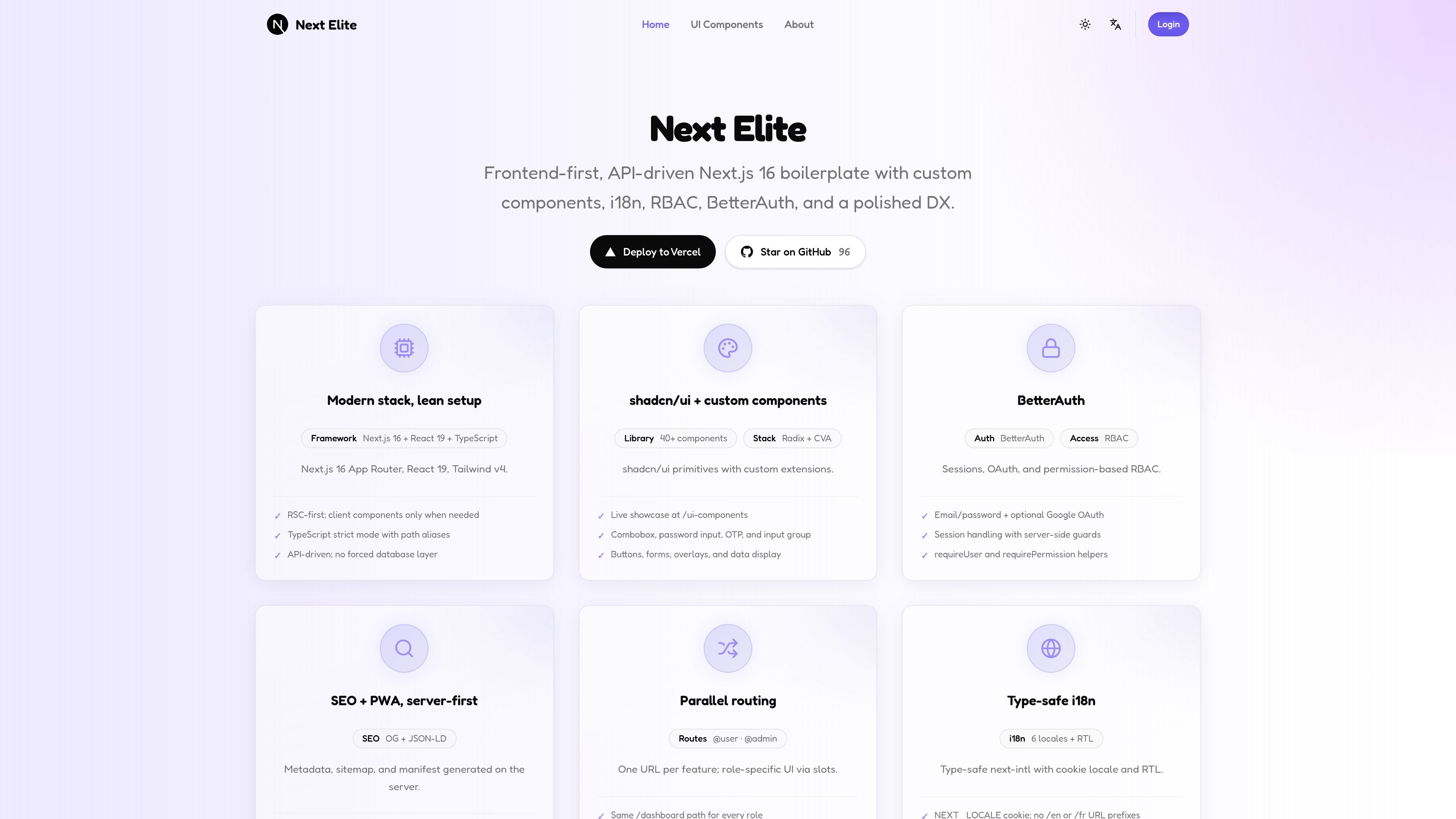
Next Elite is a frontend-first, API-driven boilerplate for building applications with Next.js 16, React 19, and TypeScript. The homepage positions it as a lean starting point that keeps the stack focused on the frontend while avoiding forced database layers.
The project combines authentication, role-based access control, localization, forms, environment validation, and developer tooling in one starter. It also includes custom UI components, server-first metadata, and role-specific dashboard routing so teams can move from setup to implementation without assembling these pieces separately.
Built on Next.js 16 App Router, React 19, and TypeScript strict mode, with an RSC-first approach and client components only where needed.
Uses BetterAuth for email/password sign-in, optional Google OAuth, session handling, server-side guards, and permission-based RBAC helpers.
Provides type-safe internationalization with `next-intl`, a `NEXT_LOCALE` cookie, typed messages, six locales, and RTL support.
Ships with more than 40 shadcn/ui-based components plus custom extensions such as combobox, password input, OTP, and input groups.
Includes Zod schemas, React Hook Form, and inline error handling for login, registration, and password reset flows.
Adds server-generated metadata, sitemap, robots, manifest, canonical URLs, and JSON-LD for SEO and PWA support.
Use it as a starting point when you want a Next.js application with auth, permissions, localization, and environment validation already wired in.
Use the role-specific `@user` and `@admin` slots to build different dashboard experiences while keeping a single `/dashboard` route.
Use the typed message setup and RTL support when building a product that needs multiple languages without losing type safety.
Use the included form schemas, React Hook Form integration, and inline error patterns to implement login and account flows faster.
Use the component library and custom UI extensions when you need a polished interface without assembling every primitive from scratch.
The site describes Next Elite as a Next.js 16 and React 19 boilerplate with frontend-first, API-driven architecture, custom components, i18n, RBAC, BetterAuth, and several DX-focused utilities.
It includes a Next.js 16 App Router setup, React 19, TypeScript strict mode, Tailwind v4, shadcn/ui with custom extensions, BetterAuth, next-intl, Zod, React Hook Form, T3 Env, TanStack Query, and Sentry as described on the homepage.
The homepage shows a local setup flow that starts with cloning the repository, copying `.env.example` to `.env`, installing dependencies, and running the dev server. The site also says it can be deployed to Vercel.
The site presents role-specific dashboards through parallel routing at the same `/dashboard` path, with `@user` and `@admin` slots selected from permissions.
The pricing URL shown in the collected evidence returns a 404 page, so the available sources do not confirm a pricing plan or paid tier structure.

ByteAsk is a terminal-first AI coding agent for C and C++ that edits repos and verifies changes with compilers, debuggers, sanitizers, and tests.

CreateOS Sandbox is an isolated compute environment for running code and agent workloads in Firecracker micro-VMs with private networking and SDK, CLI, or MCP control.

hob is an independent workspace for coding agents, with local control over sessions, terminals, history, routing, and follow-up work.

Ably Chat is a chat API platform for custom realtime chat apps, with rooms, typing indicators, presence, reactions, message updates and usage-based pricing.

Prompty Town turns a link into a building in a small internet city. Buy a tile, add a prompt, and publish it alongside other buildings.

Make Real is a Next.js app that turns hand-drawn wireframes into HTML prototypes with the tldraw SDK and AI models, with canvas sketching and embedded preview.