

ProductBridge
ProductBridge centralizes SaaS customer feedback from multiple channels, then organizes and prioritizes it into roadmap items and changelogs with AI insights.
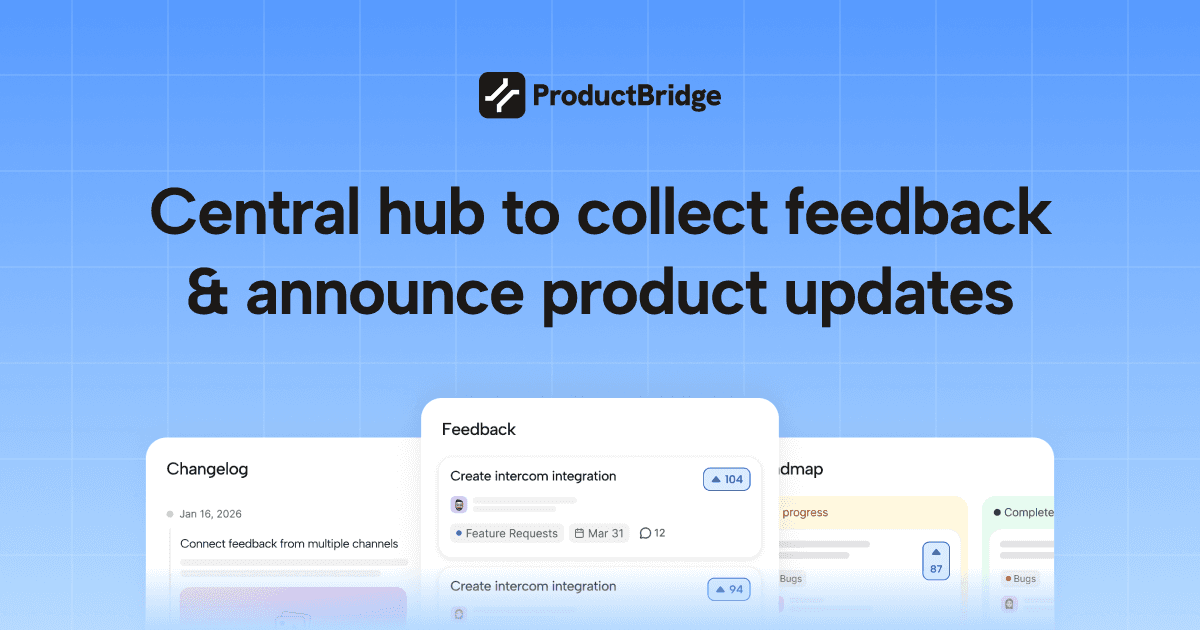
What is ProductBridge?
ProductBridge is a SaaS product designed to collect, organize, and act on customer feedback as part of a product planning workflow. It centralizes feedback from multiple channels so teams can see feature requests, issues, and ideas in one place and turn them into planned work.
The core purpose is to automate the feedback loop: gather input, deduplicate and categorize it, prioritize what matters, and then close the loop by notifying users when requested work progresses or ships. The site also highlights AI-powered analysis to help teams understand themes and trends in feedback.
Key Features
- Feedback collection from multiple sources (e.g., website widgets/portals, public boards, and support channels) to centralize ideas and issues
- Auto-categorization, duplicate detection, and scoring of requests using an AI-powered “feedback agent” to reduce manual triage
- Feature request prioritization signals such as upvotes to help teams gauge demand before committing development time
- Roadmap generation that converts top requests into planned work, with links between ideas and resulting roadmap items
- Close-the-loop notifications for users when their requested features move through statuses and go live
- Custom status workflows for organizing initiatives through stages (the site lists planned, in progress, in review, shipped, and more)
- Changelog creation based on shipped roadmap items (the site states “AI That Writes Your Changelog” and “AI Drafting Release Notes”)
- Dashboard/board organization options including public vs. private boards and segment-based boards for specific user groups
How to Use ProductBridge
- Start by getting set up and connecting at least one feedback source (the site specifically references an “Intercom integration” as part of getting started).
- Collect feedback through the product’s configured portals/widgets/boards and ensure each request is visible in the appropriate board context (e.g., public, internal, or segment-based).
- Use the AI-powered agent to auto-categorize, deduplicate, and score incoming requests, then review prioritization signals like upvotes.
- Convert selected requests into roadmap items and link ideas to features so stakeholders can see what was planned.
- Track progress with custom status workflows and notify users as work moves forward; then generate changelog/release notes from shipped roadmap items.
Use Cases
- Consolidating scattered feedback: A product team collects input from Slack/email/support or other sources into one organized space, reducing the need to manually search across tools.
- Cleaning up duplicates and organizing requests: When multiple users submit similar issues or feature requests, ProductBridge’s duplicate detection and auto-categorization helps teams handle the backlog more efficiently.
- Prioritizing with voting signals: A team uses upvotes and other prioritization cues to identify which feature requests reflect the strongest user demand.
- Planning work from customer input: Product managers convert top requests directly into roadmap items and link ideas to planned features so customer-facing teams can explain how feedback becomes product changes.
- Publishing updates with a changelog loop: After roadmap items ship, the product generates release notes/changelog content based on those shipped items and keeps users informed about progress.
FAQ
-
Does ProductBridge support AI for feedback analysis? The site describes an AI-powered feedback agent that can auto-categorize, deduplicate, and score requests, and can summarize feedback themes and priorities.
-
What sources can I bring into ProductBridge? The site mentions feedback collection from website widgets/portals, public boards, and support channels, and it also references an Intercom integration.
-
Can feedback be shown publicly and privately? Yes. The site describes public and private boards, including segment-based boards for specific user groups.
-
Does ProductBridge include a roadmap and changelog workflow? Yes. It supports turning requests into roadmap items, tracking them through status workflows, notifying users, and generating changelog/release notes from shipped roadmap items.
-
Can teams customize roadmap status stages? The site lists custom status workflows and provides example stages such as planned, in progress, in review, and shipped.
Alternatives
- Feedback + ticketing platforms: Tools that centralize support tickets and customer requests can serve as an alternative, but may require more manual effort to deduplicate, score, and connect feedback to roadmap and changelog outputs.
- Roadmap tools without automated feedback loops: Standard roadmapping/project planning apps can help manage planned work, but they may not provide the same end-to-end automation for collecting, deduplicating, prioritizing, and notifying based on customer feedback.
- Idea boards and community voting tools: Public/private idea boards can capture upvotes and user votes, but may be less focused on turning those ideas into roadmap items and generating release notes automatically from shipped work.
- Spreadsheet-based feedback workflows: Some teams still track requests in CSV/export-heavy processes; compared with ProductBridge, this tends to be more manual and harder to keep consistent across collection, prioritization, and updates.
Alternatives

Struere
Struere is an AI-native operational system that replaces spreadsheet workflows with structured software—dashboards, alerts, and automations.

skills-janitor
Audit, track usage, and compare your Claude Code skills with skills-janitor—nine focused slash commands and zero dependencies.

PromptScout
PromptScout tracks how your brand is mentioned, which competitors are recommended, and what sources are cited in AI answers—plus website audits.

Lasso
Lasso is an AI-first PIM for ecommerce teams that enriches product attributes and descriptions, processes supplier data, and monitors competitors via app or API.

SaveMRR
SaveMRR scans Stripe billing data to find SaaS MRR leaks and help recover failed payments, save cancellations, and win back churn—60-sec Free Revenue Scan.

Biji
Biji is a versatile platform designed to enhance productivity through innovative tools and features.