
Unified model gateway
Use one API key and base URL to reach models from providers including OpenAI, Anthropic, Google, MiniMax, DeepSeek, xAI, Moonshot, Qwen, Zhipu, and Meta, subject to the current catalog.

RouteMux is an AI gateway for models from multiple providers through one API key and base URL, with centralized billing and redundant routing.
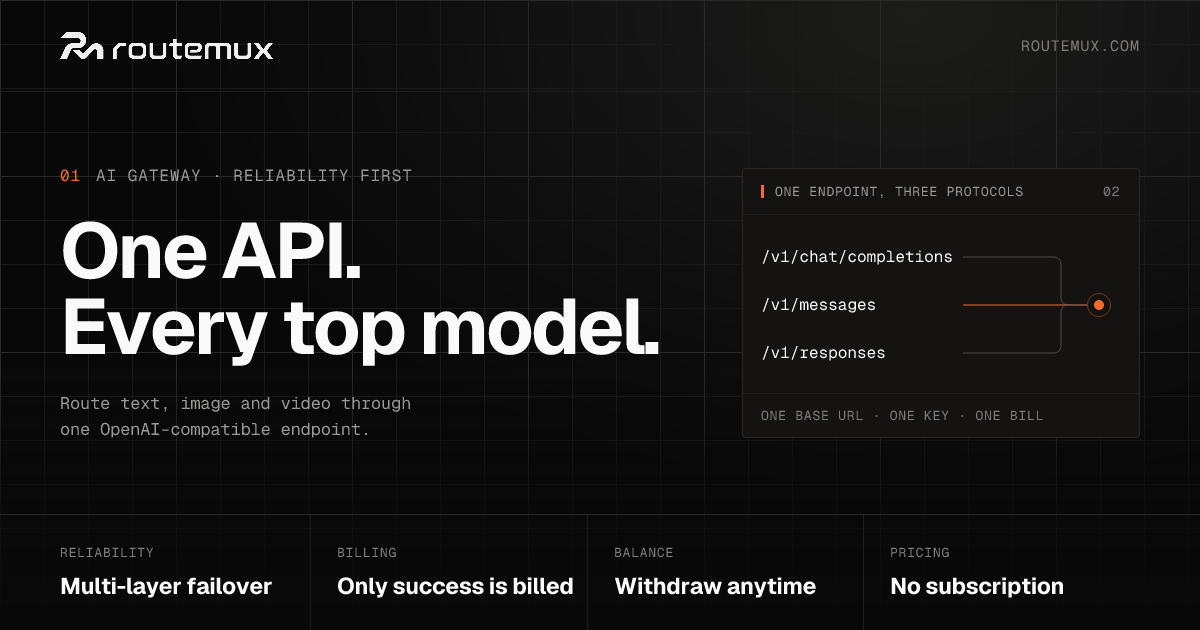
RouteMux is an AI gateway that provides one API key and base URL for accessing models from multiple providers. It presents OpenAI-compatible access alongside Anthropic-compatible and Google Vertex AI protocol options, allowing teams to evaluate or adopt different models without maintaining a separate gateway integration for each provider.
The service combines a model catalog with centralized prepaid billing, request and usage visibility, and routing designed with redundancy across the network, gateway, and model-service layers. It covers text, image, video, and audio workloads, although protocol support, inputs, outputs, pricing units, and capabilities vary by model and should be checked in the catalog and documentation.
Use one API key and base URL to reach models from providers including OpenAI, Anthropic, Google, MiniMax, DeepSeek, xAI, Moonshot, Qwen, Zhipu, and Meta, subject to the current catalog.
The catalog lists OpenAI Chat Completions, OpenAI Responses, Anthropic Messages, Google Vertex AI, image, Sora video, speech, and transcription protocol categories.
RouteMux describes redundancy across network, gateway, and model-service layers, with health-aware routing across vendors intended to support failover and recovery during interruptions.
A shared prepaid wallet supports model-family access from one account, while the pricing pages display RouteMux and official provider rates for supported models.
The homepage exposes API keys, logs, usage, billing, and activity areas in its console, providing a central place to monitor requests and spending.
The catalog includes text, image, video, and audio models, with filters for capabilities such as vision, reasoning, tool calling, JSON mode, video input, prompt caching, and context length.
Prototype a text, vision, reasoning, or tool-calling application against one gateway, then compare models from different providers without adding a separate provider integration for each test.
Run production workloads that need routing across vendors and a recovery path when a network, gateway, or model-service layer has an interruption.
Build applications that combine language models with image generation, video generation, speech, or transcription while managing access through a single account.
Give engineering or operations teams a shared place to manage API keys and review logs, usage, activity, and billing for model calls.
Use the catalog and pricing comparisons to select models by protocol, capability, context length, modality, or listed rate before connecting them to an application.
RouteMux provides a unified gateway for accessing models through OpenAI-compatible, Anthropic-compatible, and Google Vertex AI protocols. The models directory lists supported protocol types, while exact request details should be checked in the documentation for the selected model.
The site describes a single API key and base URL for model access. It also provides documentation and an llms.txt resource intended to explain the base URL, model names, billing rules, and OpenAI-compatible Python usage.
RouteMux uses a prepaid wallet. The pricing page presents per-token rates for applicable text models and notes that final charges follow actual usage; image and video entries may use different units such as per call or per second.
The homepage states that only successful requests are billed and that unused account balance can be withdrawn at any time. The site also advertises a first-top-up promotional credit offer subject to stated signup, timing, minimum-top-up, and account conditions; promotions may change.
RouteMux lists text, image, video, and audio model categories, with capabilities such as vision, reasoning, tool calling, JSON mode, video input, and prompt caching shown in its model catalog. Availability and compatibility vary by model.

AakarDev AI helps teams manage AI provider access, project setup, logs, and analytics in one dashboard. BYOK support included.

CreateOS Sandbox is an isolated compute environment for running code and agent workloads in Firecracker micro-VMs with private networking and SDK, CLI, or MCP control.

GitBot is a local browser workspace for reusable coding bots powered by Claude Code, Codex, or OpenCode, with persistent threads and configurable permissions.

Trigger.dev chat agent is a durable AI chat backend for stateful conversations that survive refreshes, crashes, and long-running turns with AI SDK useChat.

ByteAsk is a terminal-first AI coding agent for C and C++ that edits repos and verifies changes with compilers, debuggers, sanitizers, and tests.

Epherem scans web apps built with Lovable, Bolt, v0, Replit, Cursor, and Claude Code for security flaws in source code and dependencies, without running the app.