
Image generation and editing
Generates and edits images from text prompts, including text-to-image and image modification workflows shown on the pricing page.

UNI-1 by Luma is a multimodal model for text-to-image, image editing, reference-guided creation, and API-based visual workflows.
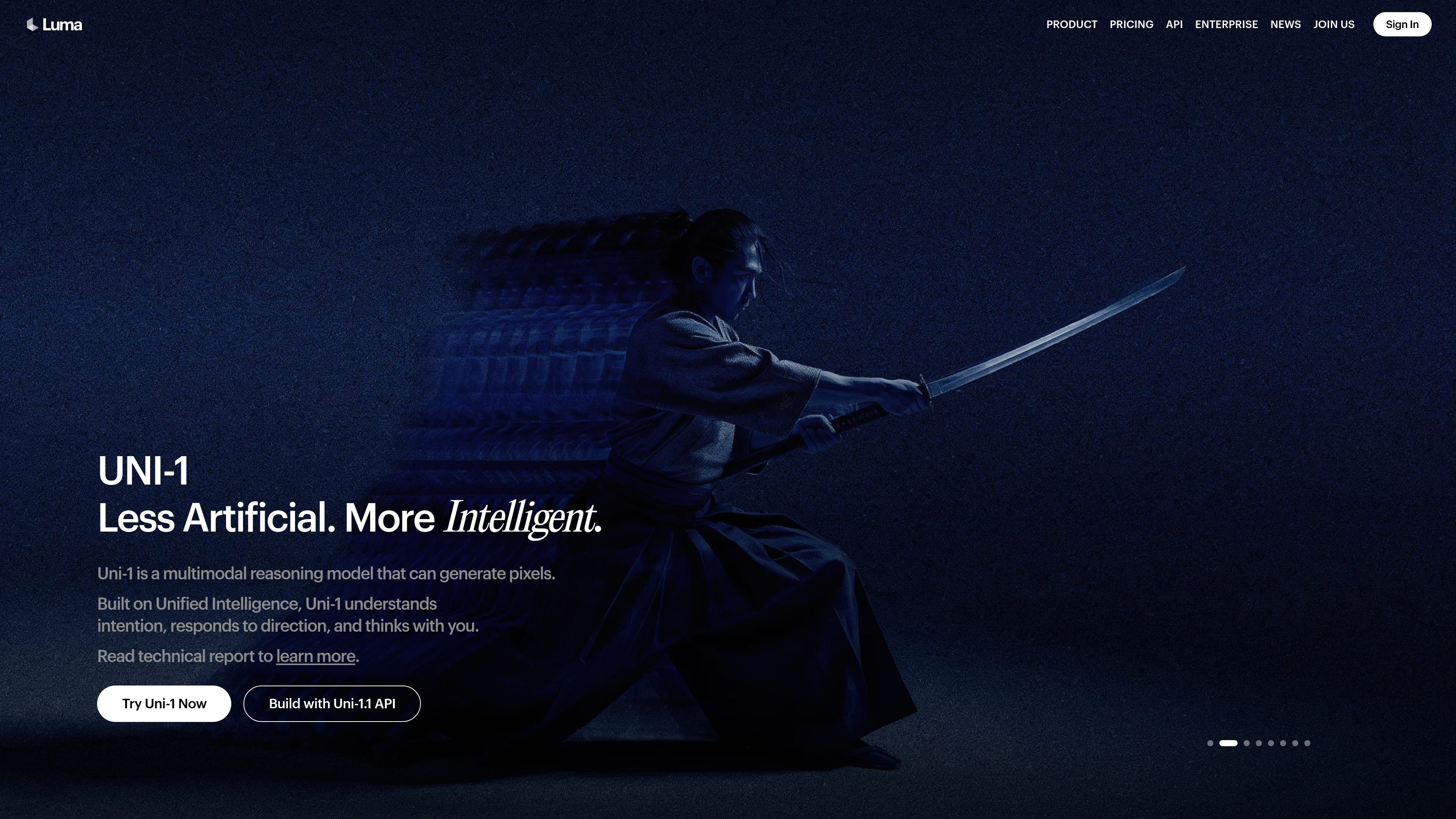
UNI-1 is Luma’s multimodal reasoning model for generating pixels. The product page positions it as a system built on “Unified Intelligence” that understands intention, responds to direction, and combines reasoning with visual generation.
The technical report describes UNI-1 as Luma’s first unified understanding-and-generation model, designed to join reasoning and imagination in a single architecture. It handles text and images in one interleaved sequence and is presented as a model that can plan, iterate, and execute across visual tasks.
Luma’s site frames UNI-1 around practical image workflows such as text-to-image generation, image editing, reference-guided creation, and culture-aware styling. The pricing page lists UNI-1 under image generation pricing, and the API page points to UNI-1 as part of multi-model creative workflows alongside video models.
Generates and edits images from text prompts, including text-to-image and image modification workflows shown on the pricing page.
Uses reference inputs to preserve identity, composition, and other visual constraints across outputs, as shown in the showcase and tech specs.
Supports multi-reference generation for cases where several source images shape the result, including one-image and multi-image workflows.
Applies structured reasoning to scene completion, spatial relationships, and plausibility-driven transformation before rendering an image.
Adapts to different aesthetics and visual languages, including culture-aware generation, manga, memes, and other style variants highlighted in the showcase.
Exposes UNI-1 as part of Luma’s API offering, with a separate API access flow and pricing for image generation.
Create images from written prompts when you need a model that can reason about scene structure, plausibility, and composition rather than only matching keywords.
Modify an existing image while preserving important visual references, such as identity, layout, or other source-grounded details.
Generate variants from several source images when a single reference is not enough to define the desired result.
Explore different visual styles or cultural aesthetics while keeping the subject and composition recognizable.
Build Luma-backed creative pipelines through the API, including workflows that combine UNI-1 for images and Ray3.2 for video.
UNI-1 is Luma’s multimodal reasoning model for generating and editing images. The site highlights it for text-to-image generation, image modification, and reference-guided workflows.
The product page points to image generation, image editing, and multi-reference generation. The showcase and technical pages emphasize reference-guided creation, cultural and style variation, and structured visual reasoning.
Luma describes UNI-1 as a unified model that combines reasoning and visual imagination. Its technical report says it can plan and reason over instructions before and during image synthesis, and the home page says it is built on Unified Intelligence.
The site indicates UNI-1 is available through Luma’s product site and API access flow, with a waitlist for early API access. Pricing is listed separately on the pricing page for image generation.
The product pages frame UNI-1 as one part of a broader Luma workflow, with the API page calling out multi-model workflows that pair UNI-1 for image generation with Ray3.2 for video generation.

AakarDev AI helps teams manage AI provider access, project setup, logs, and analytics in one dashboard. BYOK support included.

BookAI allows you to chat with your books using AI by simply providing the title and author.

Skills Janitor is a GitHub-hosted set of slash commands for auditing, tracking, and cleaning up Claude Code and OpenAI Codex skills.

FeelFish is a PC client for AI-assisted novel writing, helping writers plan characters and settings, draft and revise novels, and manage story context.

Benchspan is an AI agent security platform that discovers agents, blocks prompt injection and data exfiltration in real time, and supports pre-launch red teaming.

ChatBA is a generative AI tool for instantly creating slide decks from prompts, with help on templates, sharing, and data sources.