

Yorph AI
Yorph AI is an agentic data platform combining no-code ease with code-first control and scalability for on-demand modern data work.
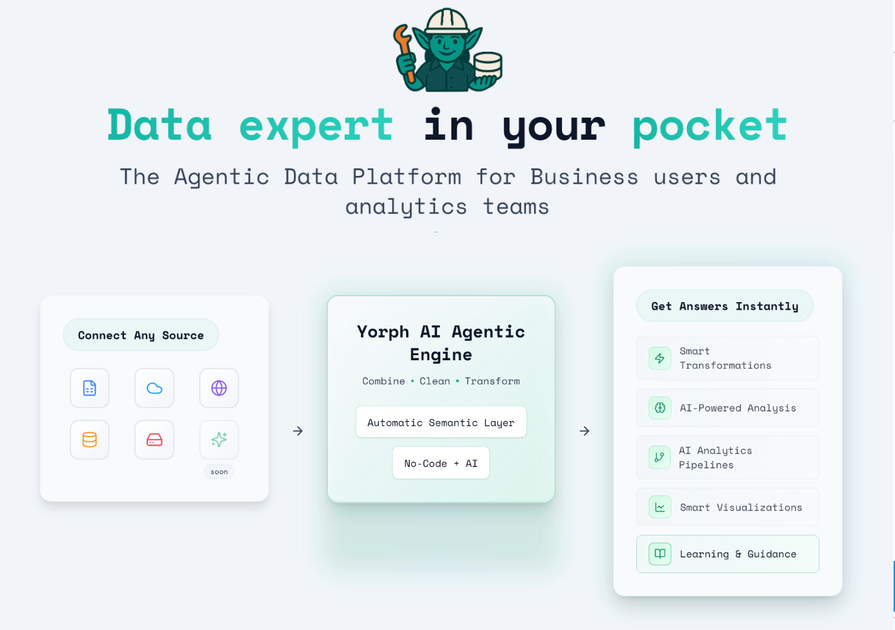
What is Yorph AI?
Yorph AI is an agentic data platform that supports modern data work, combining no-code ease with code-first control and scalability. It’s designed for users who want data expertise in an on-demand workflow.
The core purpose is to act as a “data expert in your pocket,” supporting data tasks through an agent-driven approach rather than only manual scripting.
Key Features
- Agentic approach for data work: Uses agents to help drive data tasks end-to-end, reducing the need to manually orchestrate every step.
- No-code usability: Designed to be approachable for users who want to work without writing full code workflows.
- Code-first control and scalability: Provides a code-capable path to maintain more control and support growth in more complex workflows.
- Modern data work orientation: Focused on practical data workflows, aiming to support common “data expert” responsibilities in a portable, on-demand way.
How to Use Yorph AI
- Start by describing your data task (the specific outcome you want), leaning on the platform’s no-code interface where possible.
- If you need additional control for a larger or more repeatable workflow, adjust or refine the workflow using a code-first approach.
- Run the agent to execute the data work and iterate based on the results until the output matches your requirement.
Use Cases
- Ad-hoc analysis: When you need quick answers from data without setting up a full notebook or writing a custom pipeline.
- Building repeatable data workflows: For tasks you run more than once (e.g., recurring transformations or structured outputs), where you may start no-code and then add code-level control.
- Bridging business and technical users: When non-technical users want an accessible interface while technical team members need ways to scale and refine workflows.
- Iterative data operations: For scenarios where you refine requirements after seeing intermediate outputs, using an agent-driven workflow to reduce manual step-by-step orchestration.
FAQ
-
What does “agentic” mean in Yorph AI? The platform is described as an “agentic data platform,” indicating that it uses agents to help carry out data work rather than relying solely on manual step-by-step execution.
-
Is Yorph AI no-code or code-first? It is described as combining no-code ease with code-first control and scalability, so it supports both an accessible workflow and a more controlled path.
-
Who is Yorph AI for? The messaging targets users who want a convenient way to do modern data work, including those who prefer no-code tools and those who require code-level control.
-
What kinds of data tasks does it support? The site positions Yorph AI for modern data work generally, but it does not list specific task types, outputs, or integrations on the provided page content.
Alternatives
- No-code data automation platforms: Similar in that they emphasize accessible, non-programmer workflows, but may offer less code-first control depending on the product.
- Notebook-based data tools (e.g., data analysis notebooks): Strong for detailed, manual control and iteration, but typically require more hands-on scripting than an agentic workflow.
- Code-first ETL/data pipeline frameworks: Better suited when you already rely on scripted pipelines and need maximum control, though they may be less approachable for quick, no-code exploration.
- General-purpose AI assistants for data questions: Useful for conversational data help, but may not provide the same blend of no-code workflow building with code-first scalability if orchestration is limited.
Alternatives

skills-janitor
Audit, track usage, and compare your Claude Code skills with skills-janitor—nine focused slash commands and zero dependencies.

PromptScout
PromptScout tracks how your brand is mentioned, which competitors are recommended, and what sources are cited in AI answers—plus website audits.

Lasso
Lasso is an AI-first PIM for ecommerce teams that enriches product attributes and descriptions, processes supplier data, and monitors competitors via app or API.

SaveMRR
SaveMRR scans Stripe billing data to find SaaS MRR leaks and help recover failed payments, save cancellations, and win back churn—60-sec Free Revenue Scan.

Sleek Analytics
Lightweight, privacy-friendly analytics with real-time visitor tracking—see where visitors come from, what they view, and how long they stay.

Struere
Struere is an AI-native operational system that replaces spreadsheet workflows with structured software—dashboards, alerts, and automations.