
Goal-oriented mission intake
Users describe the job in plain English. Xorviex says it parses that objective instead of asking for a hand-built plan or manually defined agents.

Xorviex is an autonomous digital workforce platform that turns a plain-language job into a supervised team of AI agents. It is aimed at founders and builders who want to automate execution without manually planning each agent.
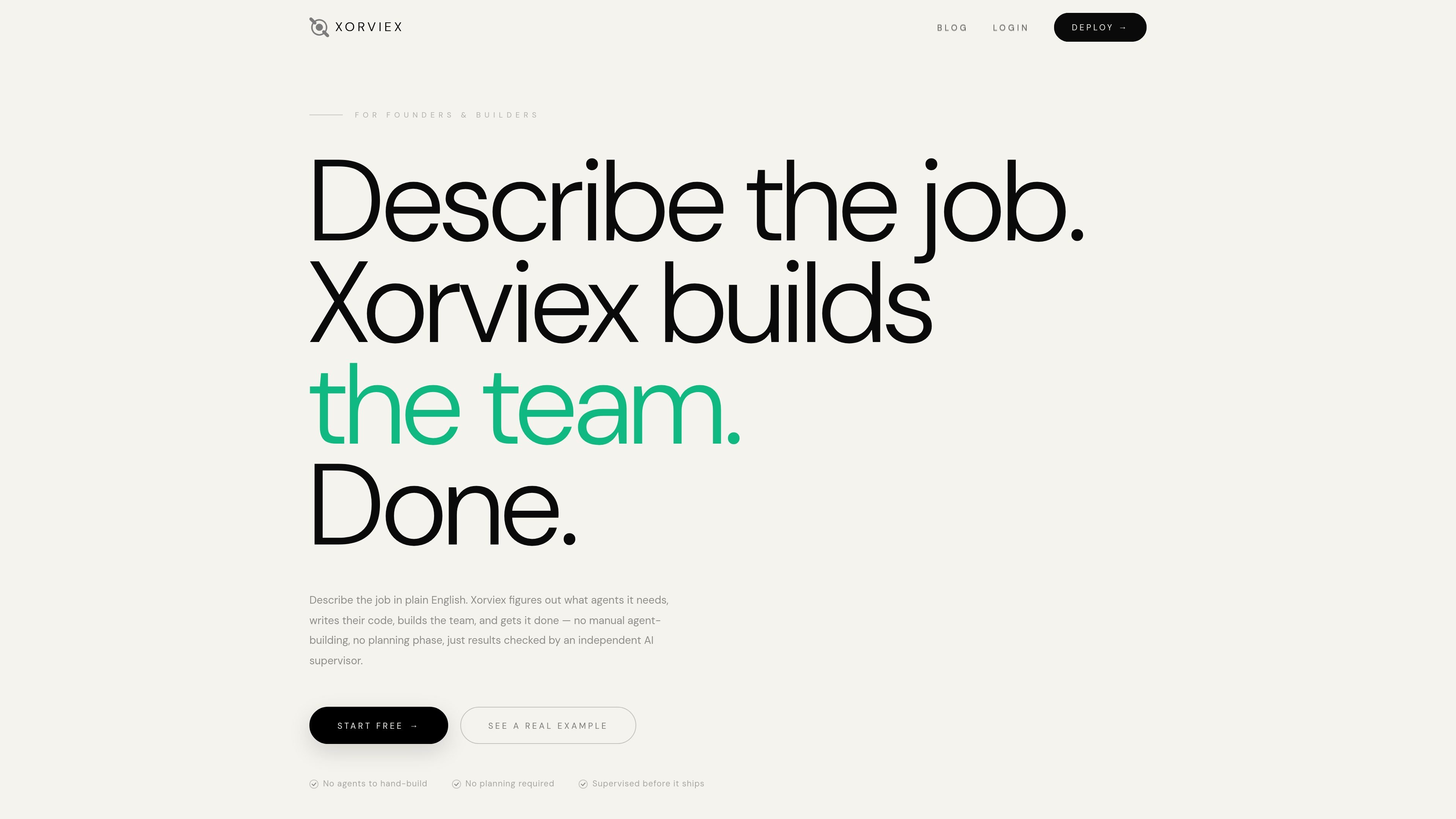
Xorviex is an autonomous digital workforce platform that turns a written objective into a coordinated set of AI agents. According to the site, users describe the job in plain English and the system decides what agents are needed, generates their code, runs them, and checks outputs with an independent supervisor before results are returned.
The product is positioned for founders and builders who want to delegate execution without manually designing each agent or writing a step-by-step plan. The homepage emphasizes mission-based workflows such as lead generation, research, copywriting, delivery, and monitoring, while the pricing page frames the product as a usage-based platform measured in Operation Units.
Users describe the job in plain English. Xorviex says it parses that objective instead of asking for a hand-built plan or manually defined agents.
The platform says it decides how many agents are needed and generates their code automatically, then orchestrates them as a team around the mission.
An independent Supervisor AI reviews outputs before they reach the user. The site says outputs are scored and checked against the mission goal before shipping.
The Idea Engine watches missions and surfaces suggestions that can be approved, rejected, or auto-applied after a chosen timeout.
The Self-Healing Engine monitors failures, latency, logs, anomalies, and spec drift, then can patch and re-verify broken runs.
Xorviex says each mission can synthesize the exact tools it needs, including web intelligence scraping, API bridging, brand voice injection, task queuing, structured parsing, and secure credential handling.
The homepage example shows Xorviex finding recent Series A SaaS companies, enriching the leads, and drafting personalized cold emails. This fits teams that want a single mission to produce both research and outreach assets.
Xorviex says it can spin up a data scraper, copywriter, and delivery agent for a mission. That makes it suitable for research-heavy workflows where structured data and written outputs need to be produced together.
The platform’s workspace memory stores brand voice, company facts, audience, and rules, then applies them across missions. That is useful for teams that need agents to stay consistent without re-briefing each run.
The Self-Healing Engine monitors errors, latency, logs, and spec drift, then can patch broken runs. This supports teams running longer or higher-volume automations that need monitoring and remediation.
The pricing page highlights concurrency, sub-agent limits, and dedicated supervision at higher tiers, which suggests the platform is aimed at teams coordinating multiple autonomous missions at once.
Xorviex describes a job in plain language, then generates a team of autonomous agents to execute it. The site says it can parse the objective, spawn the needed agents, and run supervision before results are returned to the dashboard.
The pricing page says plans include Scale, Business, Enterprise, and Enterprise+, with usage measured in Operation Units. It also says you can start free, no credit card is required, and paid usage can be billed monthly or annually with a 20% annual discount.
The site says Xorviex connects to Slack, GitHub, Notion, Google Workspace, Asana, and Ayrshare. It also says credentials are encrypted at rest and only decrypted at the moment of use.
The pricing page says the Self-Healing Engine monitors runs for failures, anomalies, and spec drift. In active mode it can generate a fix, run it through the Supervisor, and deploy it; Enterprise+ adds a human gate option and dedicated audit logging.
Xorviex says workspace memory stores company profile information, brand voice, audience, and rules once, then injects that context into mission planning, code generation, supervision, idea generation, and Command Chat.

CreateOS Sandbox is an isolated compute environment for running code and agent workloads inside Firecracker micro-VMs. It is designed for workflows that need machine-level isolation, private networking between sandboxes, and programmatic control through SDK, CLI, or MCP.

Redline is a budgeting tool for Claude Code that paces sessions to stay within time, token, cost, or plan-percentage limits. It uses Claude Code’s native hooks and statusline to help sessions finish with a usable result instead of stopping abruptly.

Macuse is a macOS app that lets AI assistants control native Mac apps through MCP and use Computer Use for any app. It works with clients like Claude Desktop, Cursor, and Raycast, and keeps automation on-device.

ByteAsk is a terminal-first AI coding agent for C and C++ that edits repositories and verifies changes with the real compiler, debugger, sanitizers, and tests before showing a diff. It offers a free tier plus paid plans, with editor connectors and zero-retention handling described in the source.

Goldfish is an AI memory app for macOS that helps you reply, write, summarize, and continue using the context already on your Mac. It stores memory locally and writes in your tone.

ArtDeck is a visual reference board app for iPhone, iPad, and Mac that lets artists collect mixed reference material on one canvas and study it with ToolBox lenses. It works offline, supports optional iCloud sync, and is sold as a one-time purchase with no account required.