
Live architecture canvas
Draw backend systems as node and edge graphs on a single canvas, covering controllers, services, repositories, tables, DTOs, queues, and related parts of the backend.

Solarch is a web-based backend-architecture tool that validates node-and-edge diagrams as you draw them and can generate matching code from the approved graph. It is aimed at teams and developers who want architecture-first workflows instead of code-first AI generation.
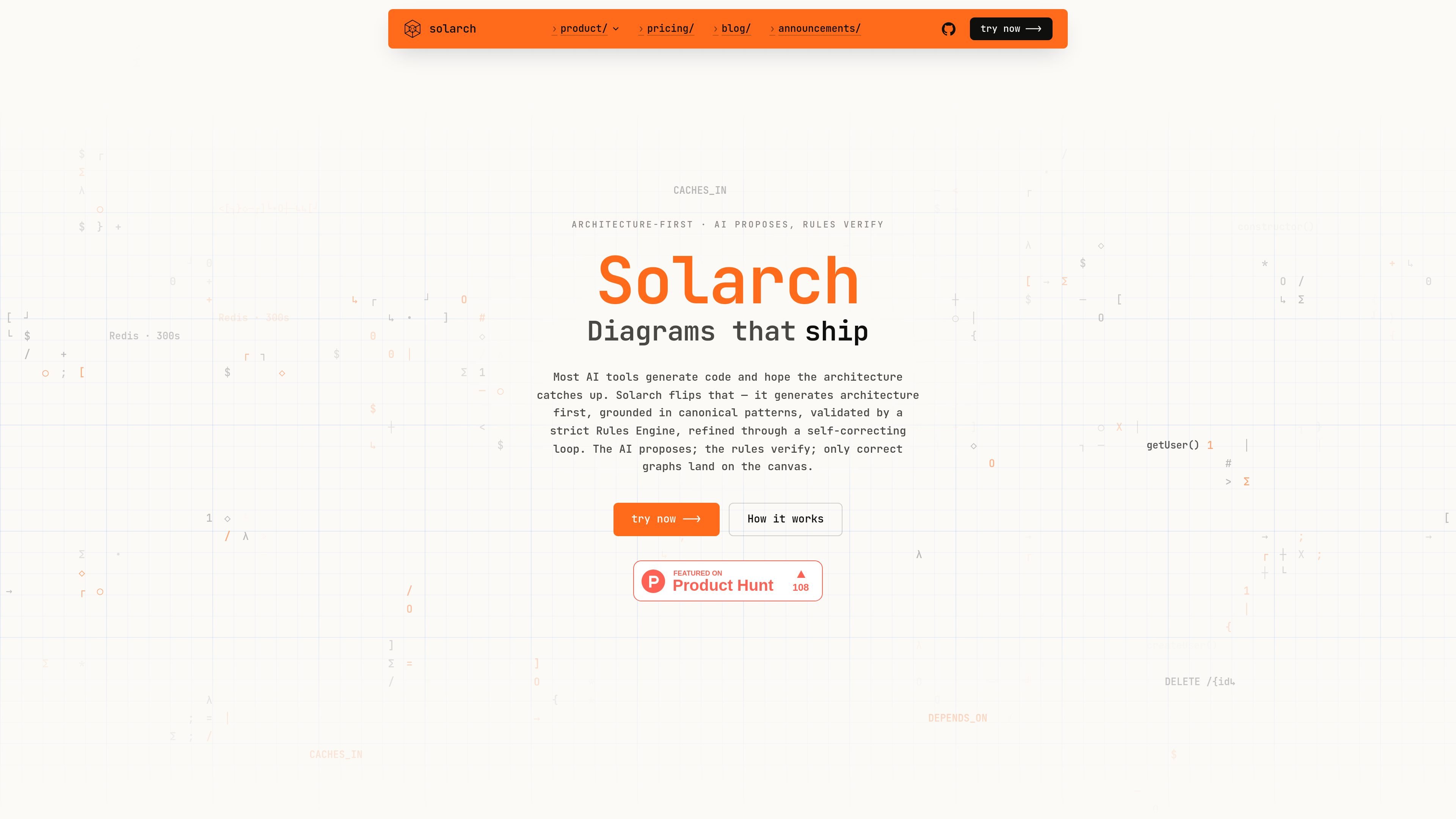
Solarch is a backend-architecture tool that lets you model systems as a live node-and-edge graph instead of starting from code. The product is built around a strict Rules Engine that validates each connection as you draw it, so only allowed architectural relationships land on the canvas.
Once the graph is valid, Solarch can generate code that matches the architecture. The site describes a hybrid engine that compiles the graph into a deterministic skeleton and then uses AI to fill in the remaining function bodies, with exports for code, Mermaid diagrams, API contract, and AI-readable memory.
Draw backend systems as node and edge graphs on a single canvas, covering controllers, services, repositories, tables, DTOs, queues, and related parts of the backend.
Validate connections with a default-deny rules system that rejects illegal edges immediately, including cases such as a controller trying to reach a table directly.
Use an AI architect that proposes structure from canonical patterns, backed by a vector-indexed library of those patterns.
Run a hybrid generation flow where a deterministic compiler produces the skeleton and AI fills only the empty function bodies.
Export the result as code, a Mermaid diagram, an API contract, vector memory, or AI-readable memory, with Cursor and Claude Ready export called out on the site.
Work with single-home nodes and ghost references so each node has one source location while other tabs reference it instead of copying it.
Map a backend system before implementation so controllers, services, repositories, and tables are connected according to enforced rules.
Turn a validated graph into starter code when you want a deterministic skeleton first and AI help only where the function bodies are still empty.
Check architectural intent while working with a team that wants one source of truth, single-home nodes, and ghost references across tabs.
Convert architecture into a Mermaid diagram, API contract, or AI-readable memory when the same system needs to feed documentation or other tools.
Solarch is a backend architecture tool. You draw a system as a node and edge graph, the Rules Engine validates the connections, and the accepted graph can be turned into code that matches the architecture.
Solarch generates the architecture first rather than starting from code. It uses canonical patterns, a default-deny Rules Engine, and a hybrid code engine that compiles the graph into a skeleton before filling function bodies.
The Rules Engine is a default-deny validator. It enforces 7 anti-patterns and 3 conditional checks, and it rejects illegal connections as soon as you draw them.
The source shows exports for code, Mermaid diagrams, API contract, and AI-readable memory, and the site also mentions Cursor and Claude Ready export.
Solarch offers a free plan, paid Draw, Build, and Code plans, a Team plan, and an Enterprise option. The pricing page and FAQ both say plans include a 7-day trial, while the free plan is free forever.

Lucid Train is a local-first AI coding harness that turns repository code into architecture diagrams and uses those diagrams as specifications for coding agents. It is available as a desktop app and a lightweight Rust CLI, and it can run with local models or your own API keys.

Cherry Blossom is a browser-based PCB editor that turns plain-English prompts into editable schematics, PCB layouts, and fabrication files. It is built for people who want AI-assisted board drafting with verification checks and open exports.

ByteAsk is a terminal-first AI coding agent for C and C++ that edits repositories and verifies changes with the real compiler, debugger, sanitizers, and tests before showing a diff. It offers a free tier plus paid plans, with editor connectors and zero-retention handling described in the source.

CreateOS Sandbox is an isolated compute environment for running code and agent workloads inside Firecracker micro-VMs. It is designed for workflows that need machine-level isolation, private networking between sandboxes, and programmatic control through SDK, CLI, or MCP.

hob is an independent workspace for coding agents that keeps agent sessions, terminals, history, and follow-up work organized around the tools and providers you already use. It is aimed at developers who want local control over routing, history, and workspace structure rather than a bundled model stack.

Ably Chat is a chat API platform for building custom realtime chat applications. It supports room-based messaging, typing indicators, presence, reactions, and message updates, with usage-based pricing options for different deployment stages.