

Browser Arena
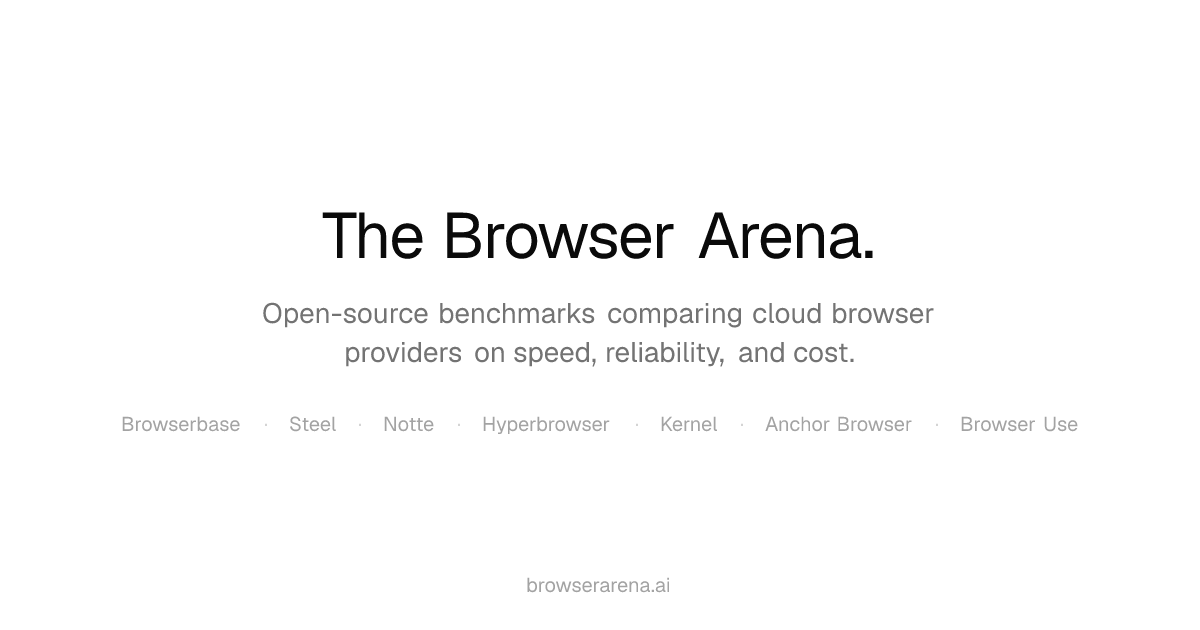
Browser Arena is an open-source, reproducible benchmark site comparing cloud browser infrastructure providers by speed, reliability, and cost.
What is Browser Arena?
Browser Arena is an open-source, reproducible benchmarking site for comparing cloud browser infrastructure providers on speed, reliability, and cost. It presents evaluations in a consistent table so you can compare providers for web automation and AI browser-agent workflows.
The project is described as built by Notte and hosted as an open-source benchmark that is intended to be reproducible (including via Railway), with the ability to add providers and add benchmarks.
Key Features
- Open-source benchmark data and evaluation framework: The site is explicitly described as open-source, supporting transparency into how comparisons are produced.
- Reproducible results: The benchmarks are described as reproducible on Railway, helping teams re-run or verify evaluations.
- Standardized scoring across three dimensions: Results are organized into a value score with equal emphasis on reliability, latency (speed), and cost.
- Provider comparison table with region, runs, and metrics: Each provider entry includes region, number of runs, reliability percentage, latency in milliseconds, and cost per hour.
- User actions to extend the benchmark set: The UI includes prompts to “Add a Provider” and “Add a Bench,” indicating an extendable benchmark catalogue.
How to Use Browser Arena
- Browse the existing provider evaluations: Start by reviewing the comparison table to see reliability, latency, and cost figures for the listed providers.
- Use the value score as a quick filter: Compare providers using the displayed value score that reflects reliability, latency, and cost.
- If you maintain benchmarks, reproduce them: Use the project’s “reproduce” workflow (referenced as reproducible on Railway) to run or validate evaluations.
- Extend the benchmark list: If you need additional coverage, use “Add a Provider” or “Add a Bench” to contribute new comparisons.
Use Cases
- Selecting a cloud browser provider for automation: Use the table to compare providers when deciding which infrastructure best matches your reliability and latency requirements.
- Balancing speed and spend: Compare latency (ms) alongside cost per hour to choose a provider that fits both performance and budget constraints.
- Validating reliability for agent workflows: Review reliability percentages to identify providers with fewer failures for long-running or repeated web automation tasks.
- Running reproducible evaluations for internal decisions: For teams that require repeatable results, use the reproducible setup to re-run benchmarks and confirm that provider performance is stable.
- Contributing new benchmarks or providers: If you’re building your own evaluation criteria, add providers or benches so others can compare results using the same framework.
FAQ
-
Is Browser Arena open-source? Yes. The page states it is open-source.
-
Are the benchmarks reproducible? The site says the benchmarks are reproducible on Railway.
-
What metrics does Browser Arena compare? The table compares reliability, latency (in milliseconds), and cost (cost per hour), and it displays a value score.
-
How are “value score” results determined? The page indicates the value score is balanced across reliability, speed (latency), and budget/cost, presented as 33% each.
-
Can I add my own providers or benchmarks? The UI includes options to add a provider and add a bench, and the page encourages contributions.
Alternatives
- Managed browser automation platforms (general-purpose): These are typically used directly to run browser automation rather than to publish standardized comparative benchmark tables.
- Your own internal benchmark harness: Instead of relying on a public comparison site, teams can define tests for their specific workloads and measure reliability/latency/cost in their own environment.
- Other open-source benchmarking repositories for infrastructure: Adjacent projects may focus on different systems (e.g., compute, networking, or general browser testing), but they may not provide the same provider-focused speed/reliability/cost comparison layout.
- Cloud performance testing frameworks: Tools in this category can measure responsiveness and failure rates, but may require more setup to translate results into provider comparisons for browser automation.
Alternatives

AakarDev AI
AakarDev AI is a powerful platform that simplifies the development of AI applications with seamless vector database integration, enabling rapid deployment and scalability.

Arduino VENTUNO Q
Arduino VENTUNO Q is an edge AI computer for robotics, combining AI inference hardware and a microcontroller for deterministic control. Arduino App Lab-ready.

Devin
Devin is an AI coding agent that helps software teams complete code migrations and large refactoring by running subtasks in parallel.

open-codex-computer-use
open-codex-computer-use is an open-source “Computer Use” MCP server that lets AI agents run desktop GUI actions on macOS, Linux, and Windows.

Codex Plugins
Use Codex Plugins to bundle skills, app integrations, and MCP servers into reusable workflows—extending Codex access to tools like Gmail, Drive, and Slack.

Ably Chat
Ably Chat is a chat API and SDKs for building custom realtime chat apps, with reactions, presence, and message edit/delete.