CartAI icon

CartAI

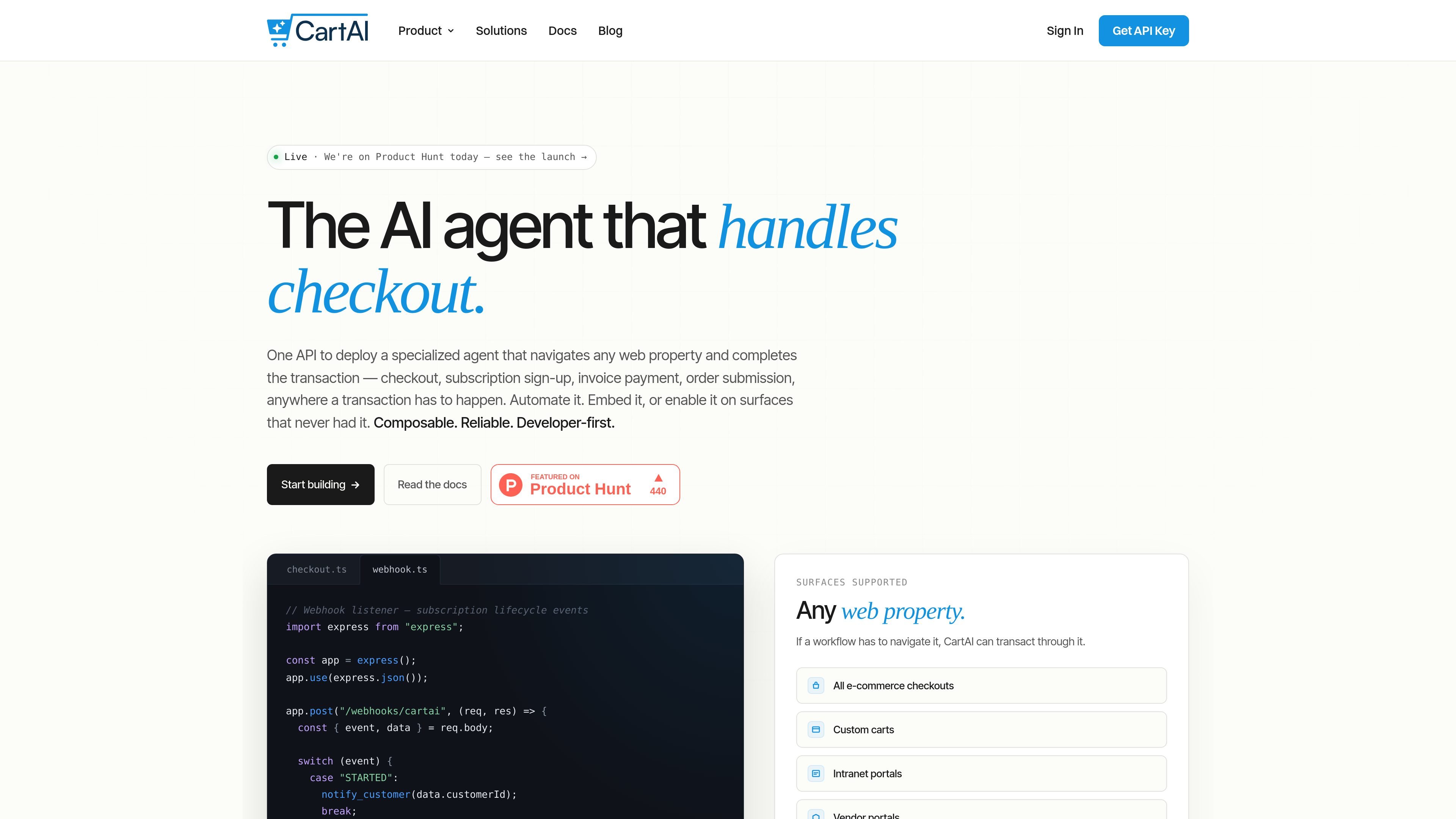
CartAI is an agentic commerce platform for search, checkout, payment sessions, and attribution on live merchant sites.

CartAI

Agentic commerce infrastructure for checkout and order completion

CartAI is an agentic commerce platform built to complete transactions on behalf of users. It provides APIs for product search, checkout, payment sessions, and monetization so teams can move from discovery to confirmation through a single transaction-oriented flow.

The product is aimed at workflows where a purchase, subscription sign-up, invoice payment, or order submission must actually clear. CartAI runs on the merchant's live site today and also describes support for commerce protocols as merchants expose them, with webhooks used to track the task through completion.

Core capabilities

Async checkout execution

Submit a checkout task with customer details, shipping information, selected items, and payment data or a payment session. The agent runs asynchronously and drives the merchant's live checkout flow through cart, address, payment, and confirmation.

Catalog, details, and estimates

Search across merchants, inspect product variants, and estimate totals before checkout. The catalog product returns ranked results, variant breakdowns, stock state, pricing, and checkout estimates from structured endpoints.

Hosted payment sessions

Use hosted payment sessions so card data stays out of your backend. The payment flow returns a session URL and sessionId, and checkout tasks can consume that sessionId after the customer authorizes payment.

Webhook tracking

Receive real-time lifecycle updates through webhooks. The checkout page documents state transitions such as QUEUED, STARTED, IN_PROGRESS, CONFIRMED, PLACED, and COMPLETED.

Multiple integration modes

Choose the delivery mode that matches your stack: direct API integration, an MCP server for model-driven checkout, or a hosted cart for surfaces that do not have checkout built in.

Built-in attribution support

Preserve attribution through monetization flows. The catalog pages note commissionUrl data, and the platform includes a monetization product for affiliate commissions and attribution.

Practical ways to use CartAI

  • Programmatic checkout for application backends

    Connect CartAI to a backend service that needs to place orders for users. The API accepts customer data, item details, and a payment session, then returns asynchronous task status and webhook events for follow-up actions.

  • Product discovery before checkout

    Build agents that search for products, inspect variants, and estimate costs before purchase. The catalog endpoints return ranked results, stock state, variant dimensions, and shipping-aware totals that can feed a purchase flow.

  • Embedded checkout on existing surfaces

    Embed a checkout experience on surfaces that never had one, such as a content site, portal, or embedded workflow. CartAI's hosted cart is described as a drop-in component or iframe with variant selection, address entry, payment, and confirmation built in.

  • Affiliate and attribution workflows

    Let a monetized surface capture commission when an agent buys through it. The platform includes monetization and attribution support so affiliate-style workflows can preserve revenue attribution through the sale.

  • Complex order submission across merchants

    Handle multi-item or multi-merchant transactions where the task can span several SKUs and multiple retailers. The checkout page explicitly supports one task carrying multiple SKUs across multiple merchants, with one agent per merchant when needed.

Pros and Cons

Pros

  • Combines catalog search, checkout execution, payment sessions, and monetization around the same transaction flow.
  • Supports asynchronous checkout with webhook-based status tracking, which fits backend and agent workflows.
  • Offers structured endpoints with live product data, variant inspection, and pre-checkout total estimates.
  • Provides a hosted payment UI so card data does not pass through the merchant backend.

Cons

  • Public pricing is not shown on the site, and the pricing page link currently resolves to a not-found page.
  • Some surfaced capabilities are explicitly marked as coming soon, including the hosted cart and American Express support.
  • The source emphasizes checkout flows and related commerce tasks rather than broad browser automation beyond transactional use cases.

FAQ

How does CartAI fit into an existing backend or agent workflow?

CartAI provides an API-first flow. You create a checkout task or payment session server-side, pass in customer and item data, and then receive asynchronous status updates through webhooks as the agent moves through the merchant flow.

What ways can teams ship CartAI?

The site shows three delivery modes: the CartAI API, an MCP server for MCP hosts such as Claude Desktop, Code, Cursor, and VS Code, and a hosted cart that can be embedded as a drop-in component or iframe.

What workflows does CartAI cover?

CartAI supports checkout tasks that can span multiple SKUs and even multiple merchants. The product pages also describe separate catalog, checkout, payments, and monetization modules around the same transaction primitive.

How much does CartAI cost?

The source materials do not show public pricing on the site. The pricing link currently resolves to a not-found page, so pricing should be treated as undisclosed on the public site.

Are there any known limitations?

CartAI is designed for transactional flows that need to clear on the merchant's own site or through supported commerce protocols. The source does not claim support for every merchant or every payment method, and some items such as the hosted cart and American Express support are marked as coming soon.

Quick Facts

Category
Agentic commerce platform
Primary users
Developers and teams building transactional agents
Delivery modes
API, MCP server, hosted cart
Source domain
cartai.ai
Workflow focus
Checkout, payments, catalog search, and monetization
Pricing
Not publicly listed on the site