
Edgee
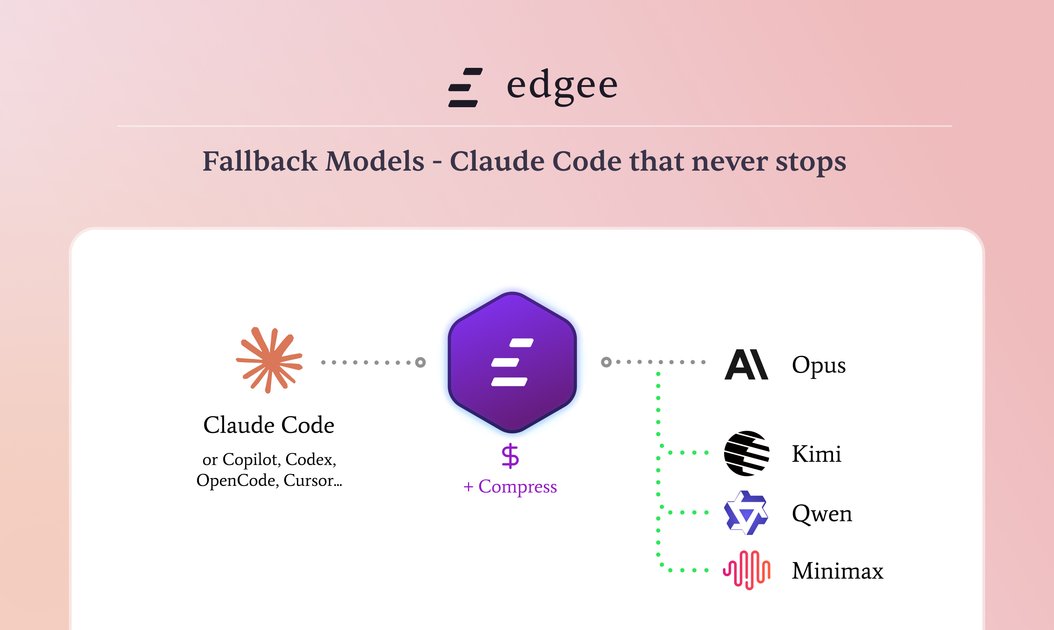
Edgee Fallback Models keeps Claude Code sessions running with automatic failover to other models when Anthropic is down or limits are reached.
What is Edgee Fallback Models?
Edgee Fallback Models is a routing layer for Claude Code sessions that keeps requests moving when the primary model fails, reaches a quota, or becomes unavailable. It sits between Claude Code and model providers, so a request can be retried against a configured fallback model without changing the developer’s workflow or code.
The product is designed for users who rely on Claude Code for ongoing work and want automatic failover to other models such as Edgee-hosted models, BYOK providers, or cloud-hosted AI endpoints. It also supports rerouting requests to a specific model for standardization or cost control.
Key Features
- Automatic fallback on 429 and 5xx responses: if the primary model is rate-limited or errors, Edgee retries the same request through the next model in the configured chain.
- Rate-limit and quota detection: Edgee can switch models when a weekly plan cap or other usage threshold is reached, reducing interruptions during long coding sessions.
- Priority-ordered model chains: users configure a preferred sequence of models in the dashboard, and Edgee routes requests according to that order.
- Support for multiple client tools: the page says it works with Claude Code, Codex, and OpenCode, which makes the routing approach usable across more than one coding client.
- Edgee-hosted fallback models: the service includes six hosted models ready to use without separate API keys, including Gemma, GLM, Qwen, Kimi, and MiniMax options.
- Bring Your Own Key and Bring Your Own Cloud options: users can route fallback traffic to providers such as OpenAI, Anthropic, Mistral, DeepSeek, xAI, AWS Bedrock, Google Vertex AI, and Azure OpenAI using their own credentials.
- Dashboard-based setup: the workflow is configured in the Edgee dashboard and CLI, with no proxy setup or code changes required.
- Transparent rerouting: requests continue through the fallback path with the same session context, so the developer does not need to restart the workflow manually.
How to Use Edgee Fallback Models
Start by installing the Edgee CLI and connecting Claude Code through Edgee instead of sending requests directly to Anthropic. Then configure a priority-ordered fallback chain in the dashboard, selecting hosted models, BYOK providers, or cloud endpoints as needed. After that, Edgee monitors requests and automatically reroutes them when the primary model fails or reaches a limit.
Use Cases
- Handling a provider outage during active coding work: if Claude Opus or another primary model becomes unavailable, Edgee can move the request to the next model so the session keeps going.
- Recovering from plan or usage caps: when a weekly limit is reached, teams can continue using Claude Code without waiting for the reset window.
- Standardizing model selection across a team: a group can route requests to a single approved fallback model instead of letting each client choose independently.
- Using an organization’s own cloud accounts: teams that want fallback traffic to stay within their AWS, Google Cloud, or Azure environment can configure Bedrock, Vertex AI, or Azure OpenAI.
- Adding a Plan B for policy or billing changes: organizations that depend on Claude Code can prepare for quota or billing changes by setting up alternate models in advance.
FAQ
Does Edgee require changes to Claude Code prompts or source code? No. The page states that setup uses the Edgee CLI and dashboard, with no code changes required.
Which products does it work with? The page explicitly mentions Claude Code, Codex, and OpenCode.
Can I use my own model providers instead of Edgee-hosted models? Yes. The page says you can bring your own key or route through your own cloud accounts, including AWS Bedrock, Google Vertex AI, and Azure OpenAI.
What happens when the primary model fails? Edgee detects errors such as 429 and 5xx responses, or a quota threshold, and routes the same request to the next available model in your fallback chain.
Is fallback routing included in every plan? No. The page says automatic fallback and rerouting are part of the Team plan.
Alternatives
- Manual model switching in Claude Code or another client: this keeps the workflow simple, but it requires a person to notice failures and change models by hand.
- Direct use of a single AI provider: this avoids an extra routing layer, but it leaves the workflow dependent on one vendor’s uptime and quota policies.
- Custom proxy or gateway infrastructure: teams can build their own routing logic, but that usually means maintaining infrastructure, health checks, and provider-specific failover rules themselves.
- Cloud-native AI endpoints without a unified fallback layer: AWS Bedrock, Google Vertex AI, or Azure OpenAI can host models, but they are not presented here as a complete Claude Code failover system on their own.
Alternatives
AakarDev AI
AakarDev AI is a powerful platform that simplifies the development of AI applications with seamless vector database integration, enabling rapid deployment and scalability.

Devin
Devin is an AI coding agent that helps software teams complete code migrations and large refactoring by running subtasks in parallel.
imgcook
imgcook is an intelligent tool that converts design mockups into high-quality, production-ready code with a single click.

Ably Chat
Ably Chat is a chat API and SDKs for building custom realtime chat apps, with reactions, presence, and message edit/delete.

BookAI.chat
BookAI allows you to chat with your books using AI by simply providing the title and author.

DeepMotion
DeepMotion is an AI motion capture and body-tracking platform to generate 3D animations from video (and text) in your web browser, via Animate 3D API.