
Repository-based API discovery
Scan repository code to identify APIs, generate OpenAPI 3.1 specifications, and organize endpoints into collections without requiring an existing OpenAPI file.

Elva discovers APIs from source repositories, generates specs, scores readiness, and governs access for developers and AI agents through docs, SDKs, Postman, and MCP.
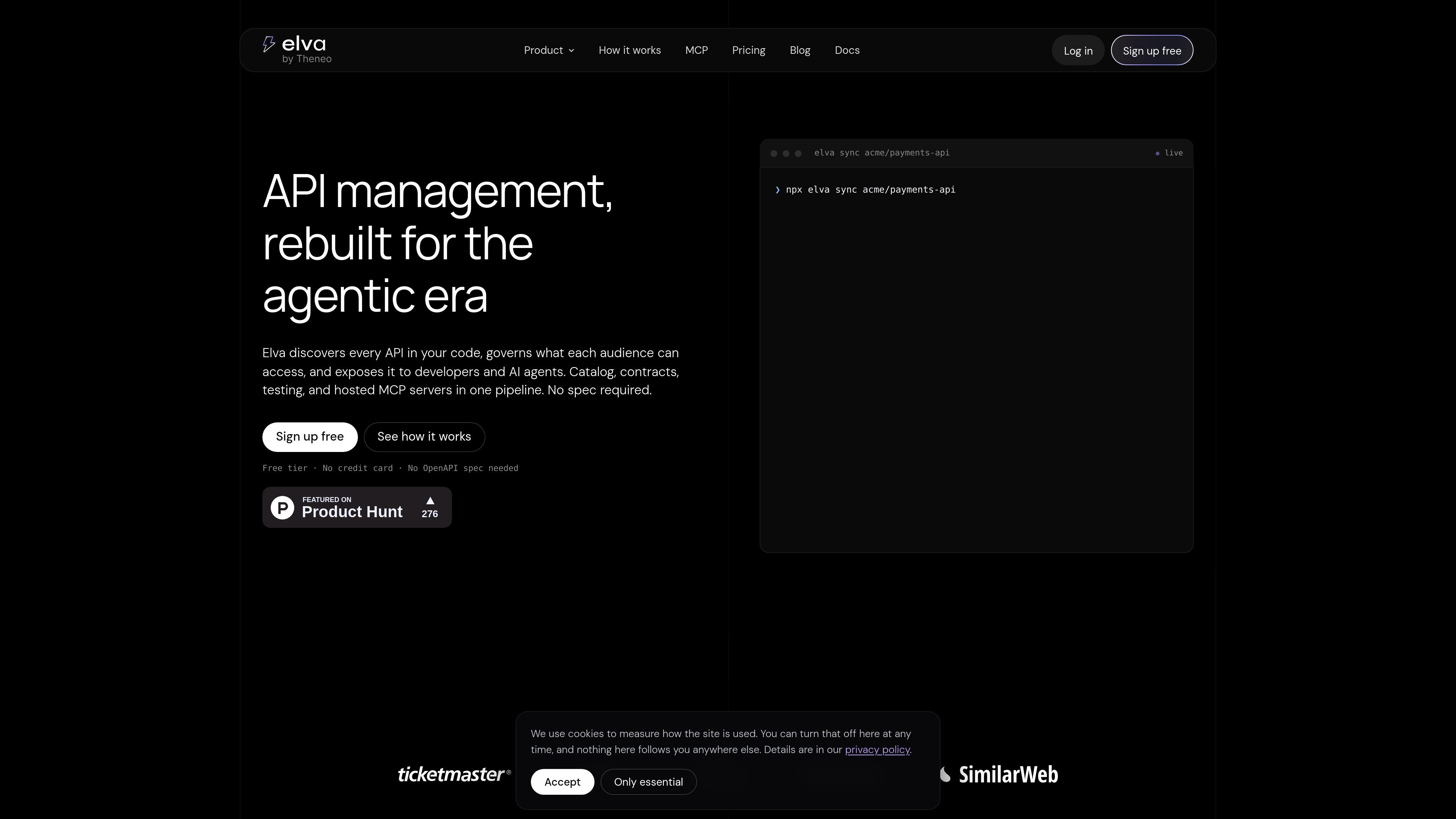
Elva is an API management and publishing platform for teams that maintain APIs in source repositories and need to make them usable by developers and AI agents. It scans code to discover endpoints, generates OpenAPI 3.1 specifications, organizes APIs into a catalog, and scores their design, security, developer experience, performance, and AI readiness. The workflow is designed to work without an existing OpenAPI specification.
After discovery, teams can define contracts for internal services, partners, public developers, or AI agents. A contract specifies the endpoints and fields an audience may access, and Elva checks commits for drift, breaking changes, and policy violations before publication. Approved contract outputs can be published as specs, documentation, MCP servers, Postman collections, and TypeScript SDKs. The product also includes API testing, an MCP Playground, hosted MCP infrastructure, and usage or agent feedback features that vary by plan.
Scan repository code to identify APIs, generate OpenAPI 3.1 specifications, and organize endpoints into collections without requiring an existing OpenAPI file.
Score collections or endpoints across areas such as design, developer experience, AI readiness, security, and performance, then surface issues including missing descriptions, untyped fields, and undocumented authentication.
Apply AI-assisted improvements to API descriptions, response schemas, and authentication documentation, with results rescored after changes.
Create audience-specific contracts that control endpoint and field visibility, including options to exclude PII or internal fields. Policies can warn, notify, or block publication when changes break the contract.
Deploy governed contract outputs as hosted documentation, OpenAPI files, MCP tools, Postman collections, and TypeScript SDKs. MCP servers include gateway authentication and call logging, with per-tool scopes on higher plans.
Use the MCP Playground and agent feedback to test tools, inspect calls, identify unclear descriptions or failures, and feed supported feedback into catalog improvements.
Scan multiple services to create a current endpoint inventory, generate missing specifications, and identify weak authentication, schemas, descriptions, or readiness scores before other teams consume the APIs.
Create a partner-specific contract that exposes only approved endpoints and fields, removes PII or internal data, and blocks publication when a schema or authentication change would break the partner integration.
Turn a governed API contract into stable MCP tools for Claude, Cursor, ChatGPT, or another MCP client. Use the Playground and gateway logs to inspect tool calls and diagnose schema or latency problems.
Use commit checks, breaking-change flags, stakeholder notifications, and contract outputs to coordinate API changes across internal services, public documentation, SDKs, and downstream consumers.
Elva scans a repository, discovers endpoints, generates OpenAPI 3.1 specifications from code, builds an API catalog, scores API quality, and can publish selected APIs through documentation, SDKs, Postman collections, and MCP servers. The site states that an OpenAPI specification is not required as an input.
Contracts define the audience, endpoints, and fields that may be exposed. Elva compares commits with those contracts, identifies drift and breaking changes, and can warn, notify, or block publication depending on the contract policy.
Elva can generate hosted MCP servers from governed APIs. The MCP gateway provides authentication and logging, while the contract determines which tools an audience can see. The site also documents self-hosted MCP deployment as an Enterprise capability.
Yes. The Free plan includes one repository, unlimited endpoints, specification generation from code, API scoring, manual API testing, the MCP Playground, one hosted MCP server, and 1,000 tool calls per month. Paid plans add repositories, contracts, hosted servers, usage capacity, and governance features.

ByteAsk is a terminal-first AI coding agent for C and C++ that edits repos and verifies changes with compilers, debuggers, sanitizers, and tests.

CreateOS Sandbox is an isolated compute environment for running code and agent workloads in Firecracker micro-VMs with private networking and SDK, CLI, or MCP control.

GitBot is a local browser workspace for reusable coding bots powered by Claude Code, Codex, or OpenCode, with persistent threads and configurable permissions.

hob is an independent workspace for coding agents, with local control over sessions, terminals, history, routing, and follow-up work.

Ably Chat is a chat API platform for custom realtime chat apps, with rooms, typing indicators, presence, reactions, message updates and usage-based pricing.

Manta AI is an autonomous web app testing tool that maps app behavior, catches regressions, and generates tests from a URL, no scripts or selectors needed.