

findable
findable is an LLM SEO toolkit for monitoring and improving AI search visibility across ChatGPT, Claude, Gemini and more—turn insights into fixes.
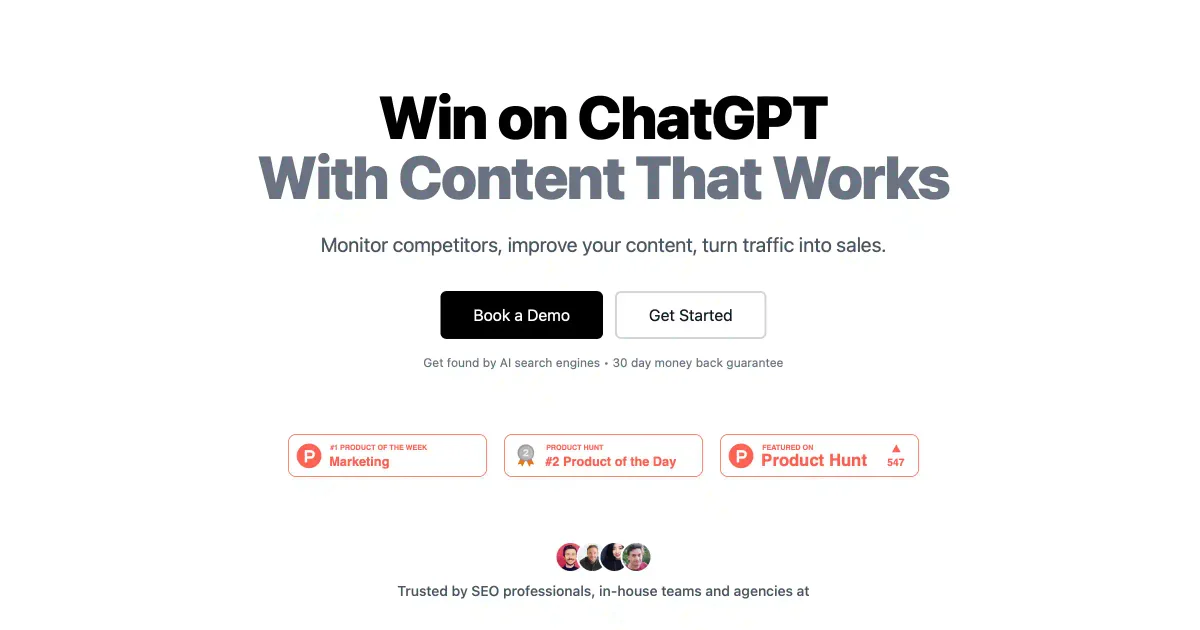
What is findable?
findable is an LLM SEO monitoring and content generation toolkit designed to help brands and marketing teams improve how their content is recommended and cited in AI search and assistant experiences. Its core purpose is to measure AI visibility (including citations and related signals), identify what to change, and help users produce content and technical adjustments that target both AI search agents and traditional search.
The product tracks visibility across multiple AI and search experiences (for example, ChatGPT, Claude, Gemini/Google AI, Perplexity, and other sources listed on the site) and connects that monitoring to actionable workflows such as content gap analysis, crawlability checks, and EEAT-related scoring.
Key Features
- AI search visibility tracking (brand and competitor monitoring): Monitor where your brand appears in AI recommendations and compare against added competitor prompts or domains to spot share and ranking changes.
- Brand Report for AI visibility signals: Identify what AI outputs say about your brand and capture signals such as citations and sentiment (as described on the site).
- Content Gap: Detect content gaps based on query/search recommendations so you can prioritize what to publish or update.
- Crawlability Check: Assess whether AI crawlers can access your site and produces example crawlability snapshots (e.g., shown for a domain like wsj.com on the site).
- FAQ Generator: Generate SEO-optimized FAQs in seconds to support content creation.
- Search Console Audit: Review ChatGPT & Google traffic data from Google Search Console as part of the optimization workflow.
- EEAT Check Score: Evaluate trust-related signals in a way the site describes as an EEAT scoring feature.
How to Use findable
- Connect your data sources: Start by signing in and connecting Google Search Console and Webmaster Tools (the site states these connections are supported).
- Measure baseline AI visibility: Use the analytics/monitoring workflow to understand your current presence across the AI and search experiences supported (the site highlights ChatGPT, Google AI, Gemini, Perplexity, and Claude).
- Generate and implement fixes: Run optimization tools such as content gap analysis, crawlability checks, and EEAT scoring; use outputs like generated FAQ content and content briefs to guide updates.
- Monitor and refine: Continue ongoing monitoring to track progress and adjust your strategy based on the real-time insights described.
Use Cases
- Improve recommendations in AI search answers: Identify what questions or prompts lead to your brand being recommended (or not), then use content gap and crawlability checks to align on-page content with what AI systems can access and cite.
- Track competitor share of AI recommendations: Add competitor prompts/domains and compare visibility scores to find topics where competitors appear and where you may be able to publish or update content to compete.
- Convert AI search findings into new content: Use the FAQ Generator and content brief workflow (described as “AI-powered content briefs”) to produce content drafts tied to the gaps surfaced by monitoring.
- Support technical and trust-focused improvements: Use the crawlability check and EEAT-related scoring to guide updates aimed at making content easier for AI crawlers to reach and easier for systems to treat as credible.
- Audit performance using Search Console data: Use the Search Console Audit to connect AI/search visibility work with existing performance signals captured in Google Search Console.
FAQ
-
Which search and AI experiences does findable monitor? The site lists multiple sources, including ChatGPT, Google AI Mode (Google/Gemini), Perplexity, Claude, and others (the page also includes a crawlability/AI crawler accessibility section).
-
Can I monitor competitors in addition to my own brand? Yes. The site states you can add competitor prompts or domains to monitor their share of AI recommendations and compare visibility scores.
-
Does findable use Google Search Console data? Yes. The site explicitly mentions a “Search Console Audit” for ChatGPT & Google traffic and says you can connect Google Search Console.
-
Can it generate content like FAQs? Yes. The site lists an FAQ Generator that creates SEO-optimized FAQs.
-
Does findable support regional or language-specific tracking? Yes. The site says prompts can be monitored for specific regional personas and languages.
Alternatives
- General SEO analytics platforms: Tools focused on keyword research, ranking, and on-page optimization can help with traditional SEO, but they typically do not provide the same AI assistant/LLM-specific monitoring and crawlability checks described for findable.
- Content production and brief tools: Writing and brief-generation platforms can support FAQ and content outlines, but they may not include AI search visibility monitoring, citation/sentiment tracking, or EEAT/crawlability checks tied to LLM outputs.
- Technical SEO crawling/auditing tools: Dedicated crawling tools can help diagnose crawlability and indexing issues for search engines; however, they may not cover AI crawler accessibility and AI-search recommendation signals as directly as findable.
- AI search/agent monitoring services: Some services focus specifically on tracking how brands appear in AI assistants; depending on the provider, they may emphasize monitoring more than content generation and SEO-oriented fixes.
Alternatives

ClayHog
ClayHog tracks AI Search Visibility & GEO—see what ChatGPT, Gemini, Perplexity, Claude, and Google AI Overviews say about your brand, incl. citations and sentiment.

beehiiv
beehiiv is an all-in-one newsletter and website platform with publishing, growth, analytics, and monetization tools for creators and brands.

Skayle
Skayle is a fully automated content and visibility engine that runs search-powered research before writing to help brands rank on Google and AI search.

SaveMRR
SaveMRR scans Stripe billing data to find SaaS MRR leaks and help recover failed payments, save cancellations, and win back churn—60-sec Free Revenue Scan.

Sleek Analytics
Lightweight, privacy-friendly analytics with real-time visitor tracking—see where visitors come from, what they view, and how long they stay.

Struere
Struere is an AI-native operational system that replaces spreadsheet workflows with structured software—dashboards, alerts, and automations.