
Two-line SDK instrumentation
Wrap the model once and instrument every `generateText` and `streamText` call in two lines. The product is positioned as a lightweight observability layer for AI agent runs.

Foglamp is an observability layer for AI agents on the Vercel AI SDK. Track cost, latency, traces, eval scores, and alerts for production `generateText` and `streamText` calls.
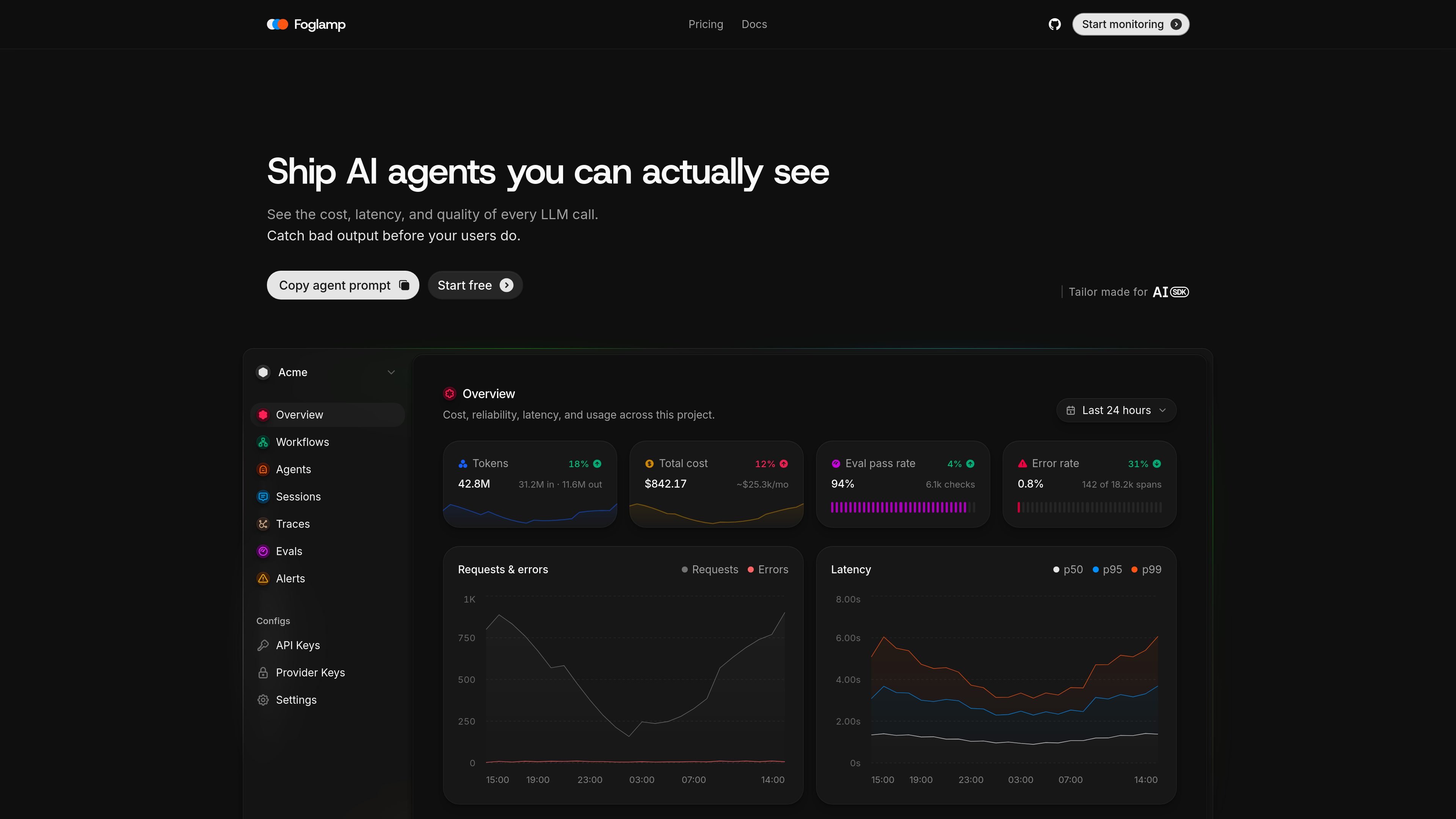
Foglamp is an observability layer for AI agents on the Vercel AI SDK. It is designed to show the cost, latency, token usage, traces, eval scores, and alerts for each `generateText` and `streamText` call.
The product focuses on production agent workflows: instrument once, then inspect runs, score sampled traffic, and set alert rules when cost, error rate, latency, or quality drift. The source positions it as a way to understand what AI agents are doing in real time and to catch bad output before users do.
Wrap the model once and instrument every `generateText` and `streamText` call in two lines. The product is positioned as a lightweight observability layer for AI agent runs.
Track per-agent spans, latency, and spend across the full call flow, including orchestrator and downstream agents. This helps teams see where time and cost accumulate in a workflow.
Measure production quality with code checks and LLM judges on live traffic. Evals run on a 0–1 scale with pass thresholds, and the source notes checks such as valid JSON, no PII, tone, and groundedness.
Set threshold rules on cost, latency, error rate, and eval scores. Foglamp checks these rules every minute and can scope them to an agent, model, or project.
Attribute cost by model, agent, workflow, and individual customer using live provider pricing. The product says it uses real token usage and supports breakdowns that match billed usage more closely.
Jump from an alert or failed score directly to the traces behind it. The source also highlights waterfall-style traces with the exact prompt and response per span.
Track latency, cost, and trace data for each production agent run so teams can see what changed after a deploy and identify the exact model or step involved.
Monitor spend by model, agent, workflow, or customer and set daily or threshold-based limits to catch regressions before they show up on a bill.
Score live traffic with code checks and LLM judges to measure pass rate, then trend quality over time for specific agents or workflows.
Receive email or Slack alerts when cost, latency, error rate, or eval scores cross a threshold, then inspect linked traces to investigate the spike.
Review waterfall traces with exact prompts and responses per span to understand how an orchestrated agent chain produced an outcome.
Foglamp is built around the Vercel AI SDK and instruments `generateText` and `streamText` calls. The source does not describe other supported SDKs or frameworks.
The pricing page shows a Free plan, a Pro plan, and an Enterprise plan. Free includes 10,000 spans per month and 3 days of retention; Pro is $49 per month; Enterprise is custom pricing.
Yes. The source says alerts can be scoped to an agent, model, or the whole project, and delivered to email and Slack.
Foglamp scores sampled production traces on a 0–1 scale using code checks and LLM judges, and the source says you can sample a fixed rate or score everything.
The source emphasizes real-time cost attribution, distributed traces, alerts, and evals for production agent runs, but it does not describe support for unrelated observability stacks or non-Vercel SDKs.

ByteAsk is a terminal-first AI coding agent for C and C++ that edits repos and verifies changes with compilers, debuggers, sanitizers, and tests.

CreateOS Sandbox is an isolated compute environment for running code and agent workloads in Firecracker micro-VMs with private networking and SDK, CLI, or MCP control.

hob is an independent workspace for coding agents, with local control over sessions, terminals, history, routing, and follow-up work.

Manta AI is an autonomous web app testing tool that maps app behavior, catches regressions, and generates tests from a URL, no scripts or selectors needed.

SonOf connects to your repo and PM tool, audits your codebase, and turns approved work into shipped tickets with senior engineering review.

Ghost is a terminal-based AI assistant for chatting, code generation, and CLI tasks. Includes free models, supports Linux, macOS, Windows, and is open source.