Peer
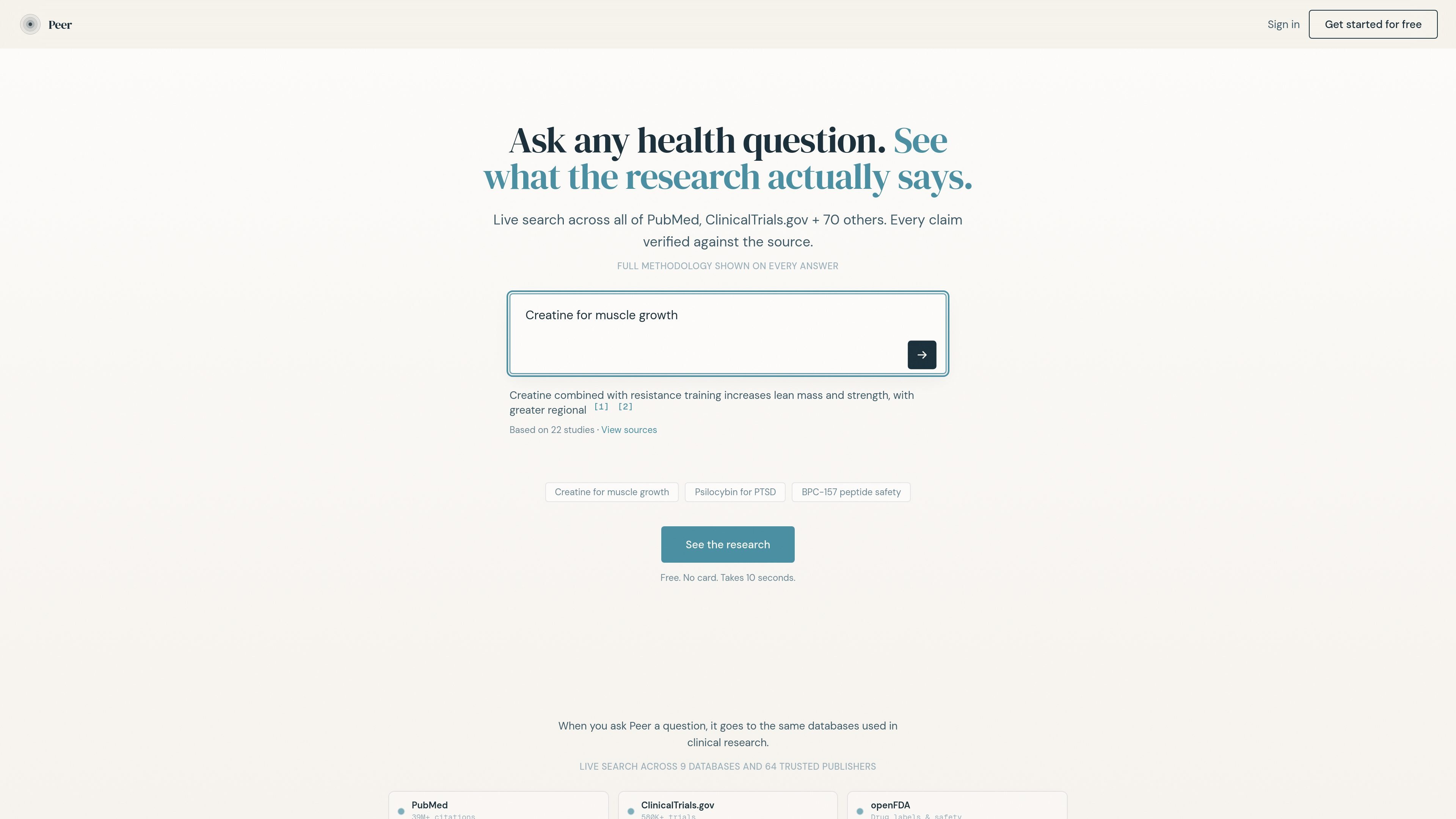
Peer helps you find health answers with visible, verifiable evidence by searching PubMed and ClinicalTrials.gov and citing real studies.
What is Peer?
Peer is a health research assistant that helps people answer health questions while grounding each claim in original sources. It searches PubMed and ClinicalTrials.gov and also consults 64 trusted health publishers to support what it says with citations.
Peer’s core purpose is to make the evidence behind health answers visible and verifiable by citing specific studies and checking each citation against its source.
Key Features
- Searches PubMed and ClinicalTrials.gov to find relevant medical studies for a question, so claims can be tied to primary research.
- Uses 64 trusted health publishers as additional sources, helping broaden the evidence set beyond a single database.
- Cites every claim to a real study, so readers can track which evidence supports each part of an answer.
- Verifies each citation against the source, aiming to reduce mismatches between what’s claimed and what the underlying study actually contains.
How to Use Peer
Start by entering a health question or topic you want information about. Peer then retrieves relevant material from PubMed, ClinicalTrials.gov, and its trusted publisher sources, and returns an answer with citations attached to the studies behind each claim.
When reviewing the response, use the citations to jump back to the underlying studies and confirm the referenced details directly in the source material.
Use Cases
- Understanding a treatment or intervention: Ask about how a specific medical intervention works or what outcomes it’s been studied for, and review the cited studies.
- Checking a health claim: Provide a claim you’ve seen (e.g., about a risk, benefit, or effectiveness) and use Peer’s cited studies and citation verification to evaluate it.
- Comparing evidence across studies: Request information on a condition or therapy and review multiple cited studies rather than relying on a single summary.
- Looking up evidence for clinical research: Ask about topics that overlap with trials and follow up by checking the cited PubMed/ClinicalTrials.gov records.
- Preparing a study-backed explanation: Use Peer’s citation-first responses as a starting point for drafting a summary that includes verifiable references.
FAQ
Does Peer only use academic databases? No. Peer searches PubMed and ClinicalTrials.gov and also draws from 64 trusted health publishers.
How does Peer handle citations? Peer cites every claim to a real study and verifies each citation against the source.
Can I confirm what Peer references? Yes. The answer includes citations intended to be checked against the underlying study sources.
What kinds of health questions is Peer meant for? Peer is designed to help with health information questions where the user needs evidence grounded in studies and verifiable citations.
Alternatives
- Manual PubMed/ClinicalTrials.gov searching: Users can look up studies directly and read them for themselves. This can be more time-consuming but offers full control and direct access to primary records.
- Evidence-focused medical literature review tools: Tools that summarize or map biomedical literature can reduce reading time, but may not provide the same claim-by-claim citation verification workflow described for Peer.
- General web search plus clinician-written sources: This approach can be quicker for broad overviews, but it often provides less direct linkage between each specific claim and the underlying study.
- Academic citation managers and reading assistants: These help organize and track sources you find, which is useful for research workflows, but they don’t inherently perform the “search and verify citations” function described for Peer.
Alternatives
Model Council
Model Council is a multi-model research feature by Perplexity that runs a single query across several top AI models simultaneously to generate a synthesized, comprehensive answer.
Comet
Comet is an AI-powered browser for iPhone and iPad with a built-in assistant to help you research, summarize, shop, schedule, and more.
MIRA vision
MIRA vision is an AI medical diagnostics system using patented synthetic pathology analysis for precise, rapid results in clinical workflows.
ClayHog
ClayHog tracks AI Search Visibility & GEO—see what ChatGPT, Gemini, Perplexity, Claude, and Google AI Overviews say about your brand, incl. citations and sentiment.
Grok AI Assistant
Grok is a free AI assistant developed by xAI, engineered to prioritize truth and objectivity while offering advanced capabilities like real-time information access and image generation.
Paperpal
Paperpal is an academic writing AI tool for research workflows—smart literature reading, English editing, rewriting, writing components, and pre-submission checks.