
Fully synthetic training data
Generates fully synthetic microscopy and tissue images instead of relying on real patient samples, which the site says removes privacy concerns and ethical restrictions.
MIRA vision develops synthetic-data-driven AI for pathology image analysis, with privacy-compliant training data, automatic annotations and controlled data generation.
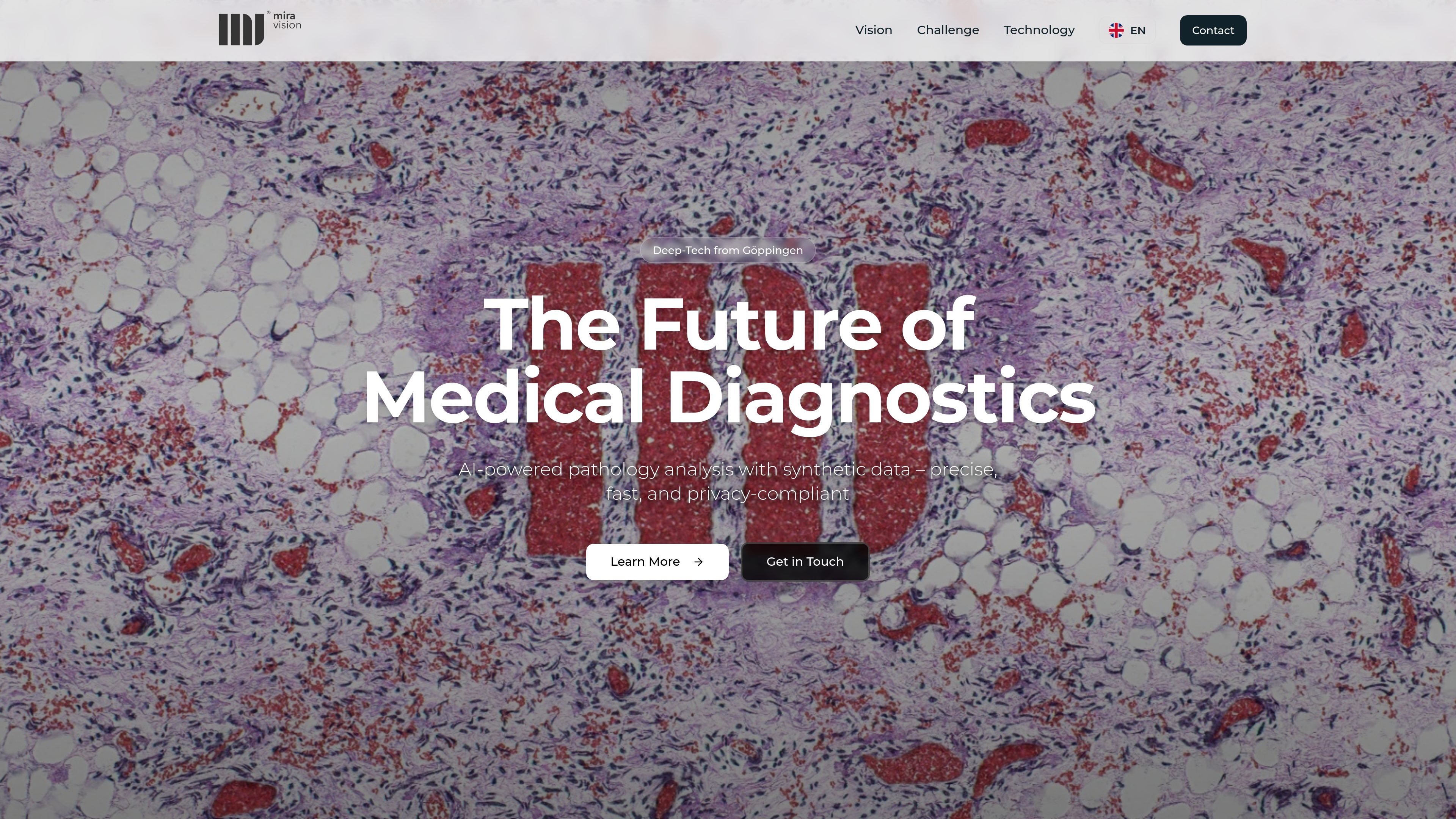
MIRA vision is a deep-tech company focused on medical diagnostics, specifically AI-powered pathology analysis. The website describes a system that analyzes pathological image data automatically and is trained entirely on synthetic data rather than real patient data.
Its core proposition is a fully synthetic, parametric training-data approach for pathology AI. According to the site, this method is intended to support photo-realistic tissue images, broader data diversity, automatic labeling, and reduced privacy and annotation burdens for diagnostic-model development.
Generates fully synthetic microscopy and tissue images instead of relying on real patient samples, which the site says removes privacy concerns and ethical restrictions.
Creates representative datasets with controlled variation across tissue types and pathological patterns, with the site emphasizing broad diversity and coverage.
Includes pixel-perfect labels and annotations as part of the generated data, reducing the need for manual expert annotation.
Uses rule-based, fully parametric generation rather than generative AI, with the site stressing reproducibility and direct incorporation of expert knowledge.
Supports specialized AI expert systems that the site says are optimized for specific disease patterns and coordinated by an AI orchestrator.
Targets pathology image analysis with the goal of faster, more precise diagnostic workflows and lower development costs.
Teams building pathology AI can use the synthetic-data approach to create training sets without relying on real patient slides, helping reduce privacy and access constraints.
Organizations that need more labeled pathology data can use automatically annotated synthetic samples to reduce the manual workload of expert annotation.
Groups working with rare diseases, varied staining protocols, or scanner differences can use controlled synthetic variation to broaden dataset coverage.
Medical AI teams facing cost pressure can use synthetic generation to reduce expenses tied to slide preparation, digitization, and large-scale labeling.
Research and product teams that need reproducible, fully parametric sample generation can use the rule-based approach to keep dataset creation consistent.
MIRA vision presents a synthetic-data approach for medical diagnostics, with pathology image analysis as the main use case. The site emphasizes AI systems that analyze pathological image data automatically while avoiding the use of real patient data in training.
The website describes a fully synthetic, parametric training-data approach. It states that the system can generate photo-realistic tissue images, support multiple tissue types and disease patterns, and include pixel-perfect annotations automatically.
The homepage positions the product around AI-powered pathology analysis and synthetic data generation rather than a general-purpose healthcare platform. Based on the available site content, it appears aimed at teams working on medical diagnostics or pathology AI.
The pricing page currently returns a 404 page not found, so the site does not expose a public pricing model in the captured content.
The site does not publish supported integrations, deployment details, or output formats in the captured pages. Those details are not stated on the public website content reviewed here.

Malyatko is a baby tracker for feeding, sleep, growth, teething, and milestones. Use it on iPhone, Apple Watch, and widgets offline, with iCloud sharing.

DANCING CATS App turns cat photos into dancing kitty clips. Simple, focused, and easy to use for playful pet-image edits.

VIDEOAI.ME is an AI video generator for spokesperson videos, ads, explainers, and social content from a script without filming.

艺映AI is a free AI video creation tool for text-to-video, image-to-video, and video-to-video creation for short social and promo clips.

Dyson Oral care features the CameraJet™ electric toothbrush with flosser, designed to precision-floss between teeth while brushing, plus toothpaste, mouth rinse and accessories.

讯飞绘镜 (iFlytek Huijing) is an AI video creation platform that transforms creative ideas into scripts, storyboard images, and dynamic videos quickly and efficiently.