
Conversational place search
Ask Maps lets you ask complex questions about places in a conversational format and receive answers grounded in Maps data.

Google Maps adds Gemini-powered Ask Maps and Immersive Navigation for conversational place discovery and clearer, more visual driving guidance.
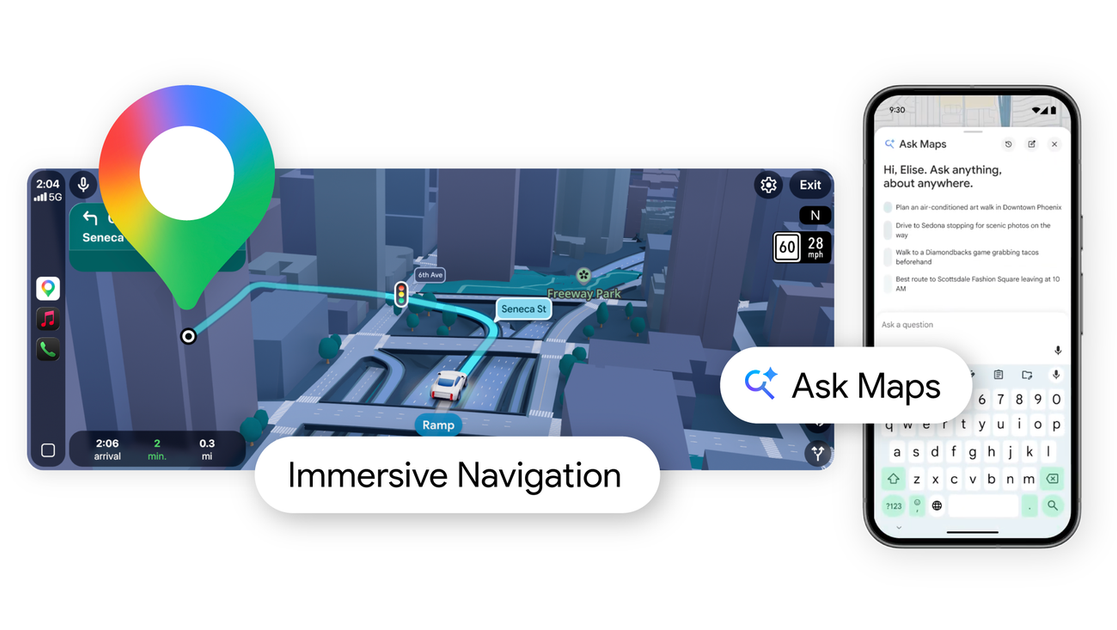
Google Maps is adding two AI-powered features built with Gemini models: Ask Maps and Immersive Navigation. Ask Maps turns place discovery into a conversational experience, while Immersive Navigation redesigns driving guidance with more visual context and route-aware prompts.
The launch post frames both features as ways to help people plan and navigate with less research and more confidence. Ask Maps is rolling out now in the U.S. and India on Android and iOS, with desktop coming soon. Immersive Navigation is starting to roll out across the U.S. and will expand over the coming months.
Ask Maps lets you ask complex questions about places in a conversational format and receive answers grounded in Maps data.
Results can be tailored using signals such as places you have searched for or saved in Maps, so recommendations are more relevant to your trip or errand.
Ask Maps can surface clear directions, ETAs, insider tips from community contributors, and a customized map to help you compare options before you go.
Once you choose a place, you can book reservations, save the place to a list, share it, or get directions with a few taps.
Immersive Navigation adds a redesigned driving experience with 3D views, clearer guidance, natural voice directions, and route visualization.
Maps can also show alternate-route tradeoffs, real-time disruptions, Street View previews, and parking help to support the final stretch of a trip.
Use Ask Maps when you have a specific need, such as finding a place to charge your phone, locating a public tennis court with lights, or comparing nearby options without opening multiple tabs.
Use the feature while planning a route or trip to surface recommended stops, directions, ETAs, and tips from real people in one conversational flow.
Use Immersive Navigation for driving when you want a clearer view of lanes, intersections, and upcoming turns, along with more natural spoken directions.
Use Maps when you need to compare alternate routes by travel time, tolls, or traffic, and want alerts for construction or crashes along the way.
Use Street View previews and destination guidance before arrival to help locate parking, identify the entrance, and know which side of the street to approach from.
Ask Maps is rolling out now in the U.S. and India on Android and iOS, with desktop coming soon.
Immersive Navigation starts rolling out today across the U.S., and availability will expand over the coming months.
Ask Maps is designed for complex, real-world questions about places, such as finding a charging spot, a nearby court, or a recommended stop on a route. It then returns personalized recommendations and a customized map.
No pricing information is provided in the source material. The launch post describes these as Google Maps features rather than a separate paid product.

An All-In-One AI Platform that combines tools for image, video, voice, writing, and chat to enhance creativity and collaboration.
Gemma AI is a phone call reminder app that calls you with scheduled reminders instead of push notifications, with Google Calendar sync and natural voice interaction.

Wallie is an open-source AI streamer that watches your screen, hears chat, and delivers live commentary in a configurable persona. Runs locally with your own keys.

ClayHog is an AI search visibility platform for tracking brand presence in ChatGPT, Gemini, Perplexity, Claude, and Google AI Overviews from one dashboard.

Claude Overlay is a Windows desktop overlay for Claude Code that reads your screen, so you can ask questions, inspect content, and request edits without leaving the app. Uses your existing Claude subscription via Claude CLI.

Grok is a free AI assistant developed by xAI, engineered to prioritize truth and objectivity while offering advanced capabilities like real-time information access and image generation.