
Open-weight image generation
Generates images as an open-weight model and is described as producing dense text rendering across languages.

Ideogram 4.0 is an open-weight image model for designed images with strong text rendering, layout control, 2K output, editable text layers, and background removal via web app or API.
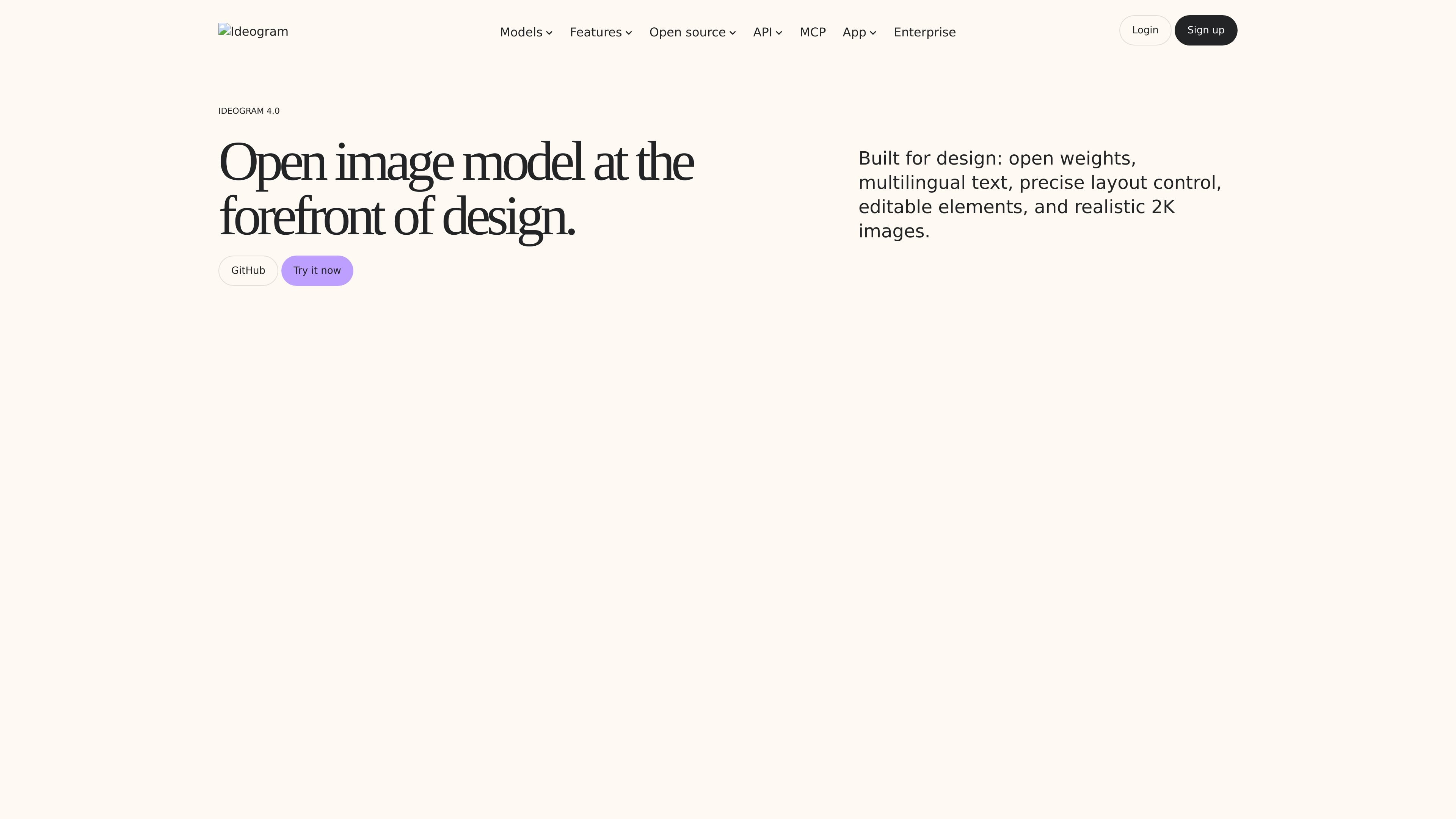
Ideogram 4.0 is an open-weight image model for generating designed images with strong text rendering, layout control, and 2K output. The product page highlights dense text handling across languages and object placement through bounding box control as part of the model’s core capabilities.
Around the model, Ideogram offers adjacent tools for design workflows, including editable text layers and background removal. Those features let users generate a design, extract text for later editing, or remove an image background with a transparent PNG output, all within the Ideogram workflow or through the API.
Generates images as an open-weight model and is described as producing dense text rendering across languages.
Supports object and text placement through bounding box control, which helps steer layout more precisely.
Produces 2K output, with the site positioning it for results that do not look AI generated.
Extracts text from generated designs into separate editable layers so headlines, labels, and copy can be changed without starting over.
Removes backgrounds using a generative model aimed at clean alpha channels, including hair, glass, logos, and fine product details.
Exposes text-layer extraction and background removal through API endpoints for programmatic workflows.
Create posters, social graphics, logos, or book-cover style layouts where the text needs to render legibly as part of the design.
Generate a layout once, then update headlines, fonts, or copy without re-prompting when the message changes.
Remove backgrounds from product photos, cutouts, or detailed subjects that need a transparent PNG for downstream design work.
Use the API to automate text-layer extraction or background removal in product, marketplace, or catalog workflows.
Yes. Ideogram says Editable Text Layers are available on all plans, including the free tier, and via the API.
Press Layerize Text after generating a design. Ideogram then separates each line of text into its own editable layer so you can rewrite copy, change the font, or adjust size without regenerating the image.
The feature works best with clear, straight text in standard typography. Curved, highly stylized, decorative, or graphic-embedded text may not be detected reliably.
Ideogram’s background remover is available on all plans and via the API. The source page describes it as producing transparent PNGs with clean edges and no manual cleanup for many common use cases.
The source materials show Ideogram supports API access for both text layers and background removal, but they do not provide a complete public pricing breakdown on the pages reviewed.
PixelDrive is a bulk image generation API for on-brand images from one template via browser editor, REST API, CSV batch, or MCP.

Napkin AI turns text into editable visuals for presentations, documents, and shareable content. Text-first generation, collaboration, and export to PPT, PNG, SVG, or PDF.

Kling AI is an AI creative studio for generating and editing images and videos, with web, mobile, and API access for creators and developers.

Skybox AI by Blockade Labs creates 360° skyboxes and environments for games, XR, film, education, architecture, and production workflows.

The AI painting generator is an online AI-powered software that automatically creates artwork based on text descriptions provided by users.

An All-In-One AI Platform that combines tools for image, video, voice, writing, and chat to enhance creativity and collaboration.