
Keyword research and content gap analysis
LazySEO scans your site, identifies the niche, and finds keyword opportunities by comparing your site against competitors before building a content plan.

LazySEO is an AI-powered SEO content automation platform that researches keywords, drafts long-form articles, and publishes them to connected CMS platforms for recurring search content.
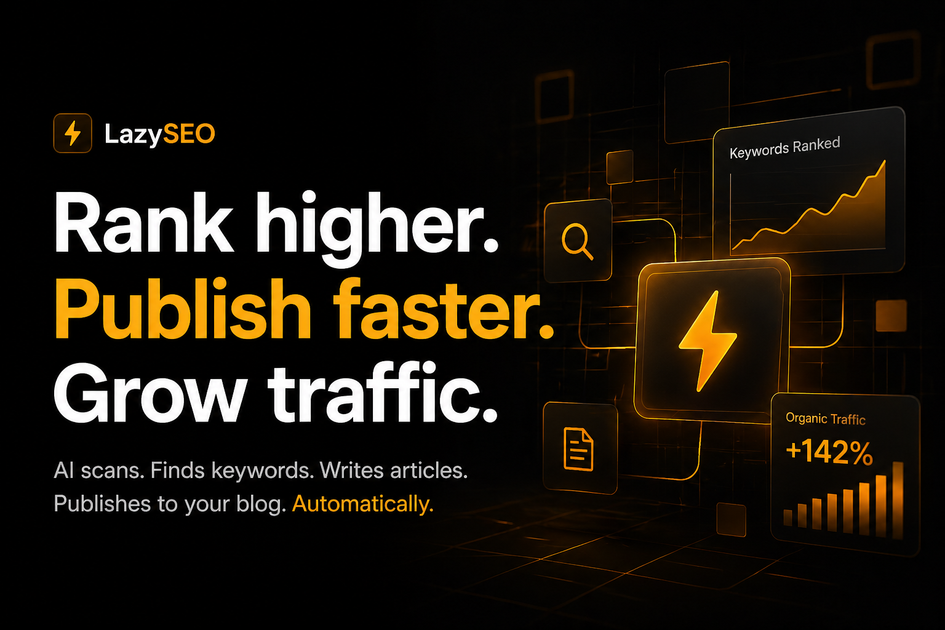
LazySEO is an AI-powered SEO autopilot that researches keywords, writes long-form articles, and publishes them automatically to a connected blog. The product is positioned around producing 30 SEO articles per month per site, with the goal of helping sites grow search traffic without a manual content workflow.
The site says the system scans a website, maps keyword gaps against competitors, generates a content plan, drafts and scores articles, and can auto-publish them on schedule. It also includes workflow options for review mode, internal linking, and publishing to common CMS platforms such as WordPress, Webflow, Ghost, Shopify, and Framer.
LazySEO scans your site, identifies the niche, and finds keyword opportunities by comparing your site against competitors before building a content plan.
It creates a 30-article monthly schedule with articles sorted by volume, difficulty, and topical cluster so the content plan is ready to run.
Articles are drafted as long-form, research-backed posts with SERP data, chapter-level drafts, and automated SEO checks before publishing.
LazySEO can publish directly to WordPress, Webflow, Ghost, Shopify, Framer, or API-based CMS setups without manual copy-pasting.
The product reads existing posts to match tone, format, and vocabulary, and it adds internal links to related pages before each publish.
A CSV workflow lets users generate one article per row from a title template, which supports programmatic SEO use cases at scale.
For a solo founder or small team, LazySEO can turn a site URL into a month-long list of search topics, then draft and publish content while the team focuses on product work.
SaaS teams can use the competitor analysis and keyword-gap workflow to target terms their buyers search and build topical coverage around those gaps.
Online stores can use the automated article pipeline to publish product- and category-related content that supports organic search visibility.
Teams running repeated location, product, or use-case campaigns can upload a CSV and generate one article per row from a reusable title template.
Organizations that want some oversight can review or edit generated articles before publishing instead of sending everything live automatically.
Yes. The pricing page says you can start a 3-day free trial, and you can cancel before day 3 to pay nothing. The FAQ also says you can cancel anytime from the billing portal.
LazySEO analyzes your website, finds high-opportunity keywords, and generates optimized articles that you can review and edit manually or send directly to your CMS with auto-publish enabled.
The site says LazySEO connects with major CMS options including WordPress, Ghost, Webflow, Framer, and Shopify. The home page also describes auto-publishing to WordPress, Webflow, Ghost, Shopify, Framer, or any API.
The pricing page says there is one plan, LazySEO Pro, so you always get the full feature set. Monthly and yearly billing are available, and you can switch billing intervals from the billing portal.
The site presents LazySEO for founders, SaaS teams, and online stores. It is designed for people who want SEO content and publishing handled automatically rather than managing the workflow themselves.

Skayle researches topics, publishes structured CMS content, and tracks AI search citations for teams needing one system for visibility.

PromptScout tracks how ChatGPT, Gemini, Google AI Overviews, and Perplexity mention your brand or competitors, with source analysis and website audits.

An All-In-One AI Platform that combines tools for image, video, voice, writing, and chat to enhance creativity and collaboration.

Slidesgo is a presentation template platform for Google Slides, PowerPoint and Canva workflows, with free and Premium templates plus AI-assisted creation.

ClayHog is an AI search visibility platform for tracking brand presence in ChatGPT, Gemini, Perplexity, Claude, and Google AI Overviews from one dashboard.

Wysera is an AI business platform with PostWyse for content and OpsWyse for CRM and revenue workflows, powered by shared Wyse AI and approval-first automation.