
Plain-language agent planning
Teams can describe an agent in plain language and have Lunen draft a structured execution plan with named tools, scoped data, and a schedule.

Lunen is an AI governance and agent-control platform for teams and enterprises to build agents in plain language, approve actions, and keep audit trails.
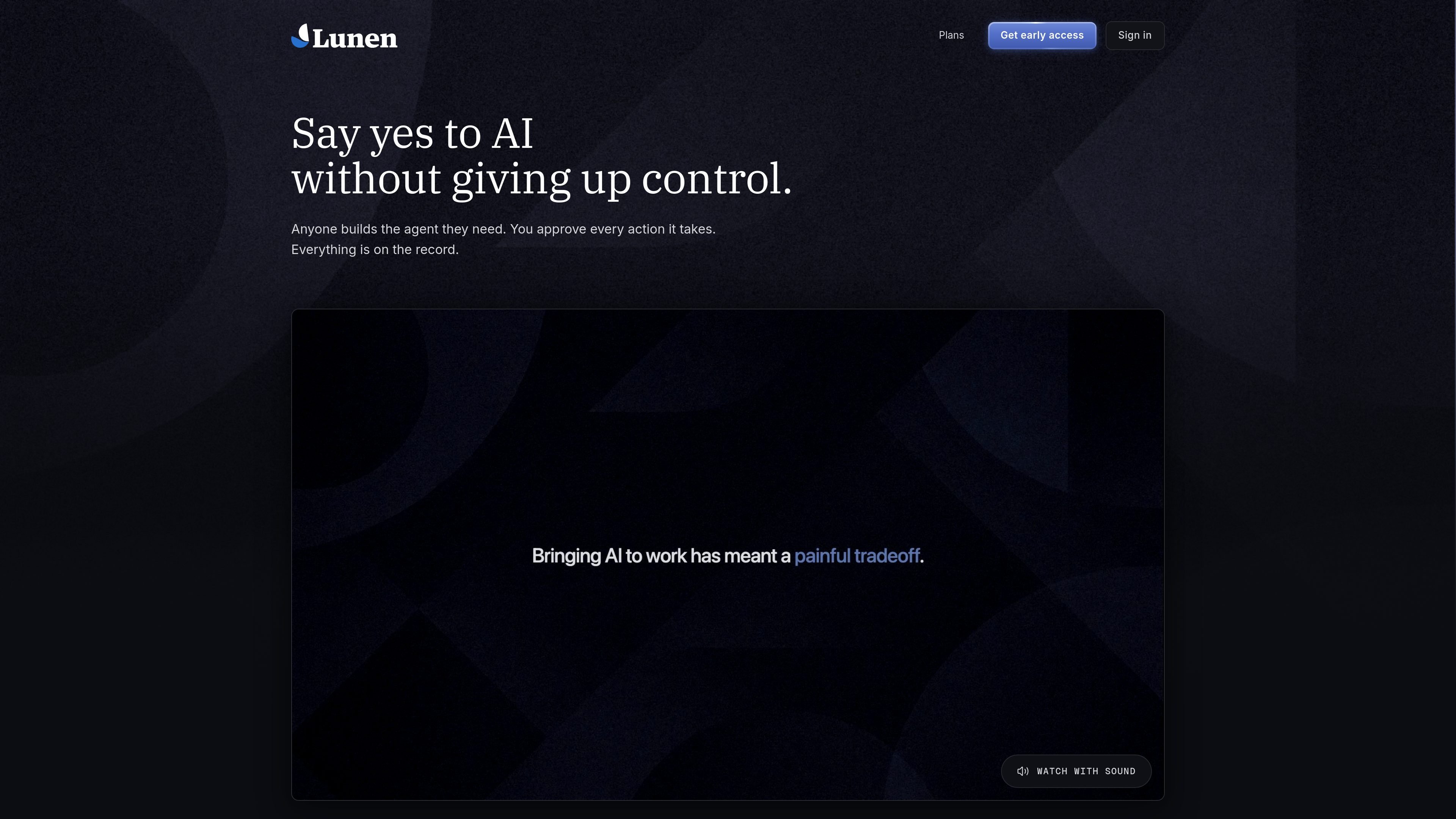
Lunen is an AI governance and agent-control platform for teams that want to build agents without losing oversight. The product centers on a single workflow: someone describes the agent they need, Lunen drafts the execution plan, and the team decides which actions can run automatically and which require approval.
The home page positions Lunen as a way to make AI usable in real work systems while keeping every action on the record. Pricing is organized around Operational Control for teams running agents in production, with an Enterprise plan for organizations that need dedicated deployment, private networking, and longer retention. A Solo plan is listed as coming soon.
Teams can describe an agent in plain language and have Lunen draft a structured execution plan with named tools, scoped data, and a schedule.
Each connected MCP tool can be set to run unattended or require human approval before each call, letting teams separate read access from write actions.
User actions and agent actions are recorded in a unified audit log, and the product page says each event can show who acted, what was approved, what model ran, and which data it touched.
Operational Control includes role-based access control, unlimited users, agents, and connected systems, plus 50,000 tool calls per month and 90-day audit retention.
Enterprise adds dedicated deployment or BYOC, private networking, extended and regulated audit retention, custom tool-call volume, and dedicated support with an SLA.
The home page shows support for tools such as Slack, HubSpot, Google, Atlassian, BigQuery, and any MCP server, indicating use across existing business systems.
A subject-matter expert can describe a recurring business task in plain language, then review the generated plan before it is saved and scheduled.
Teams can let agents search or read data from connected systems while requiring approval before actions that change records, send messages, or create objects.
Organizations that need oversight can keep both human and agent activity in one audit log for review, export, and security conversations.
Teams already working in Slack, HubSpot, BigQuery, Atlassian, or similar systems can layer governance onto existing workflows instead of replacing the tools themselves.
Larger organizations can use the Enterprise plan when they need dedicated deployment, private networking, or more specific retention and support terms.
Lunen is designed so teams can define an agent in plain language, have it generate a structured plan, and then govern each tool action with allow-or-approve policies before it runs.
The pricing page shows an Operational Control plan for teams and an Enterprise plan for organizations that need dedicated deployment, private networking, and extended audit retention. A Solo plan is listed as coming soon.
Lunen includes connected systems such as Slack, HubSpot, Google, Atlassian, BigQuery, and any MCP server shown on the home page examples.
The home page shows a plain-language workflow: describe the agent, review the generated execution plan, set policy for reads and writes, and run it with actions recorded in the audit log.

CreateOS Sandbox is an isolated compute environment for running code and agent workloads in Firecracker micro-VMs with private networking and SDK, CLI, or MCP control.

ByteAsk is a terminal-first AI coding agent for C and C++ that edits repos and verifies changes with compilers, debuggers, sanitizers, and tests.

hob is an independent workspace for coding agents, with local control over sessions, terminals, history, routing, and follow-up work.

Manta AI is an autonomous web app testing tool that maps app behavior, catches regressions, and generates tests from a URL, no scripts or selectors needed.

SonOf connects to your repo and PM tool, audits your codebase, and turns approved work into shipped tickets with senior engineering review.

Ghost is a terminal-based AI assistant for chatting, code generation, and CLI tasks. Includes free models, supports Linux, macOS, Windows, and is open source.