

MardiPay
MardiPay lets you send and request crypto on Solana using a phone number or email, with instant transfers and a unified SOL/USDC/PYUSD dashboard.
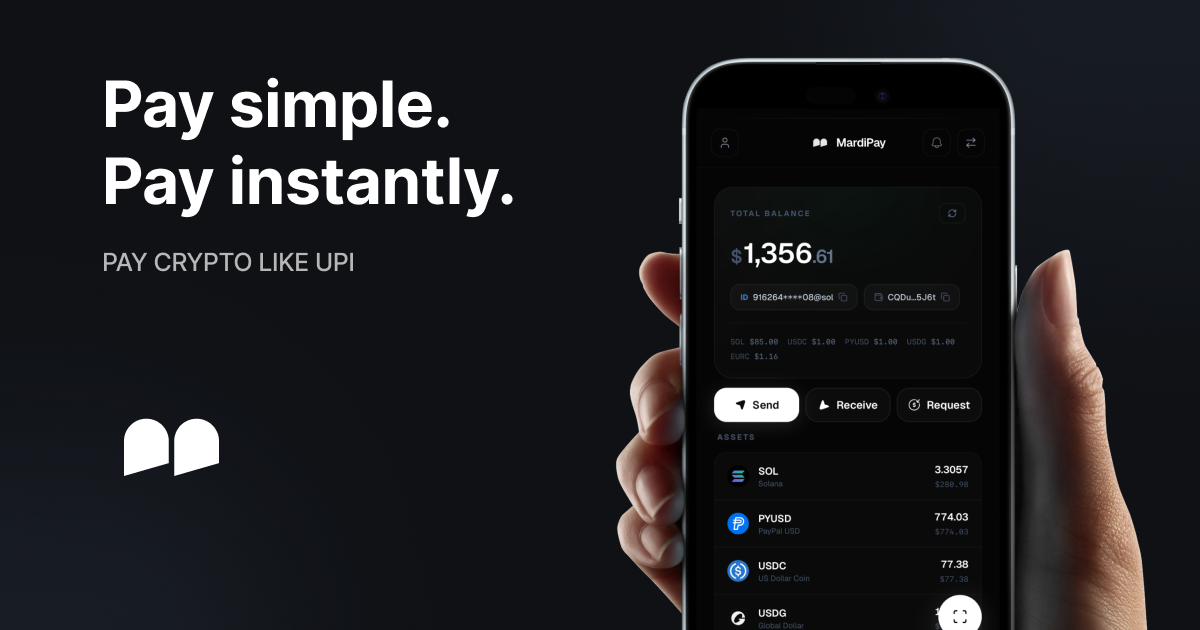
What is MardiPay?
MardiPay is a minimalist payments layer built on the Solana blockchain. It aims to make crypto sending and receiving more practical for everyday use by replacing long wallet addresses with simple, human-readable IDs.
Instead of copying a 44-character crypto address and hoping it’s correct, MardiPay lets you send using a phone number or email. The product describes near-instant settlement on Solana and emphasizes a non-recovery/irreversible workflow for transfers once sent.
Key Features
- Send via phone number or email IDs: Use simple IDs instead of copying long wallet addresses, reducing the chance of address entry mistakes.
- Instant payments on Solana: Designed for fast transfers with settlement described as under 1 second on Solana.
- Asset management in one dashboard: View and manage SOL, USDC, and PYUSD from a single interface.
- Payment requests with links: Request payment and share a link to get paid without manual address entry.
- Scan & pay with QR codes: Pay by scanning a QR code rather than typing payment details.
- Payment history: Track sent payments with simple, easy-to-understand records.
- Merchant Mode and payment links: Includes a business-oriented mode for accepting crypto payments with transparency for transactions.
How to Use MardiPay
- Get started on MardiPay: Create a MardiPay account (the site describes managing assets through its simplified interface).
- Choose the recipient identifier: Select the recipient’s phone number or email instead of a wallet address.
- Send or request payment: Either send immediately using the recipient’s ID, or create a payment request and share the provided link.
- Pay via QR when available: If you have a QR code from the payer/merchant, scan and complete payment without typing.
- Review records: Use the payment history to check what you sent.
Use Cases
- Paying individuals without address copying: Send SOL or stablecoins to someone you know by entering their phone number or email rather than a long address.
- Requesting payment for small bills: Generate a payment link to ask for payment and let the recipient pay directly using the link.
- Retail or service payments (business flow): Use Merchant Mode and payment links to accept crypto payments while providing transaction visibility.
- QR-based checkout: For situations where typing is inconvenient (in-person or mobile), scan a QR code to pay instantly.
- Managing multiple assets in one place: Keep SOL, USDC, and PYUSD organized in one dashboard for faster selection during transfers.
FAQ
What exactly is MardiPay? MardiPay is a minimalist financial primitive built on Solana that abstracts wallet complexity so you can send and receive payments using simple IDs like a phone number or email.
Is MardiPay secure? The site states MardiPay is built on the Solana blockchain and describes using non-custodial architecture where possible and verified profiles.
How do fees work? The site states network fees are typically less than $0.00025 per transaction on Solana, with no hidden subscription costs or percentage-based take rates for personal transfers.
Do I need a separate Solana wallet (e.g., Phantom)? The site says you don’t necessarily need an external wallet to get started; you can create a MardiPay account and manage assets through its simplified interface.
Can businesses accept payments with MardiPay? Yes. The product includes Merchant Mode and a payment link system designed for businesses to accept crypto payments with transaction transparency.
Alternatives
- Traditional crypto wallet transfers (address-based): Use a Solana wallet to send to copied addresses. This differs by requiring address entry and lacking the human-ID workflow described for MardiPay.
- Invoice/payment-link tools for crypto payments (general category): Services that generate payment links or checkout flows for crypto. These may rely on different payment inputs and typically focus on merchant acceptance rather than substituting wallet addresses with phone/email IDs.
- QR-based crypto payment apps: Apps centered on scanning QR codes to initiate transfers. These can overlap with MardiPay’s Scan & Pay flow, but may not provide the same phone/email ID abstraction.
- Other identity-based transfer approaches: Solutions that map recipients to simpler identifiers. The key difference is whether the workflow is specifically built for Solana and whether it includes a unified dashboard for SOL, USDC, and PYUSD as described here.
Alternatives

Deskboard
Deskboard turns folders into visual workspaces, letting you arrange files freely, add widgets, annotate content, and stay synced with actual files.

ReactVision Studio
ReactVision Studio is a browser-based AR and VR editor for building scenes visually and shipping natively to iOS, Android, and Meta Quest via React Native and ViroReact.

Shadow
Shadow is a Mac app that captures what you see, hear, and say, then runs custom Skills on that context for notes, replies, and summaries.

Montage
Montage is an agentic UI rendering platform for rich, interactive AI interface components, with a single SDK and support for any underlying model.

SearchAd AI
SearchAd AI is a chat-based tool for planning Apple Search Ads campaigns with country-specific keywords and budgets, requiring approval before launch.

Origio
Origio is a country and city comparison tool for moving or working abroad, personalized by your job and passport. Compare salaries, visas, cost of living, and quality of life.