

Ollang
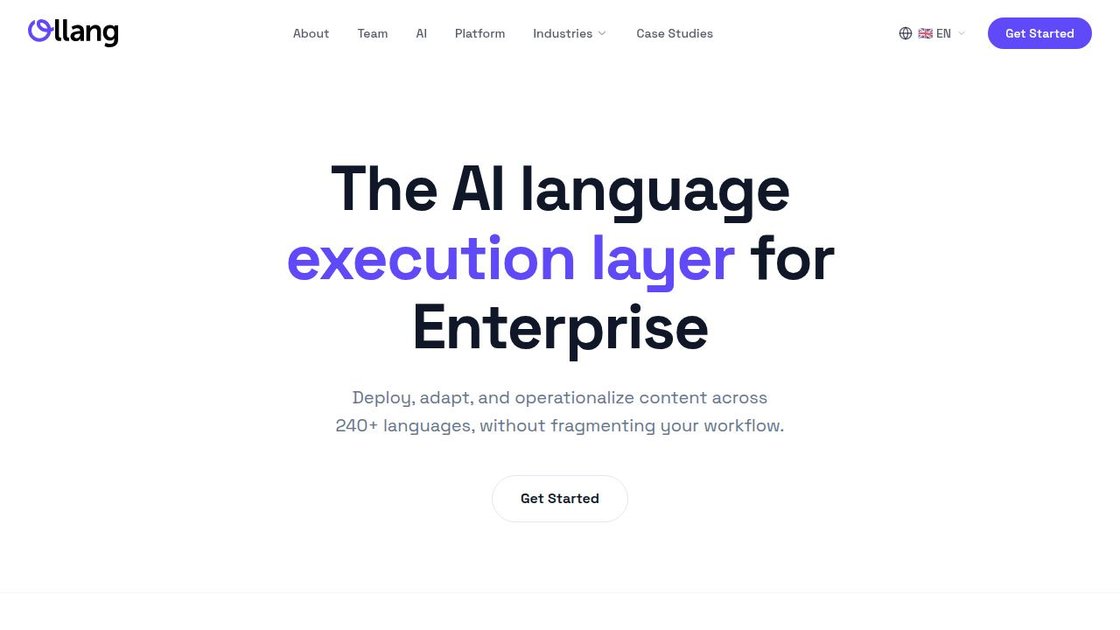
Ollang is an AI language execution layer that helps enterprise teams deploy, adapt, and operationalize content across 240+ languages without workflow fragmentation.
What is Ollang?
Ollang is an AI language execution layer that helps enterprise teams deploy, adapt, and operationalize content across 240+ languages without workflow fragmentation.
In practice, this positions Ollang as an infrastructure component in the language/localization lifecycle—supporting consistent execution across many target languages while aiming to keep the surrounding process unified.
Key Features
- Operationalize content across 240+ languages — supports execution at scale for multilingual deployments.
- Deploy and adapt content without workflow fragmentation — aims to keep a single operational workflow even as languages change.
How to Use Ollang
Start by identifying the content you need to deploy or adapt for multiple languages. Then use Ollang as the execution layer to run that multilingual deployment through a consistent workflow rather than building separate processes for each language.
Use Cases
- Multilingual content rollout for global teams: publish or update the same content set across many languages while keeping one operational workflow.
- Language adaptation for localized versions: adapt content for different language targets while using the same underlying execution layer.
- Enterprise localization operations: manage multilingual delivery as an operational process rather than ad-hoc, per-language work.
- Reducing workflow duplication: avoid maintaining separate pipelines per language by routing language execution through one layer.
FAQ
How many languages does Ollang support?
Ollang is described as enabling deployment and operationalization across 240+ languages.
What does “language execution layer” mean in this context?
Based on the site description, it refers to a layer that helps enterprises deploy and adapt content so it can be executed across multiple languages while keeping the overall workflow intact.
Does Ollang replace an entire localization workflow?
The page emphasizes not fragmenting the workflow. It suggests Ollang fits into or supports existing operations rather than requiring a completely separate per-language workflow.
What kinds of content can it handle?
The site states “content” broadly, but it does not specify formats (e.g., documents, web pages, or media). You should confirm your specific content types with the product documentation or team.
Is pricing or deployment type (cloud/on-prem) described?
The provided content does not mention pricing, hosting, or deployment mode, so those details are not confirmed here.
Alternatives
- Generic machine translation APIs: APIs can translate content into many languages, but they typically don’t provide a dedicated “execution layer” focused on maintaining a unified enterprise workflow across deployments.
- Enterprise localization management platforms: these tools focus on content workflows and translation management; depending on the platform, they may or may not provide a comparable execution-layer approach for AI-driven multilingual adaptation.
- Workflow orchestration for multilingual processing: teams sometimes build custom pipelines using orchestration tools; this can achieve unified workflows but requires more engineering effort and maintenance.
- Language technology middleware: broader middleware for language processing may cover parts of multilingual execution, but the level of workflow cohesion described for Ollang may differ.
Alternatives

Codex Plugins
Use Codex Plugins to bundle skills, app integrations, and MCP servers into reusable workflows—extending Codex access to tools like Gmail, Drive, and Slack.
Struere
Struere is an AI-native operational system that replaces spreadsheet workflows with structured software—dashboards, alerts, and automations.
OpenFlags
OpenFlags is an open source, self-hosted feature flag system with a control plane and typed SDKs for progressive delivery and safe rollouts.

AakarDev AI
AakarDev AI is a powerful platform that simplifies the development of AI applications with seamless vector database integration, enabling rapid deployment and scalability.

BookAI.chat
BookAI allows you to chat with your books using AI by simply providing the title and author.

skills-janitor
Audit, track usage, and compare your Claude Code skills with skills-janitor—nine focused slash commands and zero dependencies.