
Pull request product review
Checks each pull request against product specifications so changes can be compared with the team's stated intent before merge.

Prelint reviews pull requests against product specs to catch drift, inconsistencies, and misalignment before release, with repo-based specs and $10 free credits to start.
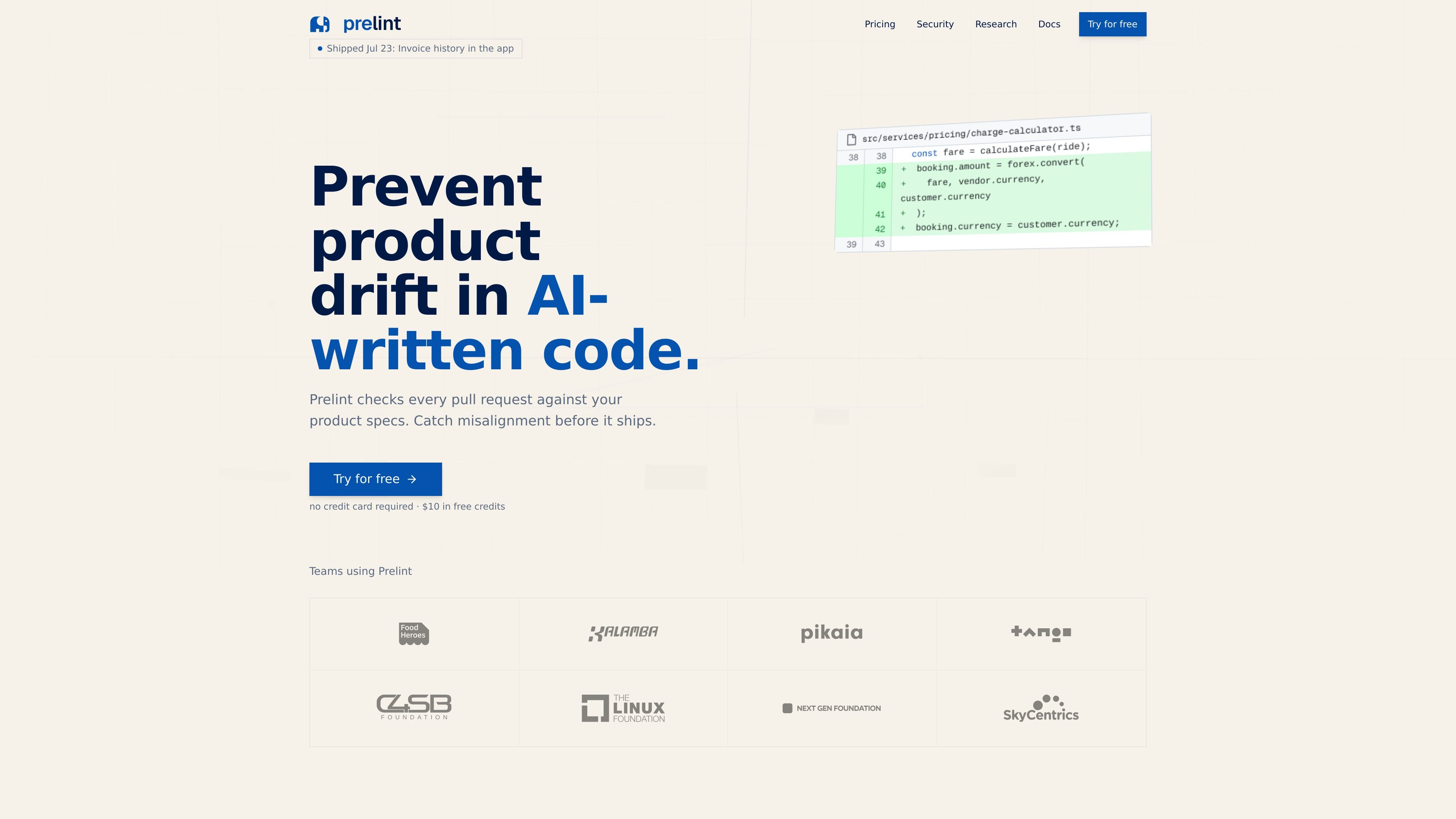
Prelint is a product review tool for pull requests. It checks proposed changes against product specifications so teams can catch product drift, inconsistencies, and misalignment before those changes ship.
The product is designed for teams using AI-written code or other fast-moving development workflows where the gap between implementation and product intent can grow over time. The source pages describe product specs living in the repository, reviews happening automatically on pull requests, and findings that help teams revise before merge.
Checks each pull request against product specifications so changes can be compared with the team's stated intent before merge.
Flags contradictions, conflicts, and missing alignment across specs and product decisions, not just code-level issues.
Returns inline findings plus a summary comment, with completed reviews counted only after they finish and post results.
Treats the repository as the source of truth for product context, with specs stored alongside the code in files such as Markdown or YAML.
Supports product questions grounded in the spec set, letting stakeholders ask why something works the way it does without interrupting engineers.
Provides billing controls such as prepaid credits, auto recharge, monthly limits, and free reviews for public repositories.
Teams can compare each proposed change with the product spec before merge, which is useful when implementation speed makes it easy for intent to drift.
Organizations working with AI-generated code can keep a product check in the loop so the agent's changes are assessed for spec alignment before humans review or merge them.
Product and engineering teams can use the repo as the shared source of truth for decisions, constraints, and terminology, reducing confusion when multiple contributors move quickly.
Stakeholders can ask why a feature or behavior exists and get answers grounded in the stored specs instead of calling a meeting for every question.
Teams watching spend can use prepaid credits, auto recharge, and monthly limits to keep billing predictable while still allowing reviews to continue.
Prelint reviews pull requests against product specs, catching drift, inconsistencies, and misalignment before changes ship. The source material says product specs live in the repo and each PR is checked against the full product context.
Prelint's pricing page says new organizations start with $10 in free credits and no credit card is required. Billing is based on completed reviews, with $1 charged for each review that finishes and posts findings or no findings.
The source says completed reviews are billed, while failed, cancelled, and timed-out reviews are free. Re-reviews after new commits or force pushes are billed again if they complete.
The source says product specs live in the repository and that Prelint checks pull requests against them automatically. It also mentions Markdown and YAML as examples of spec formats, but does not document specific integrations on the collected pages.
The collected pages do not document a full supported platform list or a specific setup flow. They do show that Prelint is used around pull requests and that reviews can be triggered by PR events, but readers should check the docs for platform-specific details.

ByteAsk is a terminal-first AI coding agent for C and C++ that edits repos and verifies changes with compilers, debuggers, sanitizers, and tests.

Manta AI is an autonomous web app testing tool that maps app behavior, catches regressions, and generates tests from a URL, no scripts or selectors needed.

CreateOS Sandbox is an isolated compute environment for running code and agent workloads in Firecracker micro-VMs with private networking and SDK, CLI, or MCP control.

hob is an independent workspace for coding agents, with local control over sessions, terminals, history, routing, and follow-up work.

SonOf connects to your repo and PM tool, audits your codebase, and turns approved work into shipped tickets with senior engineering review.

Ghost is a terminal-based AI assistant for chatting, code generation, and CLI tasks. Includes free models, supports Linux, macOS, Windows, and is open source.