
Prompt versioning and management
Version custom prompt templates, tools, and model parameters in a shared prompt CMS so teams can compare changes and manage prompt history.

PromptLayer is an LLM operations platform for versioning, testing, and monitoring prompts and agents. It helps AI teams collaborate on prompt workflows without code.
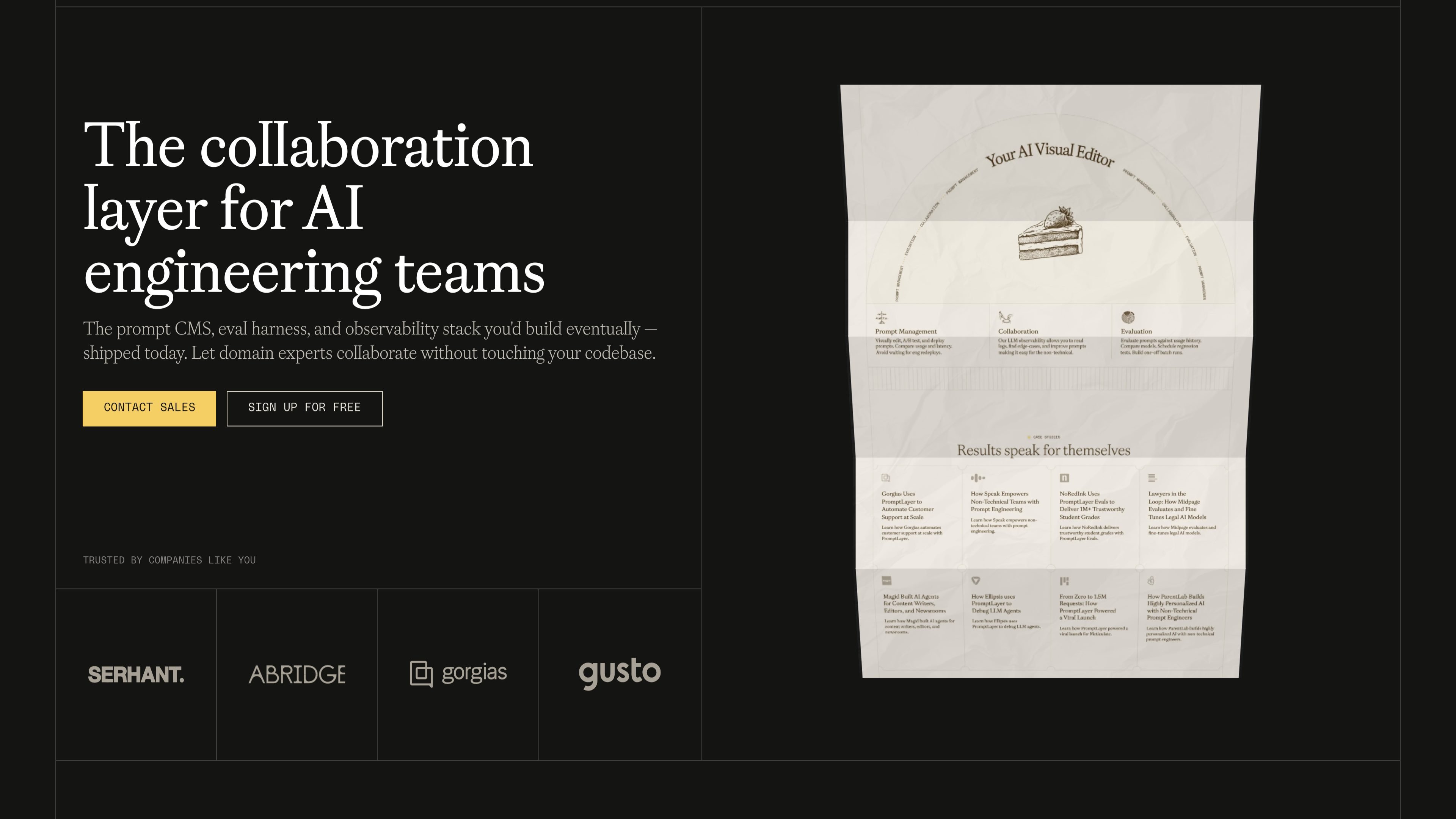
PromptLayer is a platform for teams building LLM applications that need to version, test, monitor, and organize prompts and agents. The site describes it as a collaboration layer for AI engineering teams, combining a prompt CMS, an eval harness, and an observability stack in one product.
Across the product pages, PromptLayer focuses on helping teams separate prompt logic from application code, review changes in a visual editor, run automated testing, and trace production behavior. The result is a shared workflow for domain experts and developers working on prompts, evaluations, and LLM monitoring.
Version custom prompt templates, tools, and model parameters in a shared prompt CMS so teams can compare changes and manage prompt history.
Run regression tests and evaluation pipelines after creating a new version, with support for A/B testing and release labels for different environments.
Track cost, latency, usage, feedback, requests, spans, and other metadata to understand how prompts and agents perform in production.
Use a visual editor and collaborative features such as comments and commit messages so technical and non-technical contributors can review prompt changes.
Work with datasets and eval cell executions for prompt testing, and use playground runs for interactive experimentation.
Create prompt templates, compare versions, and roll out changes with labels for development and production environments.
Run regression tests, evaluation pipelines, and A/B tests before shipping a new prompt or agent update.
Inspect requests, spans, latency, cost, and metadata to understand how an LLM workflow behaves in production.
Let developers and domain experts review prompts in a visual editor and collaborate with comments instead of editing code directly.
Use datasets and playground runs to reproduce issues, debug failures, and refine prompts based on observed output patterns.
PromptLayer is a prompt management, evaluation, and observability platform for teams building with LLMs. It provides versioning, testing, tracing, monitoring, and dataset tools in one place.
Yes. The pricing page shows Free, Pro, Team, and Enterprise plans. Free and paid plans have published limits, while Enterprise uses custom limits and requires contacting sales for details.
The pricing page states that PromptLayer Free, Pro, and Team are cloud-hosted in the US. Enterprise customers can choose self-hosted deployment on GCP, AWS, or Azure, as well as cloud-hosted EU or single-tenant options.
PromptLayer says enterprise customers can get role-based access controls, deployment approvals, SSO, and a HIPAA BAA. The pricing page also states that the company maintains SOC2 Type 2, GDPR, HIPAA, and CCPA certifications.

ByteAsk is a terminal-first AI coding agent for C and C++ that edits repos and verifies changes with compilers, debuggers, sanitizers, and tests.

Manta AI is an autonomous web app testing tool that maps app behavior, catches regressions, and generates tests from a URL, no scripts or selectors needed.

AakarDev AI helps teams manage AI provider access, project setup, logs, and analytics in one dashboard. BYOK support included.

BookAI allows you to chat with your books using AI by simply providing the title and author.

Skills Janitor is a GitHub-hosted set of slash commands for auditing, tracking, and cleaning up Claude Code and OpenAI Codex skills.

FeelFish is a PC client for AI-assisted novel writing, helping writers plan characters and settings, draft and revise novels, and manage story context.