
Collect content from multiple sources
Paste a link to supported sources such as Substack, YouTube, LinkedIn, a podcast RSS feed, or a blog. You can also upload files or paste text directly.

Prosed turns newsletters, posts, podcasts, videos, notes, and transcripts into a publish-ready non-fiction manuscript for creators and aspiring authors.
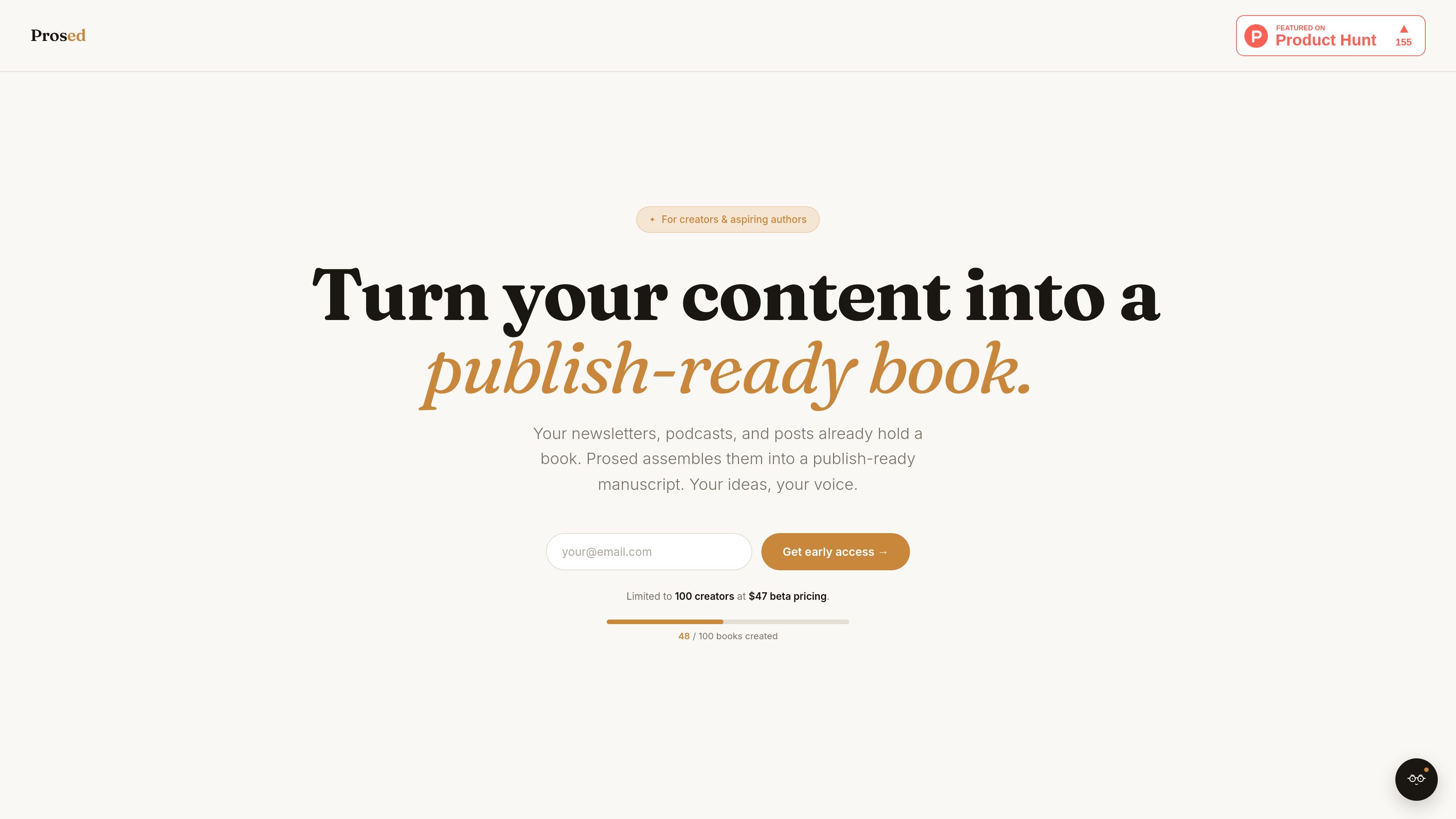
Prosed is a book-creation service for creators and aspiring authors who already have substantial material in newsletters, posts, podcasts, videos, notes, or transcripts. Its goal is to turn that existing work into a publish-ready non-fiction manuscript without starting from a blank page.
The workflow combines a creative brief, content ingestion, manuscript assembly through The Inkwell, chapter-level review in a private portal, and editorial checks from Typo. The site positions the product as a publishing process rather than a simple AI writing tool, with exports available as DOCX, PDF, and ePub.
Paste a link to supported sources such as Substack, YouTube, LinkedIn, a podcast RSS feed, or a blog. You can also upload files or paste text directly.
The Inkwell restructures your existing material into a complete non-fiction manuscript using a multi-stage pipeline built around patterns from bestselling books.
Read each chapter in a private portal, leave comments, accept or reject suggestions, and request rewrites without leaving the workflow.
Typo reviews voice, grammar, story flow, chapter cohesion, and brand alignment, with each note linked to the relevant passage.
Export the finished book as a print-ready PDF, ePub, or DOCX for publishing or direct sale.
The creative brief asks for content, topic, audience, tone, structure, and design preferences so the draft can reflect the author’s voice and intent.
Convert a Substack archive, blog, or newsletter back catalog into a single manuscript that organizes the strongest ideas into a book-length structure.
Upload transcripts, notes, or recordings from talks, podcasts, or videos and use them as the source for a written manuscript in the same voice.
Use the creative brief to define audience, tone, structure, chapter length, and personal-story balance when you have an idea but need help shaping it into a book.
Review chapters in the portal, comment on sections, and request rewrites when you want iterative control over the draft before export.
Export DOCX, PDF, or ePub files when you want a manuscript you can self-publish, share with readers, or continue refining elsewhere.
Prosed is currently focused on non-fiction books, including self-help, memoir, business, personal essays, and expertise-driven books. Fiction support is on the roadmap.
The questionnaire is designed to work from either existing content or a guided brief. It asks about your content, your book vision, tone, structure, and design preferences so The Inkwell can shape the draft.
The site says you can paste a link to a blog, newsletter, podcast, YouTube channel, or other source, or upload files such as docs, notes, transcripts, audio, and video. It also supports copy-paste input.
Prosed exports a print-ready manuscript as DOCX, PDF, or ePub.
The homepage says the beta offer is limited to the first 100 creators at $47, and that the founding price is locked in for every book during beta.

An All-In-One AI Platform that combines tools for image, video, voice, writing, and chat to enhance creativity and collaboration.

Slidesgo is a presentation template platform for Google Slides, PowerPoint and Canva workflows, with free and Premium templates plus AI-assisted creation.

Wysera is an AI business platform with PostWyse for content and OpsWyse for CRM and revenue workflows, powered by shared Wyse AI and approval-first automation.

Grok is a free AI assistant developed by xAI, engineered to prioritize truth and objectivity while offering advanced capabilities like real-time information access and image generation.

Creativly is a web-based AI creative studio for fast visual concepts, mockups, and stylized images from short inputs.

nolainocr is an AI OCR tool that extracts structured data from PDF invoices, receipts, forms, contracts, and bank statements into Excel, Google Sheets, JSON, or CSV.