

SigmaMind AI
SigmaMind AI helps developers and enterprises build and deploy production-grade voice AI agents with single-prompt or visual building, tool calling, analytics.
What is SigmaMind AI?
SigmaMind AI is a platform for building and deploying production-grade voice AI agents. It’s designed for developers and enterprises that want AI agents to handle real phone calls and other channels with tool calling, analytics, and orchestration.
The core purpose of SigmaMind AI is to help teams create conversation flows that can reason, take actions through connected systems, and operate in live environments with low-latency voice infrastructure.
Key Features
- No-code and single-prompt agent building: Create agents visually with a single prompt or via a drag-and-drop Agent Builder, while customizing settings such as latency and interruption behavior.
- Real-time tool orchestration (function calling): Connect agents to databases, CRMs, or calendar APIs so they can trigger actions during calls.
- Testing and improvement using observability artifacts: Preview agent flows across channels and use transcripts, recordings, and node/system logs to refine behavior before going live.
- Human-like voice design controls: Configure voice characteristics including prosody, breathing pauses, and filler words to produce more natural-sounding speech.
- Multimodal deployment across channels: Use one agent “brain” to operate across voice calls, live chat, and email threads, switching between channels.
- Call analytics and cost breakdowns: Track call volume, transfer reasons, durations, spend, and cost breakdowns by AI layers to support operational optimization.
How to Use SigmaMind AI
- Start with the agent builder: Create an agent using the single prompt workflow or the drag-and-drop Agent Builder.
- Connect tools and data sources: Add integrations for the systems the agent should act on (e.g., database/CRM/calendar via tool calling). Define what the agent should do during the conversation.
- Preview and test flows: Use the platform’s preview capability and review transcripts/recordings and node/system logs to adjust the conversation behavior.
- Deploy for live conversations: Launch the agent for production voice operations (including support for SIP trunking and phone number provisioning or BYOC via Twilio/Telnyx).
Use Cases
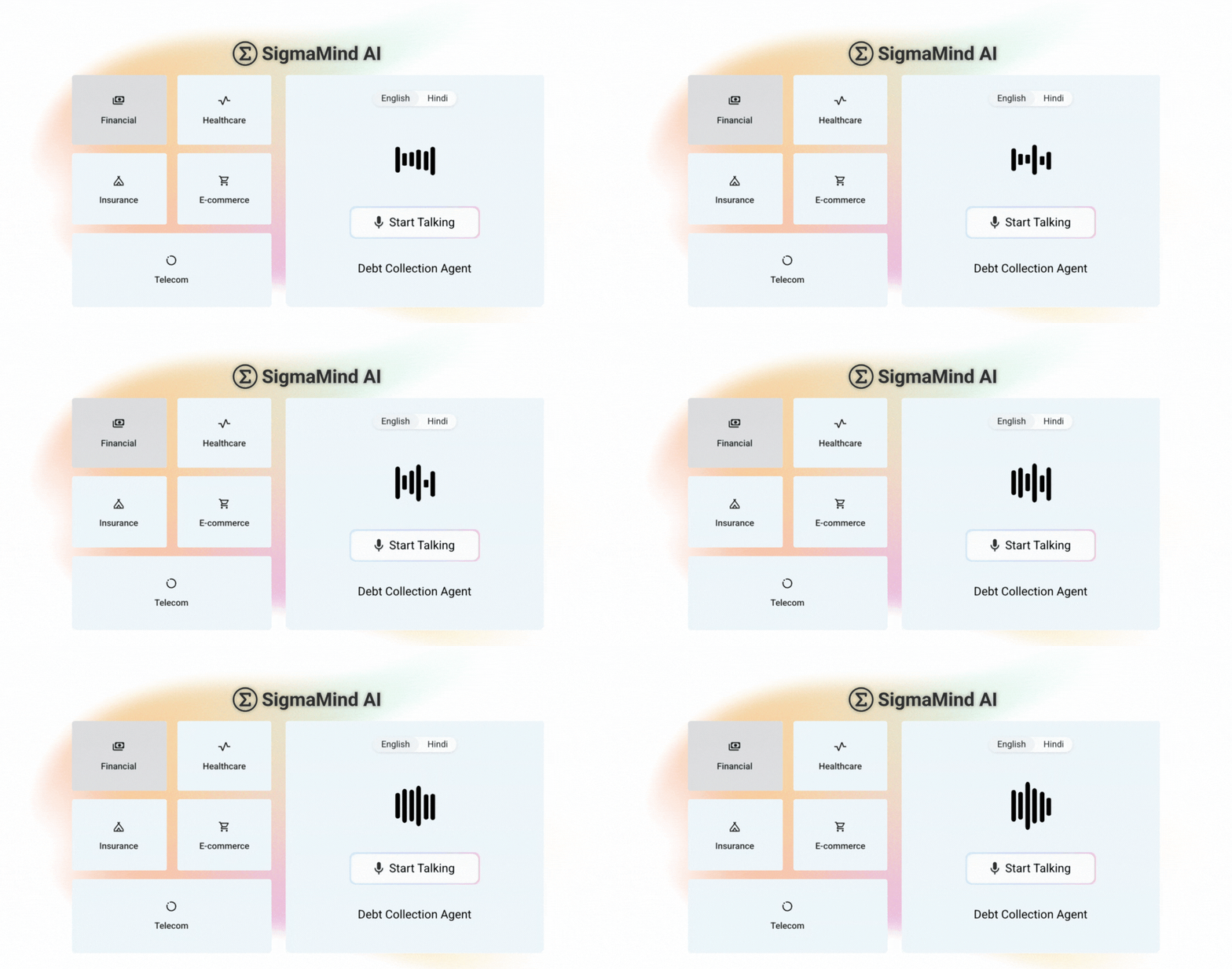
- Debt collection agent workflows: Automate collection calls with conversational reasoning and the ability to take actions through connected systems.
- Insurance support and advisory: Provide health or auto insurance guidance via voice, with channel coverage that can extend to chat/email threads.
- Customer support for telecom services: Handle service inquiries and support calls while using tool calling to interact with relevant back-office systems.
- Food delivery customer support: Assist customers with delivery-related questions and operational steps using agent-run actions.
- Operational reminders and onboarding: Run reminder and onboarding conversations that can resolve tasks autonomously and update connected systems.
FAQ
Can SigmaMind AI be used via APIs? Yes. SigmaMind provides API access, webhook triggers, and tool calling so agents can fetch data, trigger workflows, update systems, and execute actions in real time.
How does call transfer work with context for a human agent? SigmaMind supports Warm Transfer, where the receiving agent hears an AI-generated summary of the conversation before the call is connected. It can also send Custom Headers during warm or cold transfers so structured data (e.g., customer details, captured variables, intent) appears in the receiving system.
Does SigmaMind AI support phone number provisioning? Yes. You can provision phone numbers directly inside the platform and assign them to agents, without external telephony setup.
How is pricing structured? The site describes flexible pay-as-you-go pricing with a free option for test and live usage, and custom billing for agencies, BPOs, and high-scale clients. Exact pricing details are not included in the provided content.
What analytics does the platform provide? You can monitor real-time call and AI metrics from your dashboard, including total spend, cost per call/chat, cost breakdowns by layers, and call transfer/termination causes and durations.
Alternatives
- Custom voice agent stacks (telephony + LLM + orchestration framework): Build your own pipeline using a telephony provider plus speech-to-text, language model logic, and text-to-speech. This can be flexible but typically requires more engineering effort for orchestration, observability, and production hardening.
- Contact center AI platforms: Use an enterprise contact-center solution that focuses on agent assistance or automation across phone and digital channels. These alternatives may trade customization and developer control for faster integration in specific contact-center workflows.
- RPA/task automation for customer operations: For organizations that mainly need system updates and workflow execution, robotic process automation or workflow automation tools can handle actions. Compared with SigmaMind AI, they may offer less natural conversational voice handling.
- Multimodal customer support chat/email platforms: If your primary channel is digital rather than voice, a support platform with AI routing and chat capabilities can reduce voice-specific complexity, though it may not provide the same low-latency voice and telephony infrastructure capabilities.
Alternatives

AakarDev AI
AakarDev AI is a powerful platform that simplifies the development of AI applications with seamless vector database integration, enabling rapid deployment and scalability.

Arduino VENTUNO Q
Arduino VENTUNO Q is an edge AI computer for robotics, combining AI inference hardware and a microcontroller for deterministic control. Arduino App Lab-ready.

Devin
Devin is an AI coding agent that helps software teams complete code migrations and large refactoring by running subtasks in parallel.

open-codex-computer-use
open-codex-computer-use is an open-source “Computer Use” MCP server that lets AI agents run desktop GUI actions on macOS, Linux, and Windows.

Codex Plugins
Use Codex Plugins to bundle skills, app integrations, and MCP servers into reusable workflows—extending Codex access to tools like Gmail, Drive, and Slack.

PXZ AI
An All-In-One AI Platform that combines tools for image, video, voice, writing, and chat to enhance creativity and collaboration.