
BaZi Charts and Periodic Fortunes
Generates the basic structure of a personal chart from the year, month, day, and time of birth, serving as the basis for daily, weekly, monthly, and annual fortunes, as well as specialized analyses.

潮汐之眼 is an online toolkit combining Eastern traditional arts with AI-assisted insights, featuring BaZi, I Ching, Qimen Dunjia, compatibility charts, and daily fortunes.
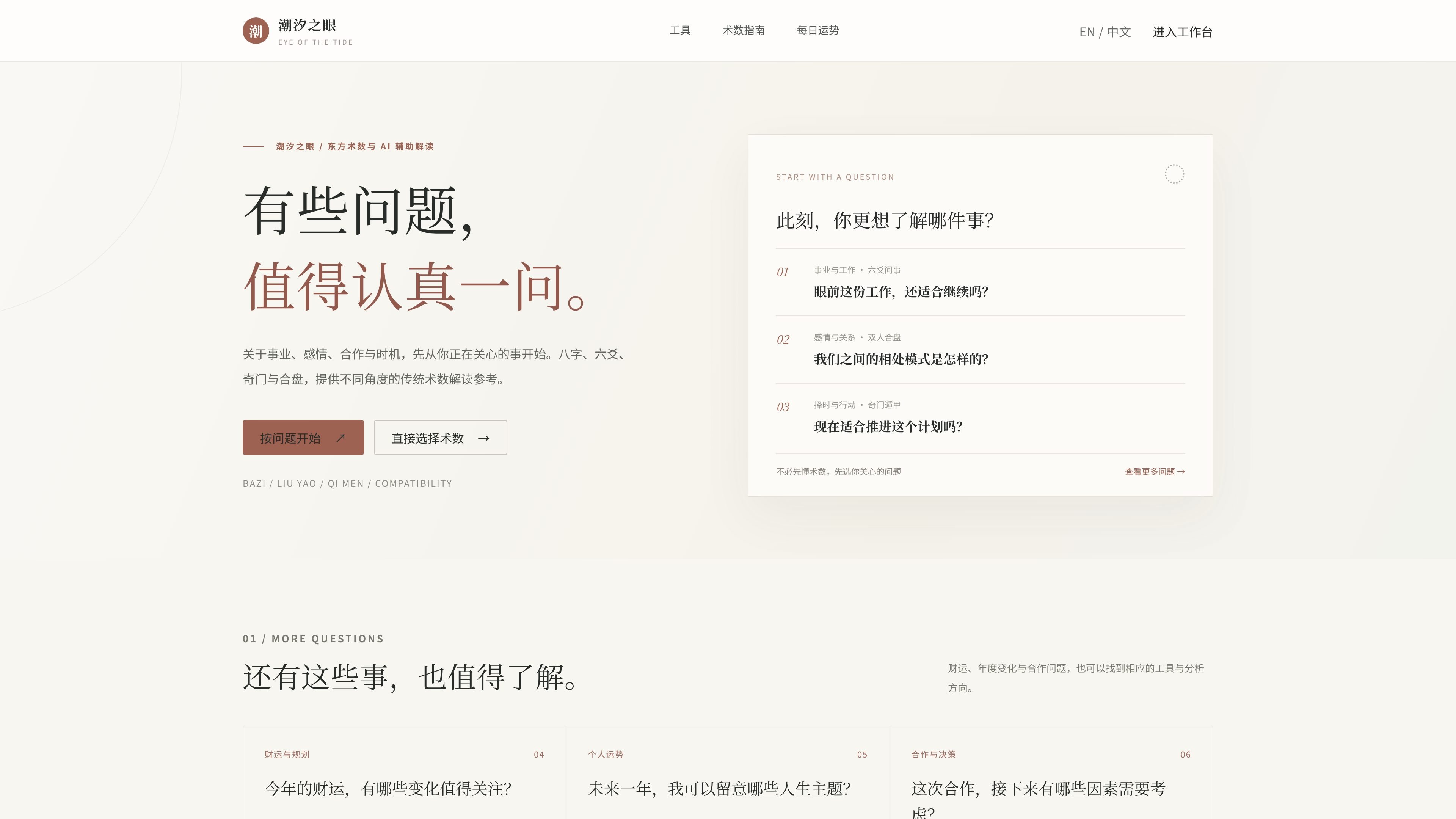
潮汐之眼 is an online toolkit combining Eastern traditional arts with AI-assisted interpretation, covering BaZi, Liu Yao, Qimen Dunjia, two-person compatibility charts, daily fortunes, and other modules. Users can start with a specific question or directly choose a traditional arts and charting tool.
The platform positions its different features at different analytical levels: BaZi focuses on personal charts and period trends, Liu Yao on the current direction of a specific event, Qimen on circumstances and the pace of action, and compatibility charts on the interaction structure between two people. Results are primarily intended to help users understand trends, structures, relationships, and key variables; the website clearly notes that they do not replace professional or real-world decisions.
Generates the basic structure of a personal chart from the year, month, day, and time of birth, serving as the basis for daily, weekly, monthly, and annual fortunes, as well as specialized analyses.
Provides more focused trends, areas of attention, and risk directions around themes such as finances, career, relationships, and health, based on the personal chart.
Uses a coin-toss divination process to generate a hexagram for a specific matter, combined with traditional rules for arranging the hexagram, the Six Relationships, the self and response lines, and AI-assisted interpretation.
Uses a Nine Palaces chart to examine circumstances, routes, timing, and the pace of action, making it suitable as directional reference for specific plans or decisions.
Compares both people’s birth information to analyze interaction structures, points of compatibility, areas requiring adjustment, and differences in pace within the relationship.
Offers lightweight everyday reference through Five Elements clothing guidance, Chinese zodiac fortunes, and horoscope fortunes, for viewing general trends and reminders for the day.
Enter birth information to view a personal chart, then explore themes and timing across daily, weekly, monthly, or annual periods.
For a single question—such as whether to continue with a job, how a relationship may develop, or matters involving an investment or contract—provide the background and use Liu Yao to consider the event’s direction and key variables.
Before advancing a plan or arranging an action, use Qimen Dunjia to organize your thinking around circumstances, routes, timing, and the pace of action.
Provide both people’s birth information to view interaction patterns, points of compatibility, and possible areas for adjustment, rather than receiving only a single compatibility conclusion.
When you only want a quick reminder for the day, view Five Elements clothing guidance, Chinese zodiac fortunes, or daily horoscopes as lightweight reference at a general level.
The BaZi chart feature uses the year, month, day, and time of birth to generate a basic personal chart; the more complete the birth information, the more detailed subsequent analysis is generally. Liu Yao and Qimen focus on a specific question, forming a hexagram or chart based on the time the question is asked.
Liu Yao is suited to questions about one specific matter, such as work, relationships, finances, or travel. Enter your question, optionally add areas of focus and background, and then generate an interpretation by tossing virtual coins six times; the page recommends casting only once for the same question.
The Liu Yao page provides a hexagram display and a brief auspiciousness assessment; the detailed version includes the Six Spirits and their relation to the self, the strength of the relevant deity, changing-line relationships, and timing inferences. The page also indicates that the report includes three in-depth follow-up questions.
The platform distinguishes between fixed-rule calculations, chart or hexagram structures, and AI-assisted integrated interpretations. The traditional arts features are better suited for considering trends, timing, structure, relationships, and key variables, and should not be treated as precise event predictions or substitutes for real-world decisions.
Different features address different levels: the free daily fortune focuses on general influences, personal BaZi fortunes focus on individual conditions, Liu Yao and Qimen focus on specific events, and compatibility charts focus on interaction structures. Therefore, different results for the same day are not necessarily contradictory.

Nyan Parlor is an AI tarot and divination service with readings for love, work, and decisions, plus I Ching and BaZi tools. Start free without signing up.

roastme.gg is a pay-to-play AI roasting site where users submit their own X handle or website, choose how much to pay, and get a public roast ranked on a leaderboard by amount paid.

Loniva is a calm daily puzzle app for memory, attention, language, speed, logic, and focus on iPhone, iPad, and Android, with a free 7-day trial.

Postaway is a web-based postcard service for free vintage-style digital postcards you can create and share by link, plus a separate waitlist for physical mail from Thailand.

Our Silly Games lets you play free browser games without installing software, discover games made by anyone, and access hosting with multiplayer and leaderboards.

MacYaps is a macOS menu bar app that plays funny audio clips for system events, with built-in voice packs, custom uploads, and a one-time lifetime license.