

Needle
Needle is a conversation intelligence platform to search 13 communities—discover customers, track competitors, monitor keywords, and spot emerging problems.
What is Needle?
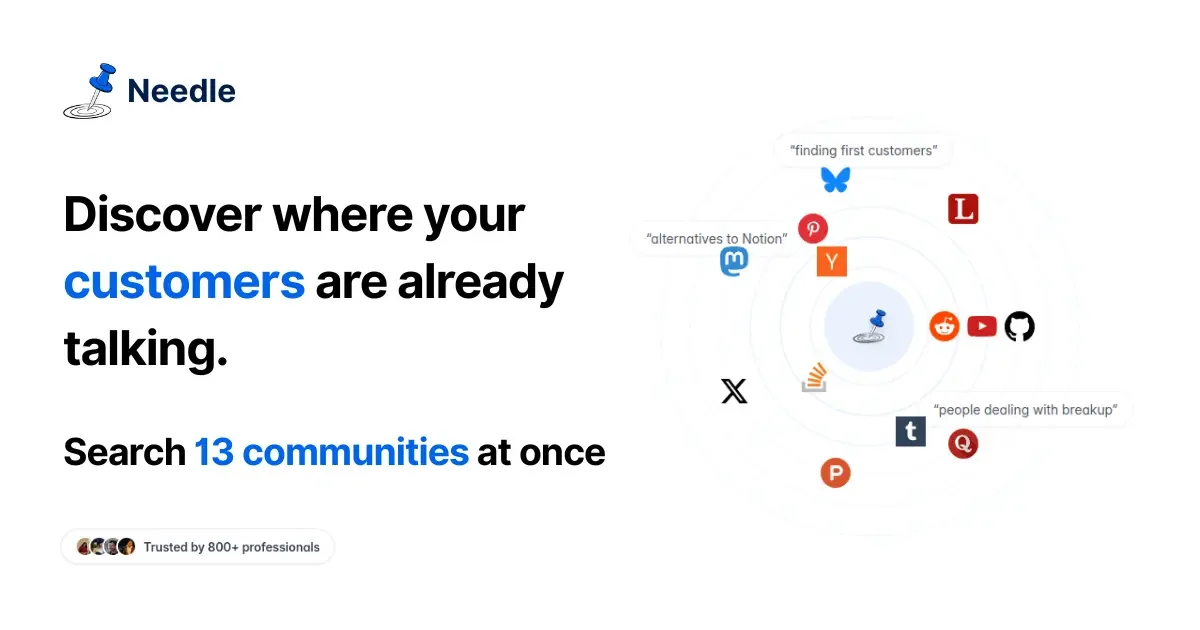
Needle is a conversation intelligence platform designed for customer discovery and early market validation. It helps you search discussions across multiple communities to discover customers, track competitors, monitor keywords, and identify emerging problems—using real conversation signals.
Rather than relying on surveys alone, Needle aggregates and organizes content from community platforms (including Reddit, Hacker News, GitHub, Twitter/X, and Bluesky) so you can spot who is asking for alternatives, what topics are trending, and where unmet needs are showing up.
Key Features
- Search across 13 communities in one place to centralize discovery work across multiple sources where people already discuss tools, problems, and alternatives.
- API-powered collection from supported platforms so results reflect ongoing public discussions from each connected community.
- Filtering and ranking by relevance and intent to surface the most relevant posts for your query rather than showing only raw search results.
- Keyword monitoring to track what’s being discussed over time and surface changes in customer concerns and interests.
- Competitor and alternatives discovery by running targeted searches (e.g., “alternatives to [product]”) to find people comparing tools and expressing preferences.
How to Use Needle
- Start with a query such as a problem area (“project management for engineers”) or a competitive angle (“alternatives to Notion”).
- Review the ranked results to see which conversations match your intent (e.g., evaluating alternatives, asking for recommendations, or describing pain points).
- Use keyword or competitor-focused searches to build a repeatable workflow for discovery and ongoing monitoring.
- Use Needle’s directory to browse verified startups and tools, or submit your product (sign-in required).
Use Cases
- Find customers looking for alternatives: Search for “alternatives to [competitor]” to find people discussing comparisons and seeking switching options.
- Validate a startup idea with real demand: Use keyword searches around a proposed product category to identify recurring problems and interest levels in community discussions.
- Spot emerging problems early: Monitor specific terms and themes to see which issues are gaining attention across multiple communities.
- Track competitor mentions and reactions: Run recurring searches tied to competitors to understand how people talk about them and what gaps customers are pointing out.
- Get a recurring “market pulse” using structured searches: Use saved/repeated queries (e.g., weekly) to summarize what’s changing based on conversation data.
FAQ
-
What communities does Needle search? Needle searches 13 communities and specifically mentions Reddit, Hacker News, GitHub, Twitter (X), Bluesky, and more.
-
How does Needle decide which results to show? Needle searches platforms via their APIs and then filters and ranks results by relevance and intent.
-
Is Needle meant for customer discovery or market research? Both: Needle is positioned as a conversation intelligence platform for market research powered by real conversations, including customer discovery and competitor tracking.
-
Can I submit my product to Needle’s directory? Yes. The site indicates you can submit your product to the directory with sign-in required.
-
Does Needle provide examples of how to search? Yes. The site includes an example query: searching for “alternatives to Notion.”
Alternatives
- General web search plus manual community review: Useful when you want flexibility, but it typically requires more time to sift through posts and interpret intent.
- Social listening or keyword monitoring tools: Better suited if your main focus is tracking keyword frequency and trend-like signals, whereas Needle emphasizes ranked, intent-oriented results across multiple communities.
- Market research platforms that use surveys or aggregated datasets: Often broader in scope for quant data, but may not capture the same “real conversation” context as community discussions.
- Niche community searchers / developer-focused discovery tools: Can be effective for single-platform discovery, but they generally don’t consolidate multiple communities in one workflow.
Alternatives

Shengsuanyun
Shengsuanyun offers cloud-based solutions for efficient data management and analytics.

Ranpo AI
Ranpo AI offers automated risk assessment for rental listings, helping property managers and landlords identify potential issues before they arise. It streamlines the screening process by analyzing various data points to ensure tenant suitability and property safety.

SaveMRR
SaveMRR scans Stripe billing data to find SaaS MRR leaks and help recover failed payments, save cancellations, and win back churn—60-sec Free Revenue Scan.

Sleek Analytics
Lightweight, privacy-friendly analytics with real-time visitor tracking—see where visitors come from, what they view, and how long they stay.

Struere
Struere is an AI-native operational system that replaces spreadsheet workflows with structured software—dashboards, alerts, and automations.

ClayHog
ClayHog tracks AI Search Visibility & GEO—see what ChatGPT, Gemini, Perplexity, Claude, and Google AI Overviews say about your brand, incl. citations and sentiment.