
Simulated conversational environments
Creates multi-party conversations with AI avatars so learners can practice skills in scenarios that resemble real interpersonal situations rather than fixed test questions.

Vantage is a Google Research experiment on Google Labs that uses generative AI to assess future-ready skills through simulated conversations. It is aimed at high school and college students and returns a skill map with qualitative feedback.
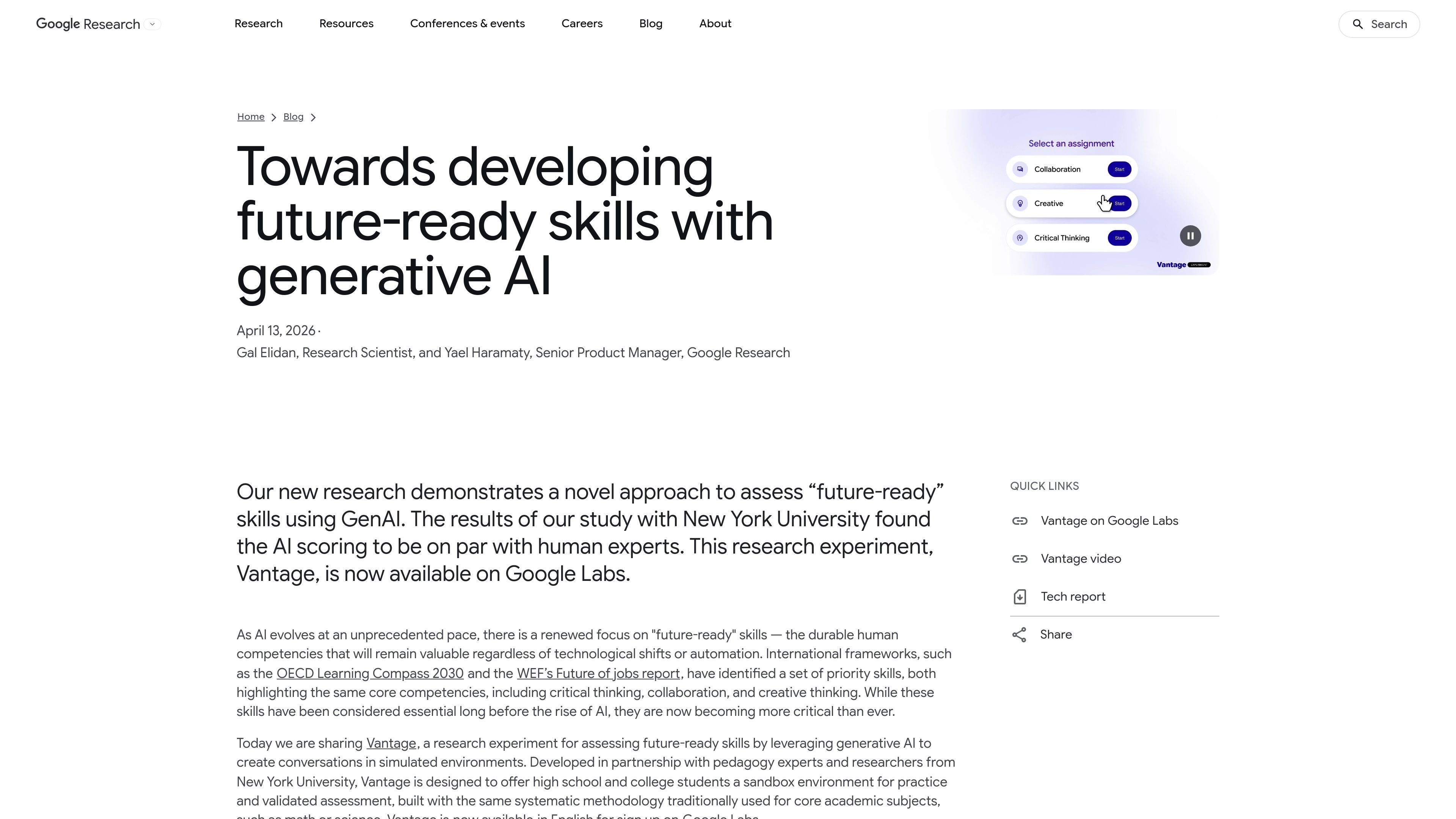
Vantage is a Google Research experiment on Google Labs for assessing future-ready skills with generative AI. It uses simulated conversations with AI avatars to create a controlled but more authentic environment for practice and evaluation.
The product is aimed at high school and college students and is described as a sandbox for practice plus validated assessment. According to the announcement, the approach is designed to make skills such as critical thinking, collaboration, and creative thinking more measurable through conversation-based tasks and rubric-driven scoring.
Creates multi-party conversations with AI avatars so learners can practice skills in scenarios that resemble real interpersonal situations rather than fixed test questions.
Uses an Executive LLM to steer the discussion toward specific assessment goals and introduce challenges such as disagreement or pushback.
Applies a shared assessment rubric during and after the conversation to gather evidence of skill use and score the learner consistently.
Produces a visual skill map and qualitative feedback after the task, making the assessed skills and sub-skills easier to review.
Supports open-ended tasks such as preparing for a debate or pitching a creative vision, giving educators a way to assess skills in context.
Was developed with pedagogy experts and researchers at New York University to validate the assessment approach.
A teacher or program lead can use Vantage to practice and assess collaboration skills in a structured conversation instead of relying only on static tests.
Students can rehearse debate preparation, creative pitching, or similar discussion-heavy tasks in a guided environment before doing them in class or in a group.
Researchers and education teams can study how adaptive AI conversation can surface evidence of skills like conflict resolution and project management.
Educators can review the post-task skill map and written feedback to identify which sub-skills need more attention in later instruction.
Vantage is available in English for sign up on Google Labs. The announcement frames it as a research experiment rather than a generally released product, so access may be limited to the Labs experience.
The source describes Vantage as a sandbox for high school and college students, built to practice and assess future-ready skills such as collaboration and conflict resolution in simulated conversations.
Users interact with AI avatars in open-ended scenarios. An Executive LLM steers the conversation with dynamic challenges, and an AI Evaluator scores the conversation against the same rubric to produce a skill map and feedback.
The announcement highlights collaboration skills in the study, including conflict resolution and project management. It does not present a full public list of supported skills beyond the example skill map shown in the post.
The post does not provide pricing details. It only states that Vantage is available for sign up on Google Labs, with no plan or fee information in the source.

BeFreed is a personalized audio learning app that turns books and other knowledge sources into narrated listening experiences. It helps people learn on demand through interactive audio, voice selection, and built-in learning tools.

GameGrad turns PDF study material into quiz questions that appear inside arcade games, so users can practice active recall while they play. It offers a free tier with one PDF and a Pro plan with more uploads, more questions, and answer explanations.

LangPanda is a browser extension for learning languages from streaming video and other supported sites. It combines instant subtitle lookup, flashcard creation, vocabulary tracking, and spaced-repetition review for 36 languages.

AakarDev AI helps teams manage AI provider access, project-level setups, logs, and analytics from one dashboard. It supports BYOK workflows and lists providers including OpenAI, Google Gemini, Anthropic, Groq, Mistral AI, and Perplexity AI.

BookAI allows you to chat with your books using AI by simply providing the title and author.

Skills Janitor is a GitHub-hosted set of slash commands for auditing, tracking, and managing Claude Code and OpenAI Codex skills. It helps users find duplicates, broken links, and unused skills, then clean them up with self-contained commands.