

Waydev
Waydev is an AI engineering intelligence platform that measures AI agent adoption, tracks code-to-production impact, and quantifies AI ROI, incl. token spend.
What is Waydev?
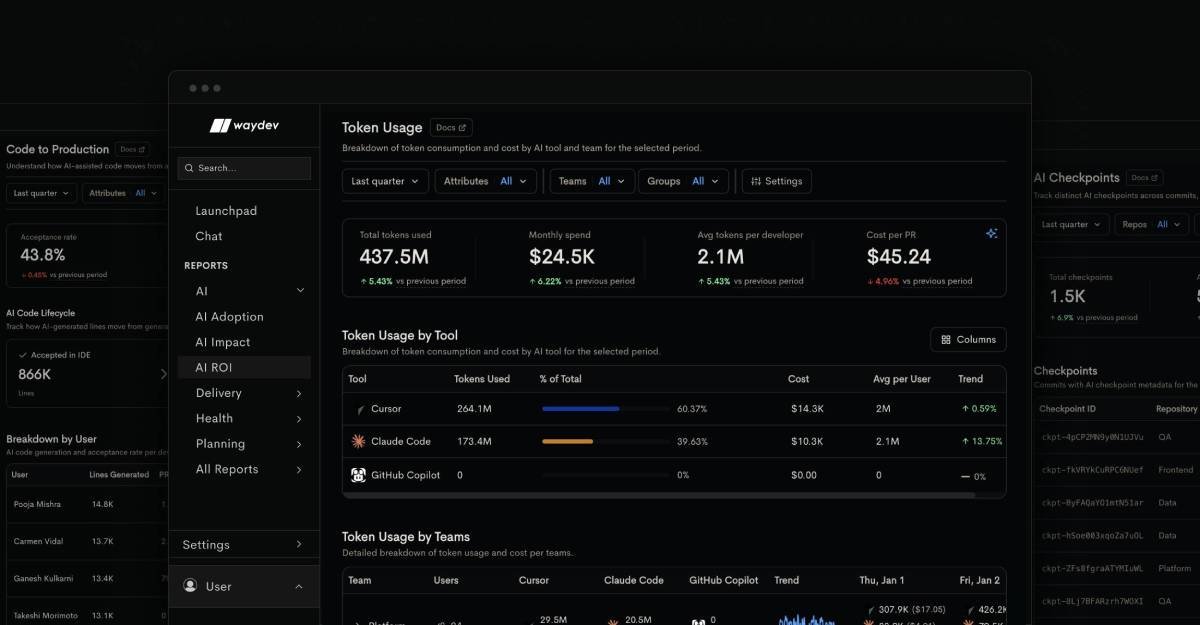
Waydev is an AI engineering intelligence platform for measuring and improving AI agent adoption and the engineering impact that follows. Its core purpose is to help engineering and product stakeholders observe AI usage across teams, track outcomes from code changes through production, and quantify AI ROI in operational terms (including token spend, as described on the site).
The platform is organized around modules for AI Adoption, AI Impact, and AI ROI, with supporting operational intelligence for delivery, health, planning, and developer experience. Waydev also frames its analytics alongside established delivery measurement approaches (including DORA metrics and SPACE-style concepts mentioned on the site) and positions itself as a unified view sourced from teams’ existing engineering tooling.
Key Features
- AI Adoption measurement for agent usage across teams, aimed at understanding whether AI agents are being adopted in practice.
- AI Impact tracking that follows changes “from code to production,” connecting engineering activity to downstream outcomes.
- AI ROI quantification that includes cost and benefit measurement down to token spend (as stated on the site) to support decision-making.
- Engineering Intelligence modules for Delivery, Health, and Planning, including DORA Metrics and DX (Developer Experience) insights.
- Analytics for code and delivery workflows, including Pull Request Insights, Merge Quality, Sprints/Commitment Velocity, Contributor Insights, Benchmark Hygiene, and Project Costs.
- Executive reporting and custom reporting tools, including Executives dashboards, Custom Dashboards, and Custom Metrics for specific questions and monitoring.
- Developer Experience (DX) surveys via Slack (and Teams is listed as “soon”), designed to capture team mood, frustrations, and potential blockers.
- Integrations with the engineering tool stack to create a “single source of truth,” specifically referencing Git platforms, ticketing systems, CI/CD tools, and calendars.
How to Use Waydev
- Request a demo or a POC (proof of concept) through Waydev’s site.
- Share the engineering tool stack connections to enable the platform to ingest data from your Git platforms, ticketing systems, CI/CD tools, and calendars.
- Use the relevant modules—such as AI Adoption, AI Impact, and AI ROI—to view how AI agents are being adopted and how they relate to delivery outcomes.
- Review role-based dashboards (Executive reports for leadership, team insights for engineering managers, contributor insights for individuals) and use Custom Dashboards/Custom Reports to build views aligned to your questions.
Use Cases
- Engineering leaders assessing whether AI agents are being adopted broadly enough to matter: use AI Adoption to observe and measure agent usage across teams.
- Teams investigating whether AI work is improving delivery outcomes: use AI Impact to connect code changes to production outcomes, while also referencing delivery/health signals.
- Organizations quantifying AI program ROI for decision-making: use AI ROI to measure benefits relative to costs, including token spend as described.
- Engineering management planning and resource evaluation: use Planning and Resource Planning to examine how scope changes and bug fixes relate to delivery velocity and cycle time.
- Improving developer workflows and quality: use Pull Request Insights and Merge Quality to identify patterns in review and integration behavior, plus Developer Experience (DX) surveys to understand blocker themes.
FAQ
-
What does Waydev measure? It measures AI agent adoption, tracks AI impact from code to production, and quantifies AI ROI including token spend, alongside engineering metrics such as DORA metrics and developer experience insights.
-
How does Waydev get data? The site states Waydev integrates with Git platforms, ticketing systems, CI/CD tools, and calendars to create a single source of truth.
-
Who is Waydev for? The site describes role-based dashboards for executives (C-level), engineering managers, product leaders, and contributors.
-
How are developer experience insights collected? Waydev’s DX module sends surveys to the team via Slack, and Teams support is listed as “soon.” The surveys are intended to capture mood, frustrations, and potential blockers.
-
Is a demo or proof of concept required to start? The site prompts users to request a demo or a POC; no self-serve setup steps are described in the provided content.
Alternatives
- Engineering metrics and analytics platforms (general APM/DevOps analytics): These can track delivery performance and operational metrics, but may not focus specifically on AI agent adoption, AI impact from code to production, and token-level ROI.
- DORA/SPACE-based delivery dashboards: Tools centered on DORA metrics and related frameworks can help with throughput, reliability, and planning, but may lack the explicit AI Adoption/Impact/ROI modules described for Waydev.
- Developer survey and feedback tools (DX-focused): These support collecting team feedback (e.g., via Slack/Teams), but typically won’t connect results to AI agent usage and production outcomes through engineering data.
- Internal data warehouse + BI reporting: Teams can build custom analytics by ingesting Git/ticket/CI/CD data into a warehouse, but they would need to define and maintain the adoption/impact/ROI logic and reporting layers manually.
Alternatives

skills-janitor
Audit, track usage, and compare your Claude Code skills with skills-janitor—nine focused slash commands and zero dependencies.

Rectify
Rectify is an all-in-one operations platform for SaaS, combining monitoring, analytics, support, roadmaps, changelogs, and agent management—via conversation.

SaveMRR
SaveMRR scans Stripe billing data to find SaaS MRR leaks and help recover failed payments, save cancellations, and win back churn—60-sec Free Revenue Scan.

Sleek Analytics
Lightweight, privacy-friendly analytics with real-time visitor tracking—see where visitors come from, what they view, and how long they stay.

Struere
Struere is an AI-native operational system that replaces spreadsheet workflows with structured software—dashboards, alerts, and automations.

Falconer
Falconer is a self-updating knowledge platform for high-speed teams to write, share, and find reliable internal documentation and code context in one place.