
Task-first evaluator setup
Define success criteria, business rules, and documentation instead of starting with a labeled dataset. The platform uses those inputs to build the first evaluator draft.

Argmin AI helps teams turn their rules, docs, and examples into an AI evaluation they can run before release. It is positioned for product and engineering teams that need quality checks without building custom evaluation code or hiring an ML team.
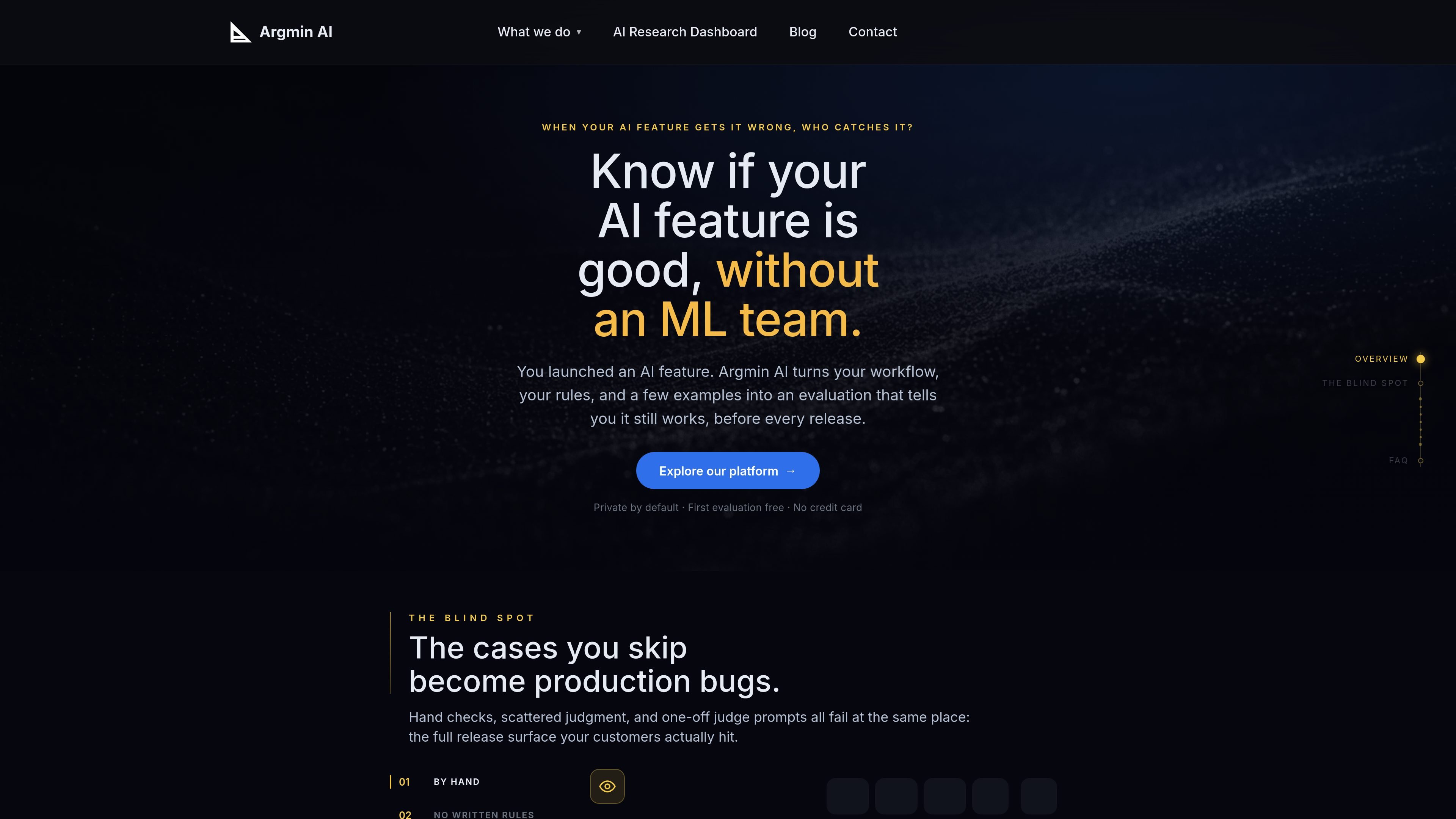
Argmin AI is an AI evaluation product for teams that need to check whether an AI feature still works before they ship changes. Its homepage positions the platform around quality evaluation without requiring an ML team or custom evaluation code.
The workflow starts from your task, rules, documents, and a few examples. Argmin AI turns those inputs into an evaluator, helps surface the cases that matter, and calibrates the checks against expert judgments so the same standard can be reused across releases.
Define success criteria, business rules, and documentation instead of starting with a labeled dataset. The platform uses those inputs to build the first evaluator draft.
Argmin AI identifies gaps, edge cases, and risky answers in your real cases so review time goes to the examples that affect agreement most.
Each check becomes a clear rule with a scale and examples for each level, including both generic quality checks and business-specific rules.
The system compares evaluator results with expert answers, highlights disagreements, and tightens the rule based on accepted or rejected corrections.
The calibrated evaluator can run before prompt, model, retrieval, or tool-call changes so regressions are caught before release.
Scores come with criterion-level explanations, and the rubric, cases, and corrections are versioned for reuse across future changes.
Use the platform to check support replies against refund, returns, escalation, or compliance rules before customers see the answer.
Apply it to health, safety, or crisis-related outputs where one bad answer can cause harm and needs review before release.
Use it to verify that a bot or assistant stays inside policy when policies live in docs, drive folders, or internal knowledge bases.
Run the calibrated evaluator before shipping prompt, model, retrieval, or tool changes so regressions are caught in evaluation rather than in production.
Use the same rubric repeatedly for large batches of cases when a human review queue would be too slow or inconsistent.
Argmin AI is positioned for teams that want to evaluate AI workflows before release using their own rules, docs, and examples. The source does not list a minimum team size, but it explicitly says no ML team is required.
The homepage says you start from the task, success criteria, and docs. Argmin AI then syncs your knowledge base, finds relevant cases, and helps calibrate an evaluator that can run before each prompt, model, retrieval, or tool-call change.
The product produces criterion-level scores and reasons for each decision, along with a readiness score and rule-level breakdowns in the examples shown on the homepage.
The source says the calibrated evaluator can be released as an endpoint your code calls before prompt, model, retrieval, or tool-call changes. It also says the rules, cases, and corrections are versioned and reused.
The source does not provide full pricing details. It does state that the first evaluation is free and no credit card is required on the homepage, while the pricing page currently returns a 404.

ByteAsk is a terminal-first AI coding agent for C and C++ that edits repositories and verifies changes with the real compiler, debugger, sanitizers, and tests before showing a diff. It offers a free tier plus paid plans, with editor connectors and zero-retention handling described in the source.

Manta AI is an autonomous web app testing tool for teams that want to map application behavior, catch regressions, and generate tests without writing scripts or maintaining selectors. It works from a URL and supports plain-English test flows, run results with screenshots, and scheduled or deployment-triggered checks.

AakarDev AI helps teams manage AI provider access, project-level setups, logs, and analytics from one dashboard. It supports BYOK workflows and lists providers including OpenAI, Google Gemini, Anthropic, Groq, Mistral AI, and Perplexity AI.

CreateOS Sandbox is an isolated compute environment for running code and agent workloads inside Firecracker micro-VMs. It is designed for workflows that need machine-level isolation, private networking between sandboxes, and programmatic control through SDK, CLI, or MCP.

hob is an independent workspace for coding agents that keeps agent sessions, terminals, history, and follow-up work organized around the tools and providers you already use. It is aimed at developers who want local control over routing, history, and workspace structure rather than a bundled model stack.

Ably Chat is a chat API platform for building custom realtime chat applications. It supports room-based messaging, typing indicators, presence, reactions, and message updates, with usage-based pricing options for different deployment stages.