
Native multimodal support
Described as the first natively multimodal model in the GLM-5 series, it can work across text and visual context rather than treating images as an add-on.

GLM-5.3-Flash is Z.ai’s native multimodal model for coding, agentic workflows, and visually grounded tasks. It is offered through the Z.ai API platform and coding plan, with the release emphasizing lower inference cost and stronger benchmark performance than GLM-5.2.
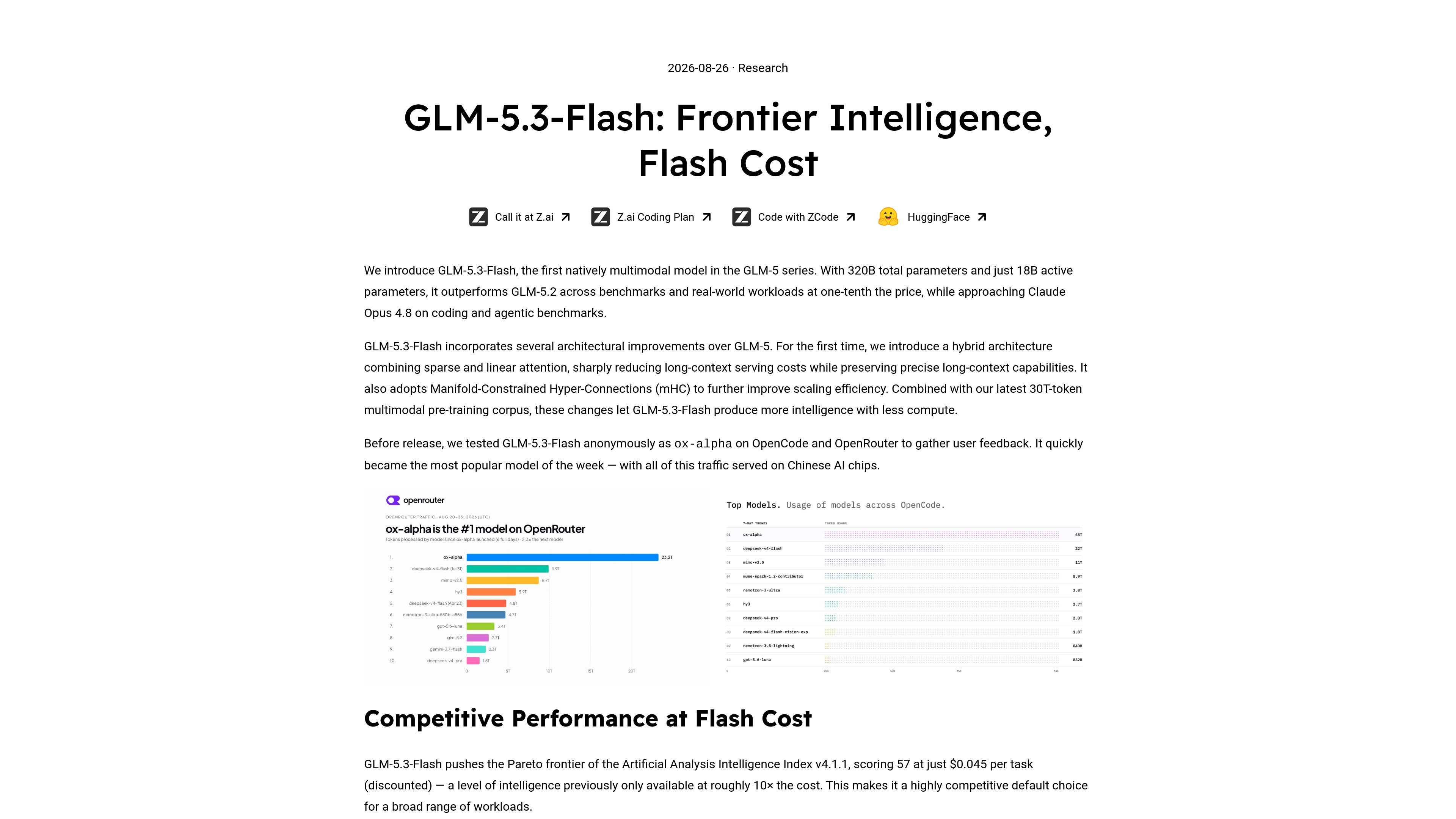
GLM-5.3-Flash is a native multimodal model in the GLM-5 series from Z.ai. The public release positions it as a cost-efficient model for coding, agentic workflows, and visually grounded tasks, with the launch post emphasizing stronger benchmark performance than GLM-5.2 at a much lower cost per task.
The product pages also frame it as part of Z.ai’s broader platform for API use, chat, and coding tools. In practice, that means it can be used through model APIs and the GLM Coding Plan for developer workflows, including tools that support coding assistance and agentic task execution.
The launch content focuses on two main ideas: better performance on coding and agentic benchmarks, and lower inference cost through a sparse-plus-linear attention design. It also emphasizes visual intelligence, where the model can work with interfaces, rendered output, documents, and other non-text artifacts in addition to standard language prompts.
Described as the first natively multimodal model in the GLM-5 series, it can work across text and visual context rather than treating images as an add-on.
The model uses 320B total parameters with 18B active parameters, which the source links to lower inference cost while retaining stronger benchmark performance than GLM-5.2.
A hybrid architecture combines sparse and linear attention to reduce long-context serving cost while preserving long-context capability.
The system introduces IndexPool to compress four indexer key vectors into one, reducing latency and memory overhead at 1M-token context length.
The release highlights coding and agentic benchmark gains over GLM-5.2, including stronger results on DeepSWE v1.1, AutomationBench, and Z.ai Code Bench v1.0.
The model is built to inspect rendered output, use visual feedback, and improve frontend or GUI work through self-verification and iterative refinement.
Use it for code generation, refactoring, and multi-step development tasks where the source positions it as stronger than GLM-5.2 on coding benchmarks and close to Claude Opus 4.8 on some evaluations.
Apply it to workflows that involve tool use, planning, and iterative execution, such as agent-driven tasks and automation benchmarks referenced in the release notes.
Use its visual intelligence for frontend development, GUI review, game development, and other tasks where rendered output or interaction matters, not just source code.
Use it for knowledge work involving documents, spreadsheets, presentations, dashboards, and other mixed-format artifacts that require joint reasoning over text and structure.
Deploy it through the coding plan or API when you need access inside supported IDEs and agent tools rather than a standalone chat-only workflow.
GLM-5.3-Flash is the first natively multimodal model in the GLM-5 series. The source describes it as available for API calls and included in the GLM Coding Plan.
The source positions it as a model for coding, agentic tasks, and visual intelligence workflows. It is also presented as useful for broader professional work that involves documents, spreadsheets, presentations, dashboards, and interfaces.
The public pages reference Z.ai’s API platform, chat experience, model API pages, and the GLM Coding Plan. The coding plan mentions use in tools such as Claude Code, Codex, ZCode, Kilo Code, Cline, OpenCode, and Clawdbot/OpenClaw.
The plan page shows subscription options starting from $18/month for the Lite plan, with higher-priced Pro, Max, Standard Seat, and Premium Seat options. The pricing page also states that usage bundles are available for API token purchases, but the source page itself is a 404 and does not provide a full pricing table.
The source notes that GLM-5.3-Flash was tested anonymously as OX Alpha before release and is now fully available and open for API calls and the Coding Plan.

ByteAsk is a terminal-first AI coding agent for C and C++ that edits repositories and verifies changes with the real compiler, debugger, sanitizers, and tests before showing a diff. It offers a free tier plus paid plans, with editor connectors and zero-retention handling described in the source.

Ghost — терминальный AI-ассистент для чата, генерации кода и запуска задач в командной строке. Бесплатные модели, Linux, macOS, Windows, open source.

Vi3ecode is a maintained development environment for working with AI coding agents. It keeps project context, terminal, Git, memory, flows, review, and communication connected around the agent you already use.

Lucid Train is a local-first AI coding harness that turns repository code into architecture diagrams and uses those diagrams as specifications for coding agents. It is available as a desktop app and a lightweight Rust CLI, and it can run with local models or your own API keys.

MeetStream is a meeting bot API for Zoom, Google Meet, Microsoft Teams, and Webex. It helps developers record, stream, and analyze meetings programmatically, with usage-based pricing and a $5 free credit to start.

CreateOS Sandbox is an isolated compute environment for running code and agent workloads inside Firecracker micro-VMs. It is designed for workflows that need machine-level isolation, private networking between sandboxes, and programmatic control through SDK, CLI, or MCP.