

Tusk AI Testing Platform
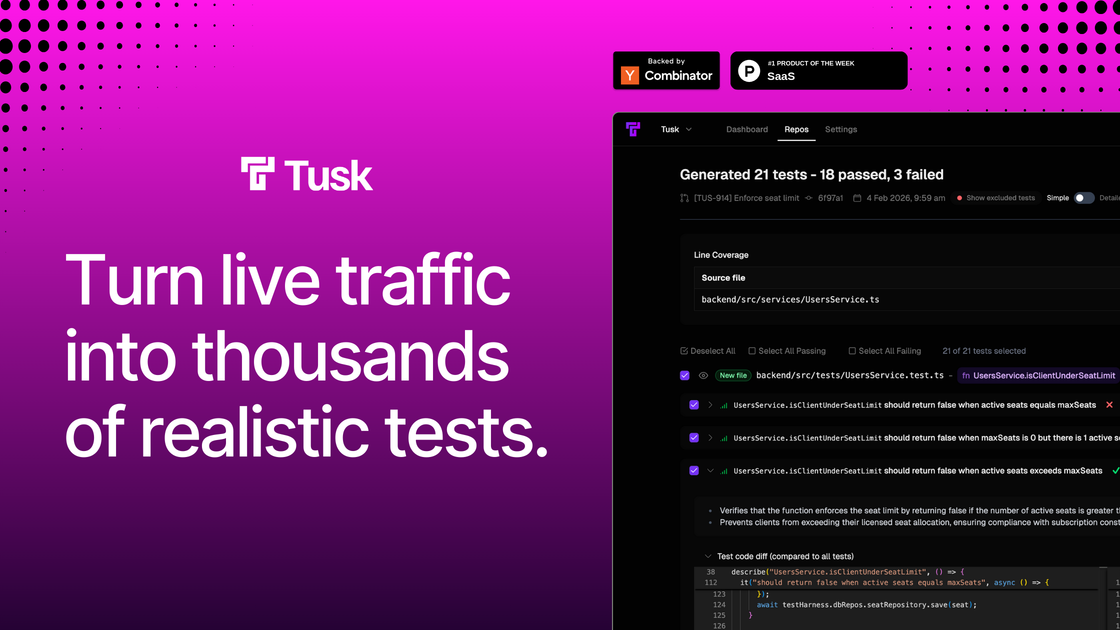
Tusk is an AI-powered testing platform that transforms production traffic into verified unit and API tests, preventing regressions and significantly boosting code coverage within the CI/CD pipeline.
What is Tusk AI Testing Platform?
Tusk is a cutting-edge, AI-enabled testing platform designed to revolutionize how engineering teams approach quality assurance. It specializes in generating high-quality, executable test cases for Unit, API, and Integration testing by analyzing your existing codebase and understanding business context. Unlike traditional testing tools that require extensive manual effort or rely solely on basic code analysis, Tusk leverages AI to uncover edge cases and functional bugs that human developers or standard coding agents often miss. The primary goal of Tusk is to enable engineering teams to ship software faster and with greater confidence by shifting quality checks left into the Pull Request (PR) stage.
By integrating seamlessly into the CI/CD workflow, Tusk enforces test coverage requirements without creating friction for developers. It moves beyond simple test generation by offering self-healing capabilities, ensuring that existing test suites remain relevant even as the codebase evolves. This automation drastically reduces the maintenance overhead associated with large test suites, allowing teams to maintain high standards of quality even during rapid development cycles.
Key Features
- Production Traffic to Test Conversion: Automatically converts real-world production traffic patterns into verified, executable unit and API test cases, ensuring tests reflect actual usage.
- AI-Enabled Regression Prevention: Identifies and generates tests for subtle regressions that are often invisible to manual review or standard static analysis tools.
- Shift-Left Testing in CI: Integrates directly into the CI pipeline to enforce test coverage requirements on every Pull Request, catching bugs before they merge.
- One-Click Test Commitment: Engineers can review the Tusk-generated test cases and commit them to a branch or raise a separate PR with a single action.
- Fully Autonomous Self-Iteration: If tests fail during execution, the AI autonomously iterates and fixes its own generated tests without requiring constant back-and-forth prompting from a developer (no copilot required).
- Self-Healing Tests: Automatically maintains and updates existing test suites across every commit, ensuring they accurately reflect the latest business logic and preventing test suite decay.
- High-Quality Coverage Gains: Proven ability to rapidly increase test coverage, as demonstrated by customers scaling from thousands to tens of thousands of tests in core functionalities.
How to Use Tusk AI Testing Platform
Getting started with Tusk is designed to be a low-friction process that integrates smoothly into existing development workflows:
- Integration & Setup: Tusk integrates directly into your existing Continuous Integration (CI) environment (e.g., GitHub Actions, GitLab CI). The platform analyzes your codebase and understands the context of your application.
- PR Triggering: When a developer opens a Pull Request, Tusk automatically runs in the background, analyzing the changes against the existing test suite and codebase context.
- Test Generation & Review: Tusk generates new, high-quality test cases targeting potential blind spots or newly introduced logic. These executable test cases are presented for review.
- Commit or Raise PR: The engineer reviews the suggested tests. They can then commit the new tests directly to the branch or raise a separate PR specifically for the test additions.
- Autonomous Maintenance: Post-merge, Tusk continues to monitor subsequent commits, automatically applying self-healing updates to maintain the integrity and relevance of the entire test suite.
This workflow ensures that quality checks are performed early, efficiently, and automatically, halving the engineering release cycle by preventing bugs from reaching later stages.
Use Cases
- Preventing Regressions in Legacy Codebases: For large, established applications where test coverage is low or tests are brittle, Tusk can generate comprehensive new tests based on current production behavior, significantly boosting coverage (up to three-quarters of coverage increases) without requiring engineers to manually map out old logic.
- Safe Refactoring and Feature Rollouts: Before major refactoring efforts, Tusk generates a robust safety net of tests covering the existing functionality. This allows engineers to refactor with confidence, knowing that any accidental breakage of existing contracts will be immediately flagged.
- API Contract Monitoring: Tusk excels at generating API tests that monitor contracts between microservices. By analyzing traffic, it ensures that service interfaces remain stable, preventing integration failures when dependencies are updated.
- Boosting Coverage for Critical Paths: Teams struggling to meet internal code coverage goals for core business logic can deploy Tusk to rapidly generate the necessary edge-case tests that target functional gaps, ensuring high-quality validation where it matters most.
- Onboarding New Engineers: New team members can rely on Tusk-generated tests to quickly understand the expected behavior and existing test coverage of complex modules, accelerating their ability to contribute safely.
FAQ
Q: What types of testing does Tusk primarily support? A: Tusk focuses heavily on automated Unit Testing, API Testing, and Integration Testing. It uses context from your codebase to generate tests that cover functional logic and service interactions.
Q: How does Tusk handle test maintenance if my code changes frequently? A: Tusk features a self-healing mechanism. It automatically maintains and updates your existing test suites on every commit to ensure they reflect the latest business logic, drastically reducing the manual effort typically required for test maintenance.
Q: Is Tusk compatible with my existing CI/CD tools? A: Yes, Tusk is designed to sit within your CI pipeline. It works by running checks on Pull Requests, making it compatible with major CI/CD platforms used by modern engineering teams.
Q: What is the process for trying Tusk before committing to a subscription? A: Tusk typically offers a free trial period (e.g., 14 days) allowing teams to integrate the platform, run initial analyses, and see the generated test coverage improvements before making a purchasing decision.
Q: Do I have to interact with the AI constantly to get tests? A: No. Tusk is designed to be fully autonomous. Once set up, it generates, runs, and even self-iterates on its tests if errors are encountered during execution, minimizing the need for constant human intervention or prompt engineering.
Alternatives

CodeSandbox
CodeSandbox is a cloud development platform for running code in isolated sandboxes—code, collaborate, and execute projects from any device.

Falconer
Falconer is a self-updating knowledge platform for high-speed teams to write, share, and find reliable internal documentation and code context in one place.
OpenFlags
OpenFlags is an open source, self-hosted feature flag system with a control plane and typed SDKs for progressive delivery and safe rollouts.

skills-janitor
Audit, track usage, and compare your Claude Code skills with skills-janitor—nine focused slash commands and zero dependencies.

Devin
Devin is an AI coding agent that helps software teams complete code migrations and large refactoring by running subtasks in parallel.

imgcook
imgcook is an intelligent tool that converts design mockups into high-quality, production-ready code with a single click.