
OpenAI-compatible API
Use the same request and response shapes as the OpenAI API, but point your client at https://inference.alvoff.ai/v1 and authenticate with your Alvoff key.

Alvoff Inference is an OpenAI-compatible API for speech-to-text, text-to-speech, embeddings, and chat/code generation.
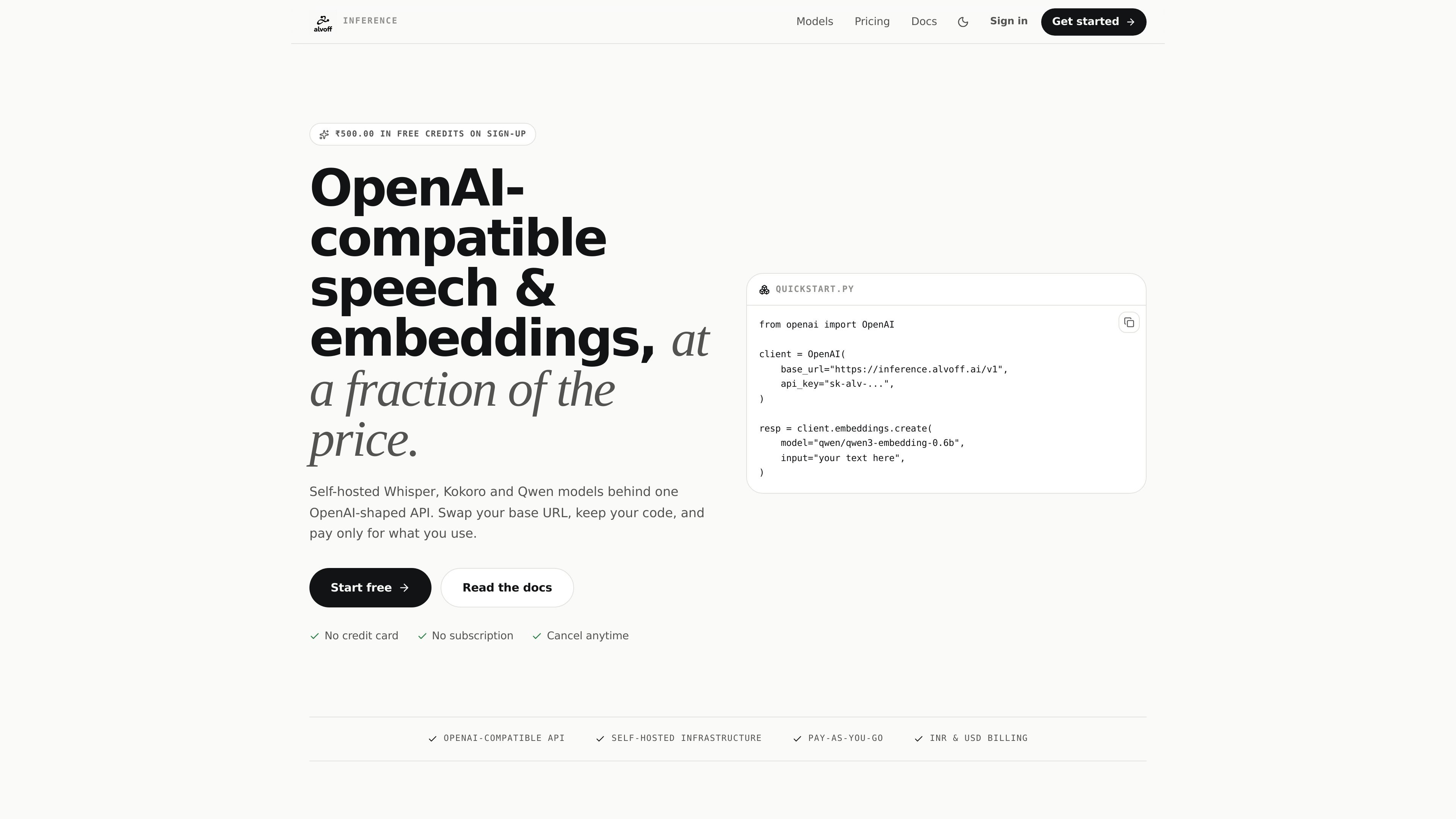
Alvoff Inference is an API service for speech-to-text, text-to-speech, embeddings, and chat/code generation. It presents those models through OpenAI-compatible endpoints under `/v1`, so teams can keep familiar SDKs and change only the base URL and API key.
The platform currently serves a small catalogue of live models, including Whisper large v3 turbo for transcription, Kokoro 82M for speech synthesis, qwen3-embedding-0.6b for embeddings, and qwen2.5-coder:1.5b for code-focused chat completions. The service is positioned as pay-as-you-go infrastructure with metered billing and free credits for new accounts.
Use the same request and response shapes as the OpenAI API, but point your client at https://inference.alvoff.ai/v1 and authenticate with your Alvoff key.
Serve audio transcription, speech synthesis, embeddings, and chat/code generation from a single API surface instead of wiring separate services together.
The catalogue lists live models for multilingual transcription, natural-sounding speech, dense embeddings, and code-optimized text generation.
Pricing is based on the unit that matches the request type, such as per hour of audio, per 1M characters, or per 1M tokens, with no subscription or minimum spend stated.
The docs explain that audio files can be uploaded in common formats including WAV, MP3, M4A, FLAC, WebM, and OGG, and that compressed audio can reduce upload and end-to-end latency.
The speech-to-text docs include ISO-639-1 language guidance for non-English audio and mention support for `/v1/audio/translations` for speech-to-English translation.
Integrate transcription into a product that already uses OpenAI SDKs. Alvoff lets you switch the base URL and key rather than rewriting your client code.
Generate voice responses or narrated content from text using the Kokoro model and a simple `/v1/audio/speech` request.
Create dense vectors for semantic search, retrieval-augmented generation, or other embedding-based workflows with the qwen embedding model.
Use the code-optimized chat model for fast code generation and completion inside developer tools or internal assistants.
Run small experiments or prototypes with free credits before committing to production usage and ongoing per-request billing.
You create an account, generate an API key, and send requests to the base URL https://inference.alvoff.ai/v1. The docs show that any OpenAI SDK can work by overriding the base URL and using your Alvoff key as a bearer token.
The documented models are speech-to-text, text-to-speech, embeddings, and chat/code generation. The current catalogue includes Whisper large v3 turbo, Kokoro 82M, qwen3-embedding-0.6b, and qwen2.5-coder:1.5b.
Yes. The site says the API is OpenAI-compatible, the endpoints live under /v1, and the examples use the OpenAI client with a custom base_url.
Pricing is per request and metered by unit: audio by the second or hour, text by characters or tokens, and embeddings by tokens. New accounts start with free credits, and billing is handled in INR while prices are also shown in USD at the live rate.
The documentation says the API supports standard HTTP status codes and OpenAI-shaped error bodies. It also notes that requests return 402 when credits run out and 429 when rate limited.

ByteAsk is a terminal-first AI coding agent for C and C++ that edits repos and verifies changes with compilers, debuggers, sanitizers, and tests.

Ghost is a terminal-based AI assistant for chatting, code generation, and CLI tasks. Includes free models, supports Linux, macOS, Windows, and is open source.

Vi3ecode is a maintained development environment for AI coding agents, keeping project context, terminal, Git, memory, flows and review connected.

AakarDev AI helps teams manage AI provider access, project setup, logs, and analytics in one dashboard. BYOK support included.

Lucid Train is a local-first AI coding harness that turns repo code into architecture diagrams for coding agents. Desktop app and Rust CLI, local models or API keys.

CreateOS Sandbox is an isolated compute environment for running code and agent workloads in Firecracker micro-VMs with private networking and SDK, CLI, or MCP control.