
AI-assisted editing
Describe a change in plain language and let AI agents update real site elements such as content, components, metadata, and publishing steps.

Avocado Studio is an open-source AI editor and page builder for Next.js sites. Edit content in plain language while keeping control of your stack, models, and deployment.
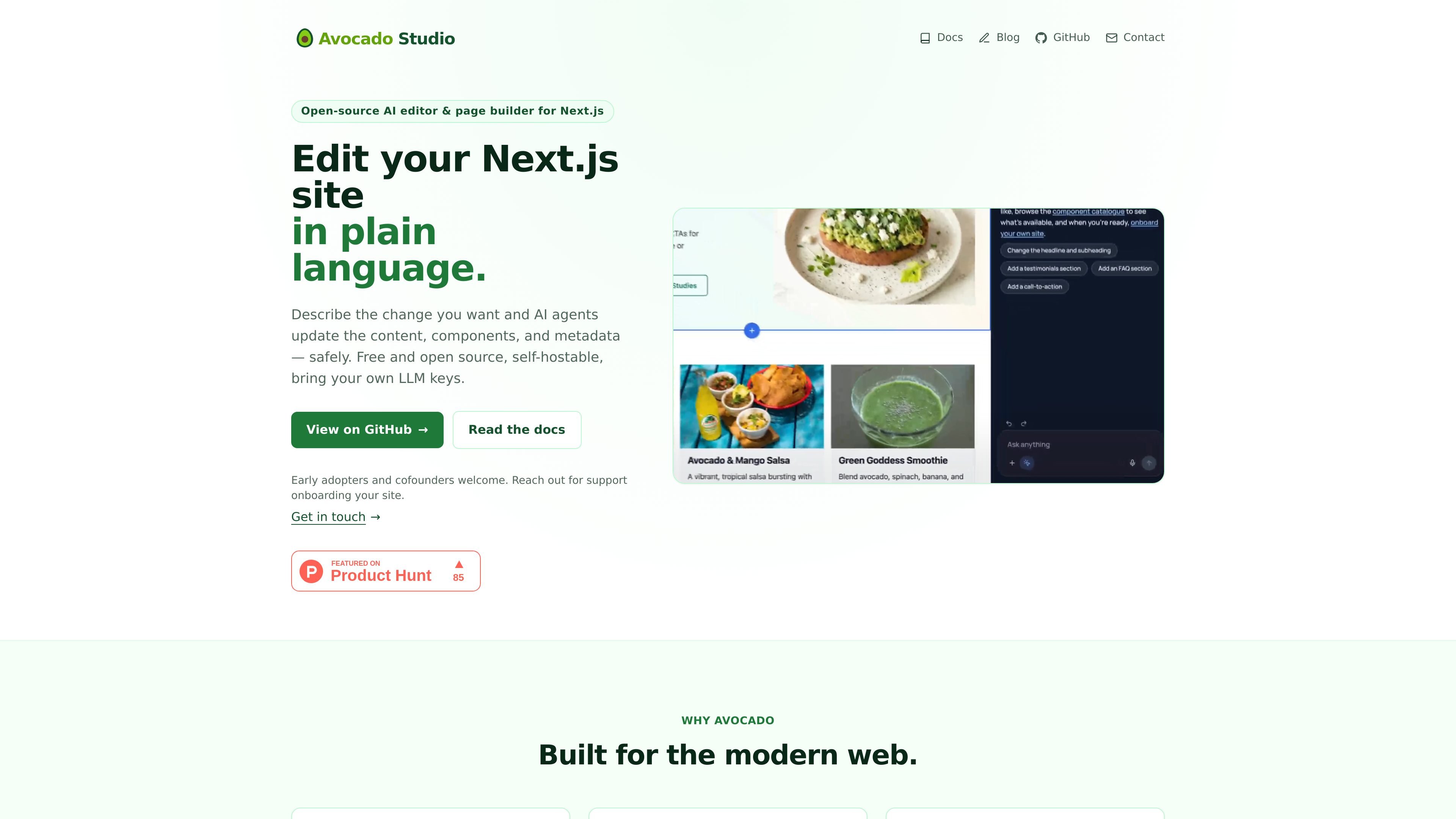
Avocado Studio is an open-source AI editor and page builder for Next.js sites. It is designed for teams that want to edit website content in plain language while keeping control over the underlying components, metadata, and publishing workflow.
The product positions itself as an open layer between AI models and an existing web stack. Rather than replacing a CMS or frontend system, it coordinates work across Next.js, CMSs, DAMs, design systems, localization tools, and publishing pipelines. The site also says it is self-hostable and supports bring-your-own model providers such as Anthropic, OpenAI, and Gemini.
The site frames the product for developers, platform teams, and early adopters that want AI-assisted editing without giving up infrastructure control or workflow ownership.
Describe a change in plain language and let AI agents update real site elements such as content, components, metadata, and publishing steps.
Review edits inside the Next.js application as changes are applied, so content and layout updates can be checked in context.
Work with your existing CMS, DAM, design system, frontend, and AI providers instead of replacing the tools already in place.
Choose Anthropic, OpenAI, or Gemini for text, images, and multimodal workflows, and route different tasks to different models.
Deploy on your own infrastructure with control over data, APIs, prompts, and integrations.
Connect editing, approvals, publishing, media, and localization into a workflow you control.
Let editors or marketers request specific website changes in plain language while the product updates the relevant components, metadata, and content in a Next.js app.
Keep publishing flow, approvals, media handling, and localization linked together when content changes need to move through several internal systems.
Generate and edit copy and images in the same workflow when a page needs structured content and visual assets updated together.
Build AI editing into an existing editorial process instead of adopting a separate all-in-one CMS or writing tool.
Avocado Studio is presented as an open-source AI editor and page builder for Next.js sites. It lets you describe changes in plain language and have AI agents update content, components, metadata, and publishing steps.
The source says it is self-hostable, so teams can deploy it on their own infrastructure and keep control of data, APIs, prompts, and integrations.
Yes. The site says you can bring your own AI providers, including Anthropic, OpenAI, and Gemini, and route different tasks to different models.
The site invites early adopters and cofounders to reach out for support onboarding their site, which suggests it is aimed at teams getting started with the product.

An All-In-One AI Platform that combines tools for image, video, voice, writing, and chat to enhance creativity and collaboration.

Slidesgo is a presentation template platform for Google Slides, PowerPoint and Canva workflows, with free and Premium templates plus AI-assisted creation.

Prompty Town turns a link into a building in a small internet city. Buy a tile, add a prompt, and publish it alongside other buildings.

Make Real is a Next.js app that turns hand-drawn wireframes into HTML prototypes with the tldraw SDK and AI models, with canvas sketching and embedded preview.

Wysera is an AI business platform with PostWyse for content and OpsWyse for CRM and revenue workflows, powered by shared Wyse AI and approval-first automation.

Grok is a free AI assistant developed by xAI, engineered to prioritize truth and objectivity while offering advanced capabilities like real-time information access and image generation.