
Real-time brain-state feedback
AWEAR continuously reads brain signals and surfaces when you are focused, overloaded, or stressed while it is happening, rather than after the fact.

AWEAR is a wearable EEG device with real-time feedback on stress, focus, emotions, sleep, and recovery to help you catch overload earlier and reset sooner.
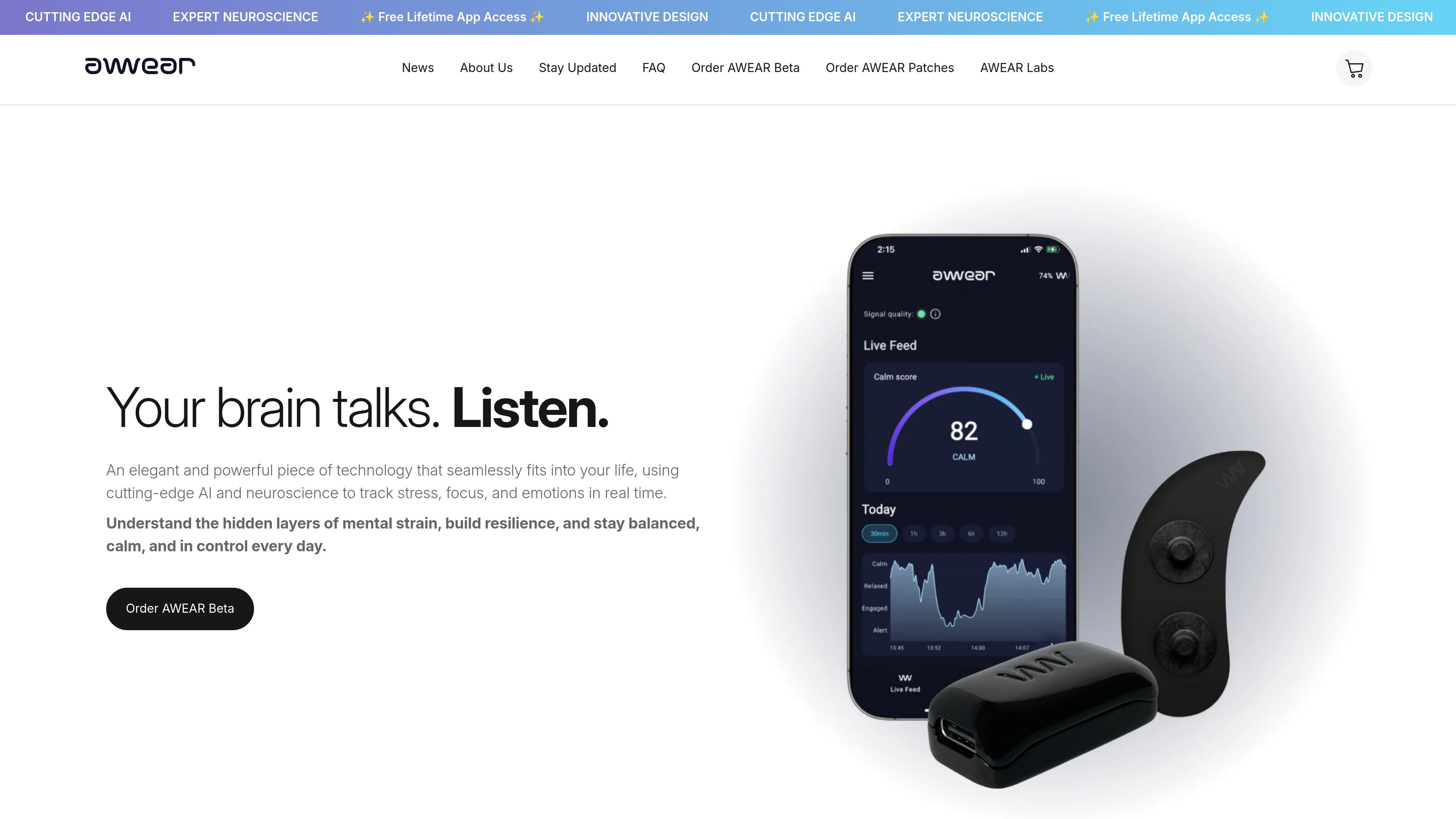
AWEAR is a wearable EEG product designed to help people understand their mental state in real time. The site positions it as a discreet device that reads brain signals and turns them into practical feedback about stress, focus, emotions, sleep, and recovery.
The product’s main job is to surface changes while they are happening, so users can notice overload earlier and respond sooner. The homepage and product page describe use cases such as preparing for a meeting, recovering from a tough moment, or recognizing when emotions are taking over. AWEAR Beta is listed as iOS only.
The public site also frames AWEAR as a work in progress: the product listing shows AWEAR Beta, the collection page lists additional AWEAR products and refills, and the waitlist page invites visitors to stay updated on product news and research content.
AWEAR continuously reads brain signals and surfaces when you are focused, overloaded, or stressed while it is happening, rather than after the fact.
The product uses EEG technology to measure rhythms of the brain and translate them into personalized insights.
The homepage highlights activity correlation, showing how meetings or workouts affect your brain across the day.
The site says AWEAR provides AI insights about stress, focus, sleep, and recovery, helping users interpret patterns over time.
A wellness timeline tracks how habits and recovery shape brain patterns over time, adding historical context to day-to-day signals.
When mental load stays high for too long, AWEAR gives a subtle cue to pause, breathe, or reset before stress escalates.
Use AWEAR when you want a live read on whether stress or focus is shifting during the day, rather than waiting for a summary after the fact.
Use the device before a meeting, presentation, or similar high-pressure event to notice rising mental load and take a brief reset early.
Use the activity correlation and wellness timeline views to see how workouts, habits, or recovery periods line up with your brain-state patterns.
Use the product when you want subtle prompts to pause, breathe, or reset as mental load stays elevated for too long.
Use AWEAR if you are interested in following the brand’s beta product updates and neuroscience-related educational content through the waitlist.
AWEAR is a wearable that uses EEG signals to provide real-time insight into stress, focus, and emotional state. The product page describes it as helping you notice rising stress and reset before it escalates.
The product page says AWEAR Beta is iOS only.
The site describes AWEAR as a discreet, wearable device that uses EEG technology and AI-driven insights. It is presented as something that fits into everyday life rather than a bedside or desk-only tool.
The public site shows AWEAR Beta as sold out in the product listing, and the pricing page is not available. The site does not provide a complete public pricing breakdown in the collected content.
The source content emphasizes individual brain-state tracking and personal insights. It does not document team features, shared dashboards, or collaboration workflows.

MIRA vision develops synthetic-data-driven AI for pathology image analysis, with privacy-compliant training data, automatic annotations and controlled data generation.

Teloframe is an AI-powered football coaching platform for tactics, drills, session planning, and player development in one workspace. Free, Pro, and Club plans.

LeanUp is an AI calorie tracker and meal-planning app for logging meals, tracking macros, and getting personalized nutrition guidance with scan, snap, search, and recipe reuse.

TrakMac is a voice-first macro tracking app for iOS that estimates calories and macros from spoken meal descriptions to help you log food and stay on track.

Padel Chess is a web-based platform for improving padel tactics with puzzle-based practice in realistic court scenarios.

Pitch Planner is a youth soccer substitution tracker for coaches and team managers. Plan lineups, track live substitutions and player minutes, and review match recaps from one phone.