
OAuth-backed app connections
Connect the apps an agent is authorized to use through OAuth-backed connectors, without placing service credentials in the agent.

CoreSpeed is an MCP-based access layer for AI agents, offering authorized app connections, portable memory, media and research tools, plus spending controls.
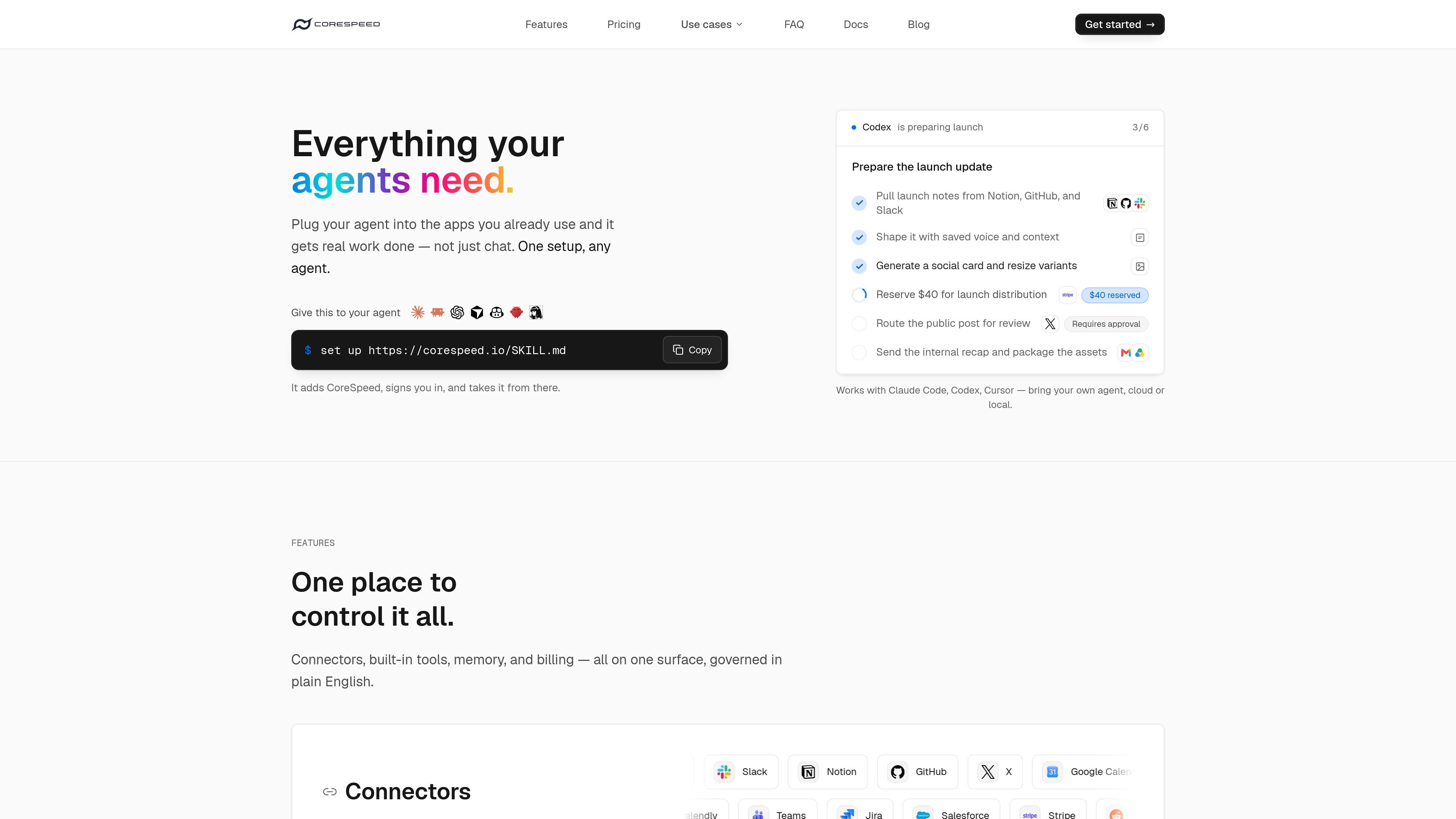
CoreSpeed is an MCP-based access layer for AI agents. It gives agents such as Claude Code, Codex, Cursor, cloud agents, local agents, and custom agents access to authorized applications, account-level memory, and built-in tools for media, web search, scraping, and social research.
The service is intended to make an agent setup portable across tools and execution environments. Users authorize connectors through OAuth, configure action and spending controls, and review activity through a shared account rather than managing separate credentials and memories for each agent.
Connect the apps an agent is authorized to use through OAuth-backed connectors, without placing service credentials in the agent.
Expose connected apps and built-in tools through one authenticated Model Context Protocol endpoint for supported and custom agents.
Provide media generation, image, video, and audio analysis, web search and scraping, and social research tools from the same agent access layer.
Store durable memory on the CoreSpeed account so it can be available when users move between agents rather than remaining tied to one machine.
Apply plain-English approval policies, handling rules for unspecified actions, and spend caps before paid calls are made.
Record activity in a ledger showing what ran, what it cost, and whether it worked, with plan-dependent history retention.
Research prospects, draft outreach, and log customer relationship activity through connected sales applications without copying information between tools.
Build campaigns, schedule social content, and retrieve funnel information through authorized marketing applications and social research tools.
Triage support tickets, prepare replies using available context, and identify potential churn signals as part of a support workflow.
Review engineering backlogs and pull requests, then manage sprint closeout from an agent conversation connected to development tools.
Categorize expenses, reconcile payouts, and support month-end close processes while applying approval rules and spend limits to agent actions.
Give the agent the setup line `set up https://corespeed.io/SKILL.md` and have it read the file raw, for example with curl. The setup process adds the CoreSpeed MCP server, signs the user in or creates an account, and keeps the skill available for later use. Manual setup instructions are available in the CoreSpeed documentation.
No. CoreSpeed uses OAuth 2.0 authorization through each provider's own authorization screen. It receives scoped tokens rather than service passwords or credentials.
CoreSpeed is designed to work with Claude Code, Codex, OpenClaw, Hermes, Cursor, cloud or local agents, and custom agents. Its MCP endpoint acts as the shared access layer.
CoreSpeed offers a free plan with 3,000 credits valid for 90 days, one member, 200 MB of memory, and 30 days of activity history. Pro costs $20 per month and includes 10,000 credits per month, up to 25 members, 2 GB of memory, and one year of history. Enterprise pricing is custom.
Users can write approval policies in plain English, choose whether unspecified actions run, request approval, or are refused, and set spend caps. Actions are recorded in an activity ledger, and approvals can be requested in the dashboard, by email, or in Slack.

CreateOS Sandbox is an isolated compute environment for running code and agent workloads in Firecracker micro-VMs with private networking and SDK, CLI, or MCP control.

GitBot is a local browser workspace for reusable coding bots powered by Claude Code, Codex, or OpenCode, with persistent threads and configurable permissions.

AakarDev AI helps teams manage AI provider access, project setup, logs, and analytics in one dashboard. BYOK support included.

Trigger.dev chat agent is a durable AI chat backend for stateful conversations that survive refreshes, crashes, and long-running turns with AI SDK useChat.

ByteAsk is a terminal-first AI coding agent for C and C++ that edits repos and verifies changes with compilers, debuggers, sanitizers, and tests.

Codex Plugins bundle reusable skills, app integrations, and MCP servers into workflows you can install in the Codex app or use from Codex CLI.