

EEVEE Mobility
EEVEE Mobility helps fleets manage EV charging with reimbursement workflows, real-time cost tracking, charging rules, and a single charge pass for public charging.
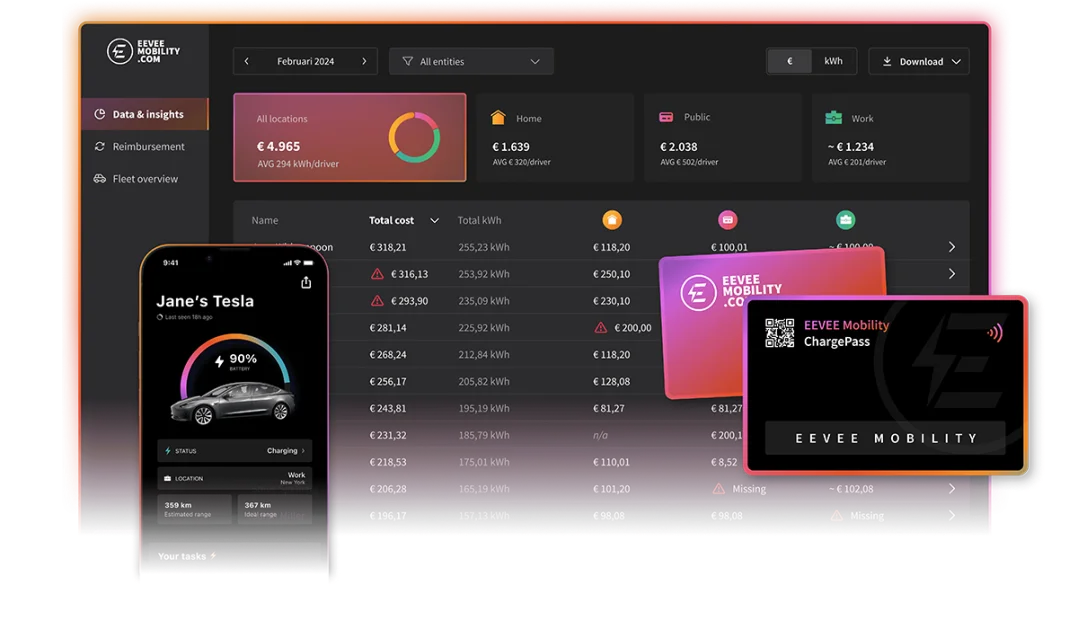
What is EEVEE Mobility?
EEVEE Mobility is a platform for managing EV charging for fleets, including reimbursement and cost tracking. It helps teams control who can charge, monitor where and when charging happens, and understand the costs tied to drivers, vehicles, and locations.
The platform also supports automated reimbursements based on vehicle data and GPS, aiming to reduce manual work and avoid the need to manage additional charging hardware.
Key Features
- Disconnect-from-hardware management powered by car data: enables charging management using vehicle information rather than relying on charging hardware configuration.
- Cost visibility with tracking by driver, car, and location: provides a view of charging costs at granular levels used for internal oversight.
- Charging rules to control access: supports setting rules that determine who can charge, where they can charge, and what charging should cost.
- Spot and stop expensive charging: includes mechanisms to identify costly charging and intervene when needed.
- Refund home charging based on car data and GPS: supports paying employees for home charging without requiring cables or managing additional charge points.
- Pay per real kWh with bank account reimbursements: reimburses based on energy usage (kWh) and directs payouts to employees’ bank accounts.
- One charge pass covering 650,000+ public charging points: allows charging across public infrastructure from a single pass.
- Brand compatibility across 15+ other compatible brands: supports multiple vehicle/car-brand options for the managed charging workflow.
- Charging cost dashboard including session details: consolidates charging costs into a simple view, including items like idle fees and international sessions (as referenced in customer feedback).
How to Use EEVEE Mobility
Start by initiating a free trial or contacting sales to begin onboarding. During setup, teams define the charging workflow—such as who can charge, where they can charge, and what costs are acceptable—using the platform’s charging rules.
Once configured, employees use the charging pass for eligible public charging. For home charging reimbursement, submit/payout is handled based on vehicle data and GPS, and reimbursements can be processed per real kWh to employees’ bank accounts.
Use Cases
- Fleet reimbursement using vehicle data instead of extra hardware: companies refund employees for home charging using vehicle data and GPS, reducing operational overhead tied to charging infrastructure management.
- Driver-level cost monitoring for EV programs: fleet managers track charging costs by driver, vehicle, and location to understand where spending is concentrated.
- Policy-based charging access: organizations apply charging rules to limit who can charge, where they can charge, and what charging should cost, helping enforce internal policies.
- Preventing unusually expensive charging sessions: teams spot costly charging patterns and stop/limit charging when it exceeds configured expectations.
- Consolidated dashboard for mixed charging contexts: organizations that used to manage charging stations can shift to a centralized view that includes session-level cost drivers such as idle fees and international charging (as described by customers).
FAQ
-
Does EEVEE Mobility require managing charging hardware like cables or charge points? The site states that home charging reimbursements are handled without cables or charge points to manage.
-
How are home charging refunds calculated? Refunds are described as being based on car data and GPS, with reimbursement processed per real kWh.
-
Can employees use public charging with a single pass? The platform references one charge pass that covers 650,000+ public charging points.
-
What data can the platform use to track charging costs? The site states tracking by driver, car/vehicle, and location, and mentions use of vehicle data and GPS for reimbursements.
-
Is compatibility limited to a single car brand? The site states compatibility with 15+ other brands.
Alternatives
- EV charging management and reimbursement platforms: look for tools that provide driver reimbursement automation, charging access policies, and session-level cost tracking for fleets.
- Fleet expense management for EV charging: systems focused on consolidating EV charging spend and allocating costs to drivers/vehicles can be an alternative, particularly if reimbursement workflow is handled elsewhere.
- Pass-based EV charging solutions with reporting: some providers focus on access via charging passes plus reporting; these may differ by how reimbursement automation and rule-based controls are implemented.
- Manual or spreadsheet-based reimbursement with driver-provided receipts: a lower-tooling alternative, typically more labor-intensive and less granular than platform-based tracking by vehicle data/GPS.
Alternatives

OpenFlags
OpenFlags is an open source, self-hosted feature flag system with a control plane and typed SDKs for progressive delivery and safe rollouts.

Sleek Analytics
Lightweight, privacy-friendly analytics with real-time visitor tracking—see where visitors come from, what they view, and how long they stay.

Codex Plugins
Use Codex Plugins to bundle skills, app integrations, and MCP servers into reusable workflows—extending Codex access to tools like Gmail, Drive, and Slack.

Struere
Struere is an AI-native operational system that replaces spreadsheet workflows with structured software—dashboards, alerts, and automations.

MacSpoof
MacSpoof is a macOS MAC address changer that lets you change or randomize your Wi‑Fi MAC to reconnect and limit device logging on public Wi‑Fi.

BenchSpan
BenchSpan runs AI agent benchmarks in parallel, captures scores and failures in run history, and uses commit-tagged executions to improve reproducibility.