
Agent registration
Register an agent by generating a keypair and associating the public key with a claimed inbox.

Eleidon is an email identity layer for AI agents that verifies inbound messages before action and lets recipients verify outbound messages. SDKs, MCP server, and CLI included.
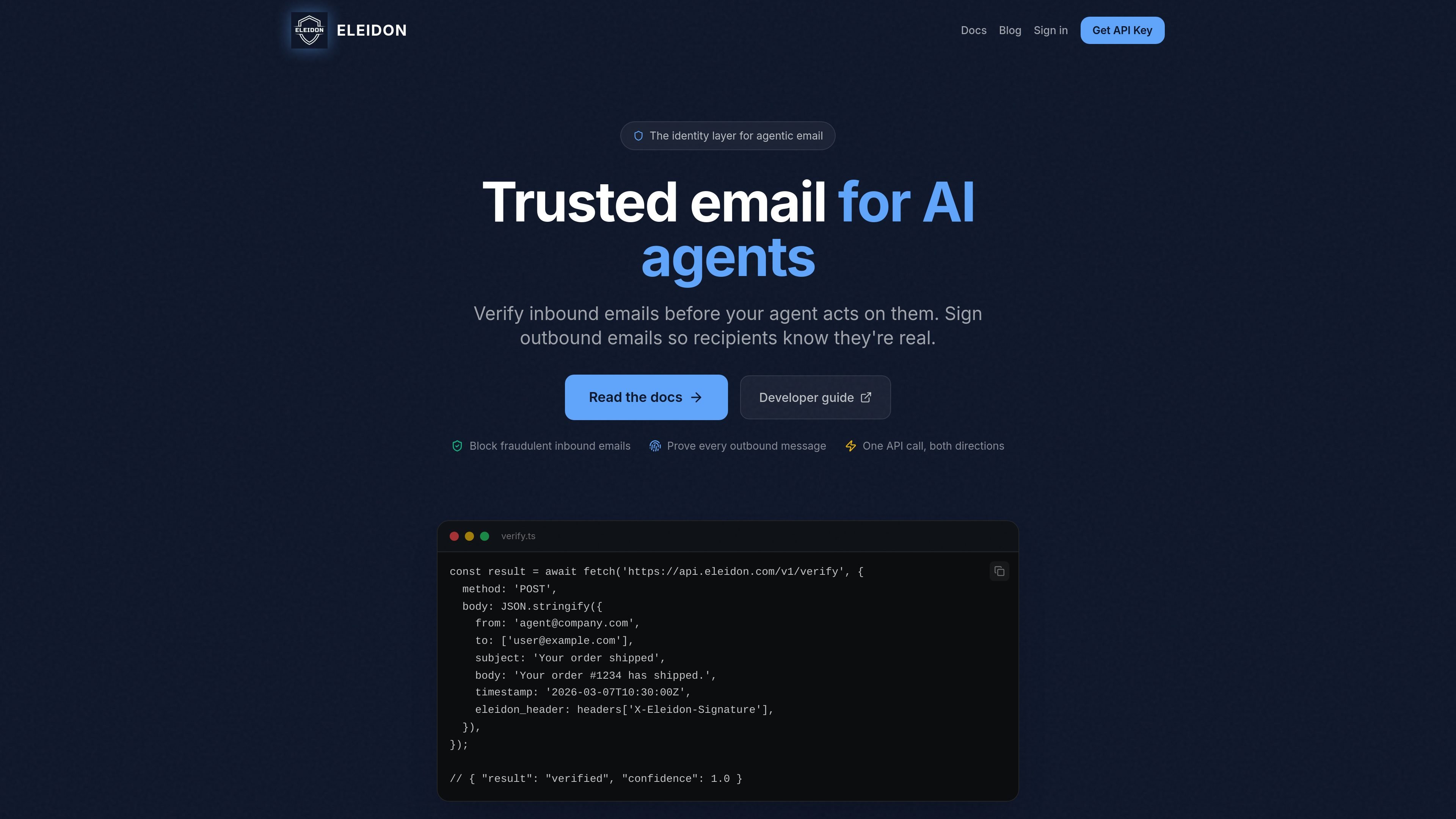
Eleidon is an email identity layer for AI agents. It is designed to help agents verify whether an inbound email is authentic before taking action, and to let humans or other systems confirm that an outbound email was actually signed by the agent that sent it.
The product centers on a simple cryptographic workflow: register an agent, sign outgoing messages, and allow anyone to verify them. The site positions this as a way to reduce spoofing risk, add message integrity checks, and provide clearer evidence when email-driven automation is disputed.
Register an agent by generating a keypair and associating the public key with a claimed inbox.
Attach a cryptographic signature to outbound email so recipients can verify the message really came from the agent.
Check inbound emails through a verification endpoint that returns a result and confidence score.
Use the service without requiring an API key for verification requests, according to the product flow shown on the home page.
Work from the provided SDKs and command-line tools, including TypeScript, Python, MCP, and CLI options.
Inspect verification output that includes identity and integrity fields such as agent ID, claimed inbox, inbox verification, and signature ID.
Use Eleidon when an agent receives an instruction email and needs a way to check whether the sender is actually authorized before acting on it.
Use the signing flow for agent-generated confirmations, status updates, or support replies so recipients can verify the message origin.
Use the verification endpoint in services that need a machine-readable answer with identity and confidence fields instead of a manual review step.
Use the SDKs or CLI when you want to add signing and verification to application code, a model-using workflow, or terminal-based operations.
Eleidon verifies inbound emails before an agent acts on them and lets recipients verify outbound messages signed by the agent. The site describes a workflow where anyone can verify a message through the verification endpoint without needing an API key.
The site presents three steps: generate a keypair and register the agent, sign outgoing email with the private key, and let recipients verify the signature through the verification endpoint.
The home page lists SDKs for TypeScript and Python, plus an MCP server and a CLI. It also shows a direct API flow for verification.
No. The pricing section says signing is free and unlimited, while verification is metered by plan. It also shows a free tier, paid plans, and a contact-us option for enterprise.
The source shows message verification returning a confidence score and fields such as agent ID, claimed inbox, inbox verification, and signature ID. It does not describe formal compliance certifications or guarantees.

AgentMail is an email inbox API for AI agents to create, send, receive, and search messages via REST APIs and SDKs. Built for threaded workflows, verification, support, scheduling, and approvals.

ClawCard gives AI agents a dedicated identity stack: email, US phone number, virtual cards, wallet, on-chain identity, and paid API access.

CreateOS Sandbox is an isolated compute environment for running code and agent workloads in Firecracker micro-VMs with private networking and SDK, CLI, or MCP control.

Liam is an AI copilot for inbox management, email replies, prioritizing messages, and scheduling meetings. Free for individuals; custom pricing for teams and enterprise.

Codex Plugins bundle reusable skills, app integrations, and MCP servers into workflows you can install in the Codex app or use from Codex CLI.

Wallie is an open-source AI streamer that watches your screen, hears chat, and delivers live commentary in a configurable persona. Runs locally with your own keys.