
Email inbox
Each agent gets a dedicated inbox for service signups, verification links, and outbound mail, so it can complete workflows that depend on email without using a shared account.

ClawCard gives AI agents a dedicated identity stack: email, US phone number, virtual cards, wallet, on-chain identity, and paid API access.
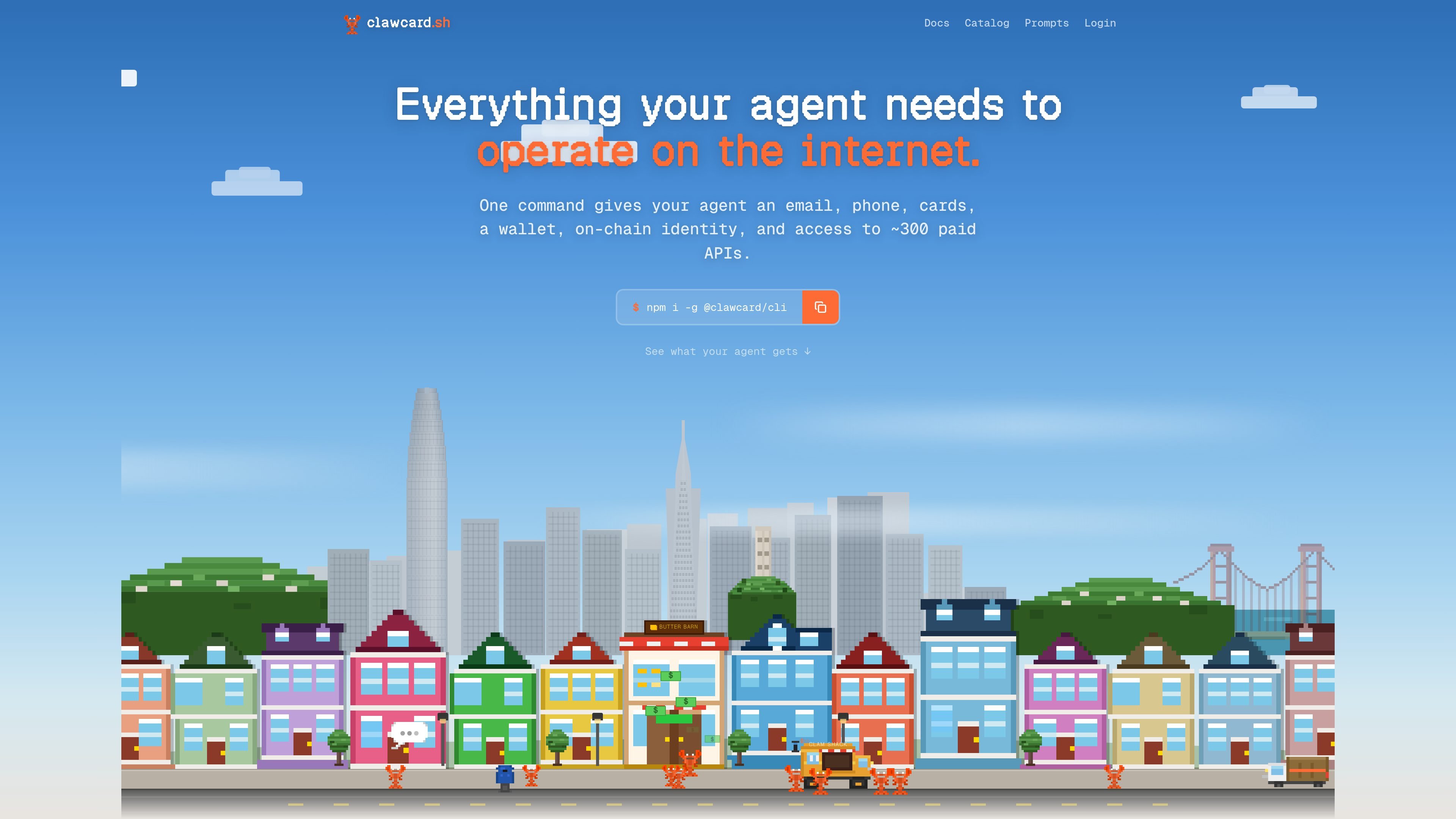
ClawCard is an identity and payment platform for AI agents. It gives an agent a dedicated email inbox, US phone number, virtual cards, a wallet, on-chain identity, and access to paid APIs through one CLI and API.
The product is aimed at workflows where an agent needs to sign up for services, verify accounts, pay for APIs, and make purchases without using a human’s personal credentials. The site positions setup as a quick install-and-top-up flow that works through the CLI and agent skill files.
Each agent gets a dedicated inbox for service signups, verification links, and outbound mail, so it can complete workflows that depend on email without using a shared account.
A US SMS-enabled number receives verification codes and 2FA messages, letting an agent handle phone verification during account creation and login flows.
The platform issues virtual Mastercards with per-card spend limits, including single-use cards and merchant-locked cards for repeat purchases at the same vendor.
A single balance can fund API calls, virtual card use, and on-chain payments, so the agent does not need separate payment systems for different tasks.
The catalog exposes roughly 300 paid API capabilities across search, scraping, enrichment, media, finance, travel, and maps, with payment handled from the same balance.
ClawCard stores API keys, passwords, and tokens in an AES-256 encrypted credential vault and includes spend limits, freeze controls, and audit logs for account control.
An agent can create accounts on websites, receive verification links in a dedicated inbox, read SMS codes, and finish onboarding without a human handoff.
The wallet and payment standards support paid API calls, including x402 and MPP flows, so an agent can retrieve data or trigger machine payments as part of a task.
The virtual card flow supports one-off purchases and subscription-style vendor lock-in, which fits buying domains, software, or other online services.
The credential vault lets agents store API keys and tokens after signup, so later tasks can reuse credentials without exposing them to the agent or human operator.
Spend limits and freeze controls make it suitable for operators who want isolated budgets and a kill switch for agent spending.
You install the CLI, create an account, and run `clawcard setup`. The docs say that gives an agent email, phone, card, wallet, and identity in about two minutes.
It is designed for agents that can read a skill file or use the CLI, including Claude Code, Cursor, Gemini CLI, Codex, OpenClaw, and other HTTP-capable agents.
You top up with a credit card, and that balance pays for API calls, virtual cards, and on-chain payments. The docs describe $5, $10, or $25 top-ups and note that most API calls cost about $0.01 to $0.06 each.
The platform supports browser-based API payment standards including x402 and MPP. The docs say x402 is used for paying APIs with stablecoins, while MPP handles machine-to-machine payments with pathUSD on the Tempo network.
Signing up is free, and the docs say there are no subscriptions or monthly fees. You only pay when you top up and use paid capabilities or virtual cards.

Dirac is an AI email assistant for Gmail that prepares a morning brief, prioritizes important threads, and drafts replies in your voice.

AgentMail is an email inbox API for AI agents to create, send, receive, and search messages via REST APIs and SDKs. Built for threaded workflows, verification, support, scheduling, and approvals.

Goldfish is an AI memory app for macOS that helps you reply, write, summarize, and continue with context already on your Mac. It stores memory locally and writes in your tone.

CreateOS Sandbox is an isolated compute environment for running code and agent workloads in Firecracker micro-VMs with private networking and SDK, CLI, or MCP control.

ArtDeck is a visual reference board app for iPhone, iPad, and Mac. Collect mixed references on one canvas and study them with ToolBox lenses. Offline, optional iCloud sync, one-time purchase.

Biji is a versatile platform designed to enhance productivity through innovative tools and features.