
Vector retrieval for AI applications
Stores and searches vectors for production AI workloads, with positioning around RAG, semantic search, agents, and recommendations.

Endee is an open source vector database for production AI systems, with managed cloud, enterprise, and edge deployment options. It helps teams build RAG, semantic search, agent retrieval, and recommendation workflows with APIs, SDKs, and memory-efficient search.
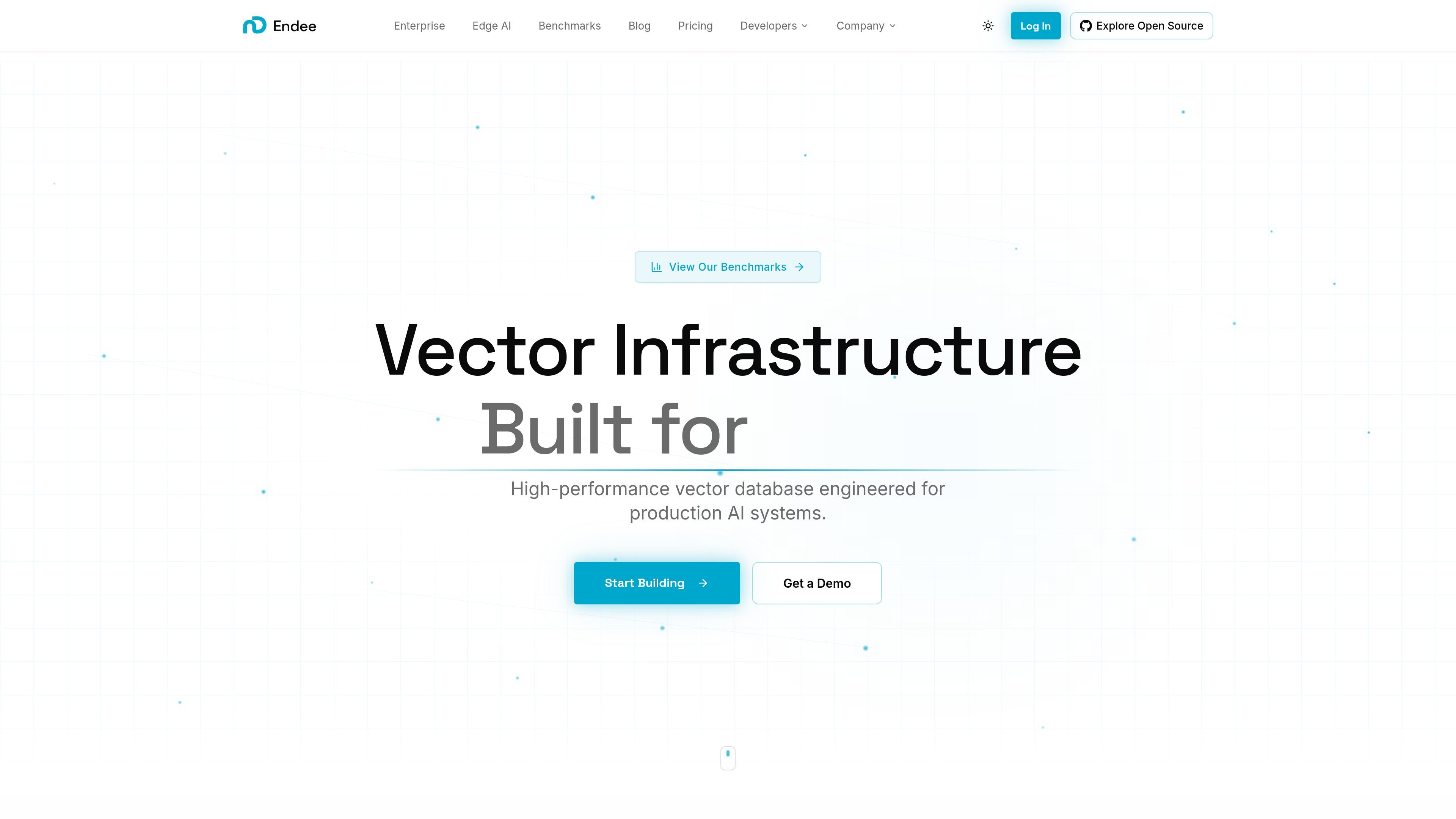
Endee is an open source vector database built for production AI systems. It focuses on fast vector search, lower memory usage, and retrieval workflows used in RAG, semantic search, AI agents, and recommendations.
The product is offered as Endee Managed Cloud with Starter, Pro, and Scale pricing tiers, plus an Enterprise edition and an edge-device deployment option. The site also describes a RESTful API, SDKs for Python, TypeScript, Go, and Java, and deployment targets that include on-prem infrastructure and devices such as Raspberry Pi, Android, and NVIDIA Jetson.
Stores and searches vectors for production AI workloads, with positioning around RAG, semantic search, agents, and recommendations.
Uses a Vector Graph Engine with layered memory design, processor acceleration, and intelligent quantization to reduce memory use while keeping search fast.
Supports hybrid search on the managed cloud plans, combining vector and keyword retrieval and adding BM25 on Pro and Scale tiers.
Exposes a RESTful API and SDKs for Python, TypeScript, Go, and Java, which gives developers several ways to connect applications.
Offers enterprise controls such as RBAC, audit logs, manual or automated backups, and support tiers that increase with the plan.
Provides an edge deployment path for Raspberry Pi, Android, and NVIDIA Jetson, with native ARM binaries and offline on-device search.
Use Endee to power retrieval for AI systems that need relevant context for generation, search, or multi-step reasoning.
Use hybrid search and semantic retrieval to find documents, products, or content by meaning instead of only matching keywords.
Use vector similarity and item embeddings to surface personalized results and related items in recommendation flows.
Use the enterprise edition when you need on-prem deployment, encryption-oriented search, backups, RBAC, and audit logs.
Use the edge offering when search must run locally on Raspberry Pi, Android, or NVIDIA Jetson without cloud round-trips.
Endee is a vector database for production AI systems. The site positions it for retrieval-heavy workloads such as RAG, semantic search, AI agents, and recommendations.
The pricing page shows a free Starter tier, a $99/month Pro tier, and a $999/month Scale tier in Endee Managed Cloud. Endee also offers an Enterprise edition and an edge-device deployment option.
The site says Endee exposes a RESTful API and SDKs for Python, TypeScript, Go, and Java, and it also offers docs and GitHub access for open-source use.
The pricing page shows limits for queries, indexes, vectors, and support vary by plan. The enterprise page adds features such as on-prem deployment, Queryable Encryption, continuous backups, and RBAC.
Endee’s public pages do not list every integration partner or ecosystem support option, so buyers should confirm compatibility with their stack before adopting it.

Falconer is an AI-powered company brain that keeps internal documentation accurate, searchable, and up to date by syncing with tools like GitHub, Slack, and Linear. It helps engineering and cross-functional teams centralize knowledge and answer questions from a shared source of truth.

Theneo is a developer portal and API documentation platform for publishing references, guides, changelogs, and private customer portals. It supports collaborative editing, automated changelogs, and AI-facing doc features for technical teams.

Memoriq is a private AI memory vault for archiving, searching, and protecting chats from ChatGPT, Claude, Gemini, and Grok. Hosted or self-hosted.

Goldfish is an AI memory app for macOS that helps you reply, write, summarize, and continue with context already on your Mac. It stores memory locally and writes in your tone.

Lasso is an ecommerce product data platform for enriching catalog records, processing supplier files, generating product content, and monitoring competitors. It combines a web app with a REST API, SDK, and MCP server for teams and developers.

Struere is an AI-native platform for turning spreadsheet data into structured operational software with dashboards, alerts, and automations. It is aimed at teams that want to replace manual spreadsheet workflows without building custom tools from scratch.