
Multimodal image, video, and text understanding
MiniCPM-V is positioned for efficient vision-language understanding across image, video, and text inputs, with the repository emphasizing device-friendly deployment rather than cloud-only use.

MiniCPM-V is an open-source multimodal LLM for image, video, and text understanding, with API access and mobile deployment on iOS, Android, and HarmonyOS.
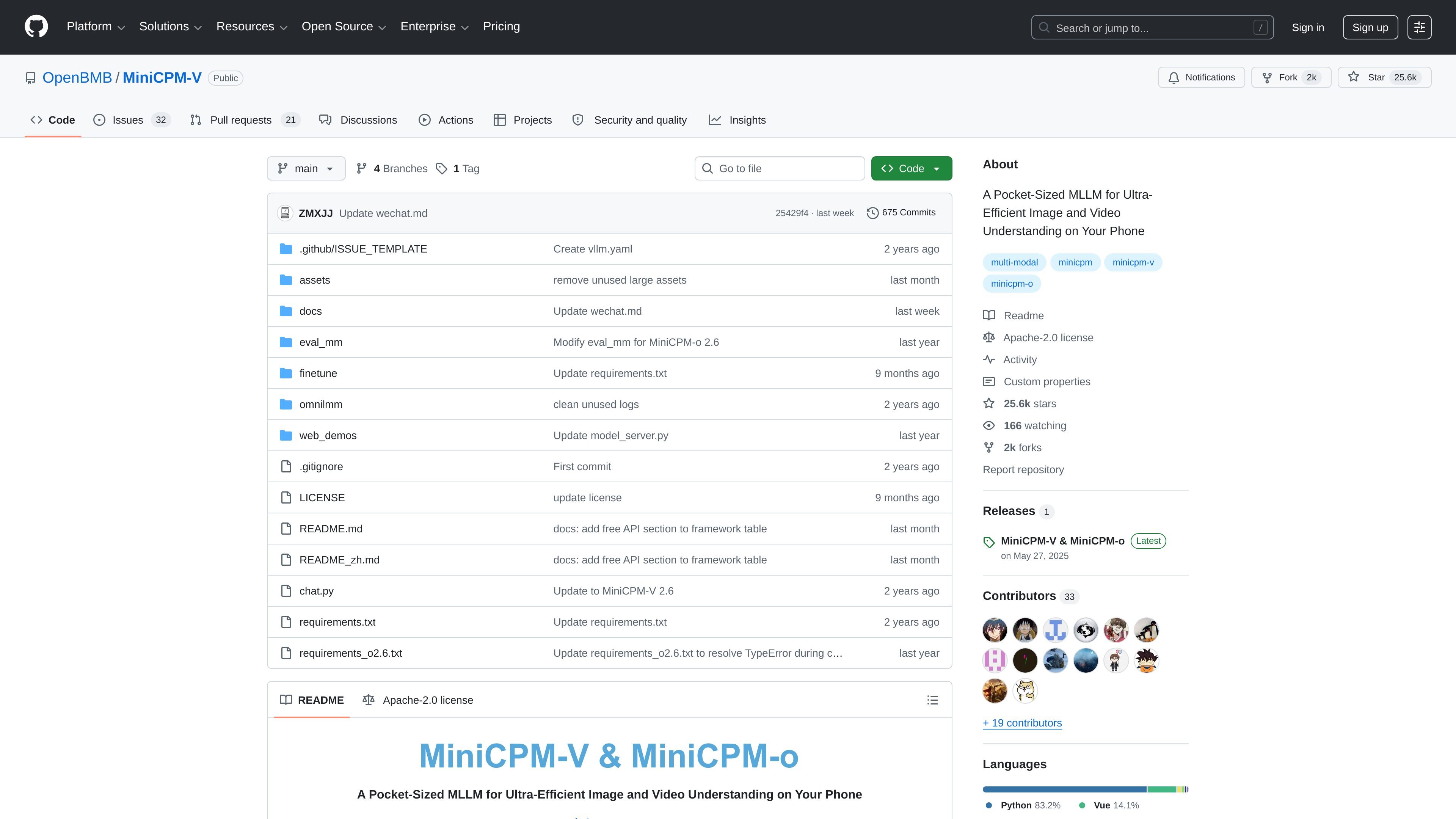
MiniCPM-V is an open-source multimodal LLM series from OpenBMB focused on efficient vision-language understanding. The repository presents it as a pocket-sized model family for image, video, and text workflows, with MiniCPM-V 4.6 described as the latest efficient model in the series.
The project is built for deployment rather than only offline research use. The README says MiniCPM-V 4.6 can run on common mobile platforms including iOS, Android, and HarmonyOS, and the API guide shows how to access the model through a Chat Completions API for both text-only and image-based requests.
MiniCPM-V is positioned for efficient vision-language understanding across image, video, and text inputs, with the repository emphasizing device-friendly deployment rather than cloud-only use.
The README highlights MiniCPM-V 4.6 as a 1.3B-parameter model designed for strong efficiency, with the repository stating it reduces visual encoding computation cost by more than 50% using intra-ViT early compression.
The model supports mixed 4x and 16x visual token compression rates, giving users a practical trade-off between speed and performance depending on the task.
The README says MiniCPM-V 4.6 can be deployed on iOS, Android, and HarmonyOS, and that edge adaptation code has been open-sourced.
The API guide documents Chat Completions access for both text-only and vision-language requests, including base64 image inputs for image understanding workflows.
The repository includes dedicated docs for API usage and multi-GPU inference, indicating support for both service-style integration and larger-scale local deployment.
Use MiniCPM-V when you need a model to interpret images, short videos, and accompanying text in a single workflow, such as visual question answering or multimodal analysis.
Teams building mobile AI experiences can use the model’s mobile deployment support to run vision-language features on devices such as phones and tablets.
Developers who want to integrate the model into a service can use the documented Chat Completions API and base64 image request format.
Engineers evaluating performance trade-offs can use the mixed 4x and 16x visual token compression settings to balance throughput and capability for different tasks.
Operators who need to scale beyond a single machine can use the multi-GPU inference documentation as a starting point for larger local deployments.
The repository describes MiniCPM-V as a multimodal LLM series focused on efficient vision-language understanding across image, video, and text inputs. Its API guide shows that MiniCPM-V 4.6 can be called through a Chat Completions API for both text-only and vision-language requests.
The API guide documents a base URL at `https://api.modelbest.cn/v1` and shows Chat Completions requests for text and image inputs. For images, the example uses a base64 data URL in the `image_url` field.
The repository says MiniCPM-V 4.6 is the latest and most efficient model in the series, with 1.3B parameters and support for deployment on iOS, Android, and HarmonyOS. The docs also mention a free public API key for trying the service.
The repository says the series supports efficient deployment on common mobile platforms, and the docs include a separate guide for running inference on multiple GPUs. The homepage also links to API, technical report, and cookbook resources.
The GitHub pricing page shows a free tier for individuals and organizations on GitHub, while the project itself is hosted as an open-source repository. The model API guide separately mentions a free public API key for trying MiniCPM-V 4.6.

AakarDev AI helps teams manage AI provider access, project setup, logs, and analytics in one dashboard. BYOK support included.

Snapmark is a VS Code extension for annotating clipboard screenshots before pasting them into AI chats. Blur sensitive details, add numbered callouts, and auto-resize large images.

BookAI allows you to chat with your books using AI by simply providing the title and author.

Skills Janitor is a GitHub-hosted set of slash commands for auditing, tracking, and cleaning up Claude Code and OpenAI Codex skills.

Arduino VENTUNO Q is an edge AI computer for AI and robotics, combining AI inference and deterministic control on one board with Arduino App Lab support.

FeelFish is a PC client for AI-assisted novel writing, helping writers plan characters and settings, draft and revise novels, and manage story context.