
Cross-provider AI visibility tracking
Tracks how a brand appears inside ChatGPT, Gemini, Perplexity, Claude, and Google AI Overview using your own accounts.

OneGlanse is an open-source GEO and AI visibility tracker for monitoring how your brand appears in ChatGPT, Gemini, Perplexity, Claude, and Google AI Overview.
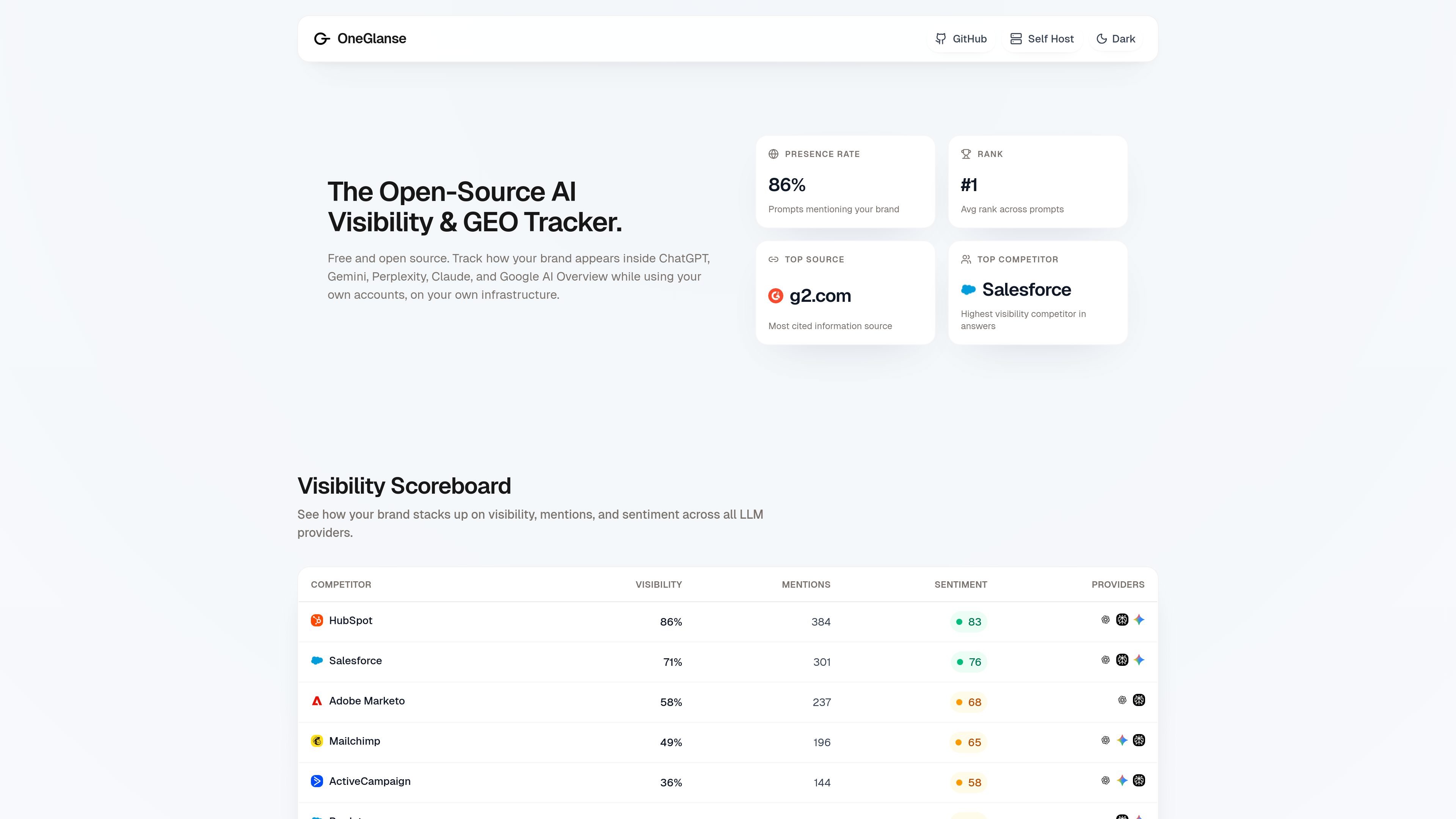
OneGlanse is an open-source GEO and AI visibility tracker for monitoring how a brand appears inside AI-generated answers. The homepage says it tracks responses from ChatGPT, Gemini, Perplexity, Claude, and Google AI Overview, and that it uses your own accounts on your own infrastructure.
The product is positioned around visibility monitoring rather than content generation. It shows metrics such as presence rate, rank, top source, sentiment, and competitor comparison so teams can review how their brand is represented across providers and then inspect the underlying responses.
Tracks how a brand appears inside ChatGPT, Gemini, Perplexity, Claude, and Google AI Overview using your own accounts.
Shows a visibility scoreboard that compares brands across visibility, mentions, sentiment, and ranking signals.
Surfaces provider-rendered answers in the same format users see them, with source attribution and analysis metrics.
Highlights presence rate, average rank, top cited source, and top competitor signals from tracked prompts.
Presents competitor visibility so teams can see where they lead or lag across AI answers.
Use OneGlanse to watch how your brand is represented across AI answers after publishing new content or updating brand messaging.
Use the comparison view to understand whether your brand is appearing more or less often than named competitors in AI-generated responses.
Review the cited sources and response text to see what information AI systems are pulling into answers about your category.
Track visibility, sentiment, and ranking signals over time to spot changes after marketing, SEO, or PR campaigns.
Use the self-hosted model when data needs to stay on your own infrastructure rather than a third-party SaaS platform.
OneGlanse tracks how a brand appears in AI answers from providers such as ChatGPT, Gemini, Perplexity, Claude, and Google AI Overview. It is aimed at monitoring visibility, mentions, sentiment, and ranking signals across those responses.
The source describes OneGlanse as free and open source, self-hosted, and running on your own infrastructure with your own accounts. The pricing page returned a 404, so no paid-plan details or limits are confirmed here.
The homepage shows provider-rendered responses with source attribution and analysis metrics in one view, plus a visibility scoreboard that compares brands across providers.
The homepage indicates it can compare your brand with competitors across visibility, mentions, sentiment, and ranking strength. The examples shown include brands such as HubSpot, Salesforce, Adobe Marketo, Mailchimp, and ActiveCampaign.

Skills Janitor is a GitHub-hosted set of slash commands for auditing, tracking, and managing Claude Code and OpenAI Codex skills. It helps users find duplicates, broken links, and unused skills, then clean them up with self-contained commands.

PromptScout tracks how ChatGPT, Gemini, Google AI Overviews, and Perplexity mention your brand or competitors, then pairs those results with source analysis and website audits. It helps teams decide what to fix in content, positioning, or site readiness next.

SaveMRR is a Stripe retention tool for SaaS teams that scans billing data for churn and MRR leaks, then automates recovery through dunning, cancel-save offers, win-back emails, and onboarding nudges. It is built for founders and bootstrapped teams using Stripe.

Hype is a web tool for finding trending YouTube topics by category, time range, and scoring mode. Spot emerging ideas and review source videos.

Sleek Analytics is a privacy-friendly web analytics tool with real-time visitor tracking, Core Web Vitals, and revenue attribution. It helps site owners understand traffic and conversions without cookie banners or a heavy setup.
Struere is an AI-native platform for turning spreadsheet data into structured operational software with dashboards, alerts, and automations. It is aimed at teams that want to replace manual spreadsheet workflows without building custom tools from scratch.