Phinq icon

Phinq

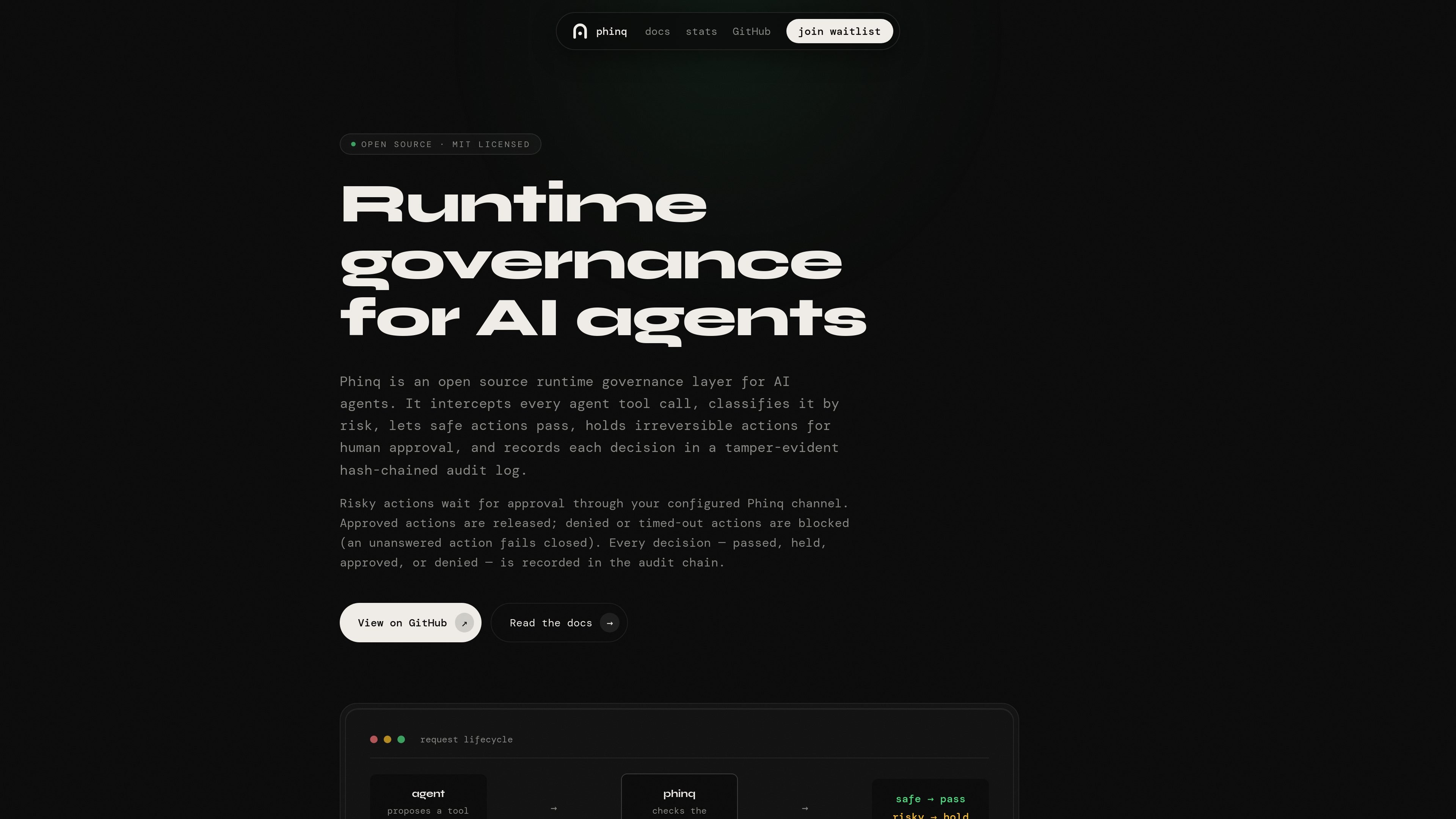
Phinq is an open source runtime governance layer for AI agents that classifies tool calls by risk, pauses irreversible actions for human approval, and records decisions in a tamper-evident audit log.

Phinq

Runtime governance for AI agent tool calls

Phinq is an open source runtime governance layer for AI agents. It sits between an agent’s proposed tool call and the execution boundary, classifies the action by risk, and decides whether it should pass, pause for approval, or be blocked. Safe actions continue automatically, while irreversible or higher-risk actions are held until a human decision is made.

The product is designed for agent workflows where a prompt alone is not enough to control behavior. Phinq enforces governance structurally at the API or execution layer, records each decision in an append-only audit log, and can run in shadow mode during setup so teams can observe decisions before turning on enforcement.


Core capabilities

Intercepts tool calls at the boundary

Phinq intercepts each tool call before execution and evaluates it from the tool name, arguments, rules, and relevant session context. That lets governance happen at the execution boundary instead of relying on prompts or agent instructions.

Classifies actions by risk

The classifier assigns a risk-aware outcome such as ALLOW or HOLD. The documentation says it uses the action’s intent and session velocity as part of the decision path.

Separates safe execution from approval

Safe actions pass through automatically, while risky actions pause for review. In enforce mode, a HOLD becomes a pending approval rather than being forwarded to the tool.

Supports human approval workflows

Approvals can be resolved through the configured Phinq channel, with CLI, Telegram, and Slack named in the docs. Approved actions are released, while denied or timed-out actions are blocked.

Records a verifiable audit trail

Every decision is written to an append-only, hash-chained audit log. The log records what the agent attempted, how it was classified, and whether it passed, waited, or was denied.

Fits multiple runtimes and clients

Phinq can run as a proxy, an in-process SDK, or a plain HTTP gate, and the docs note compatibility with OpenAI, Anthropic, Gemini, Claude Code, Codex, Gemini CLI, LangChain, CrewAI, Mastra, and MCP.

Where Phinq fits

  • Guarding irreversible agent actions

    Use Phinq when an agent can take actions that should not be left to prompt discipline alone, such as deletes, credential reads, payments, or external messages. The system holds risky actions until a human approves them.

  • Rolling out governance gradually

    Teams can start in shadow mode to observe how the classifier behaves before enforcing holds. That makes it easier to inspect decision patterns and add governance without immediately blocking work.

  • Creating an audit trail for agent decisions

    Phinq is suited to teams that want a decision record for later review. Each action is logged with its classification and outcome, creating evidence for debugging or post-incident review.

  • Adding controls to existing agent stacks

    Because Phinq can run as a proxy, SDK, or HTTP gate, it can fit different application architectures and client libraries without requiring a single framework.

  • Running human approval in team channels

    The docs mention resolution through CLI, Telegram, or Slack integration, which makes it useful for teams that want humans to approve risky actions in a familiar channel.

Pros and Cons

Pros

  • Enforces governance at the execution boundary, not just in prompts or agent instructions.
  • Provides a clear allow/hold decision path for each tool call.
  • Keeps a tamper-evident audit log with hash chaining and append-only JSONL storage.
  • Supports multiple deployment styles, including proxy, in-process SDK, and plain HTTP gate.
  • Works with several common agent clients and API styles, including OpenAI, Anthropic, Gemini, and MCP-related tooling.

Cons

  • The docs say approvals can be resolved through configured channels, but Phinq does not currently verify the real-world identity behind an approval identifier.
  • The proxy starts in shadow mode by default, so enforcement is not active until PHINQ_ENFORCE=1 is set.
  • The audit log does not include arguments and message payloads in the hash chain; those live in a separate phinq-toolcalls.jsonl corpus.

FAQ

What is Phinq?

Phinq is an open source runtime governance layer for AI agents. It sits between an agent and the tool execution boundary so each tool call can be classified before execution.

How does approval work?

Phinq intercepts the tool call, classifies it by risk, lets safe actions pass, and holds or denies higher-risk actions. If an action is held, it can be resolved through the configured approval channel; an unanswered hold fails closed.

What platforms or clients does Phinq work with?

The docs say Phinq can resolve holds through CLI, Telegram, or Slack integration. The documentation also says the proxy observes OpenAI-style, Anthropic Messages, and Gemini traffic, and the TypeScript SDK gates calls in process.

Is the audit log tamper-evident?

Yes. The audit log is append-only JSONL, canonicalized with JCS and chained with SHA-256. Each entry records intent, classification, decisions, hold transitions, and usage metadata.

Does Phinq enforce decisions immediately after install?

Phinq starts in shadow mode by default, where it classifies and logs without enforcing HOLD decisions until PHINQ_ENFORCE=1 is set.

Quick Facts

Category
Developer Tool
Product type
Open source runtime governance layer
License
MIT licensed
Primary boundary
Agent tool-call execution boundary
Deployment modes
Proxy, in-process SDK, plain HTTP gate
Source domain
phinq.co