

playedinrussia.com
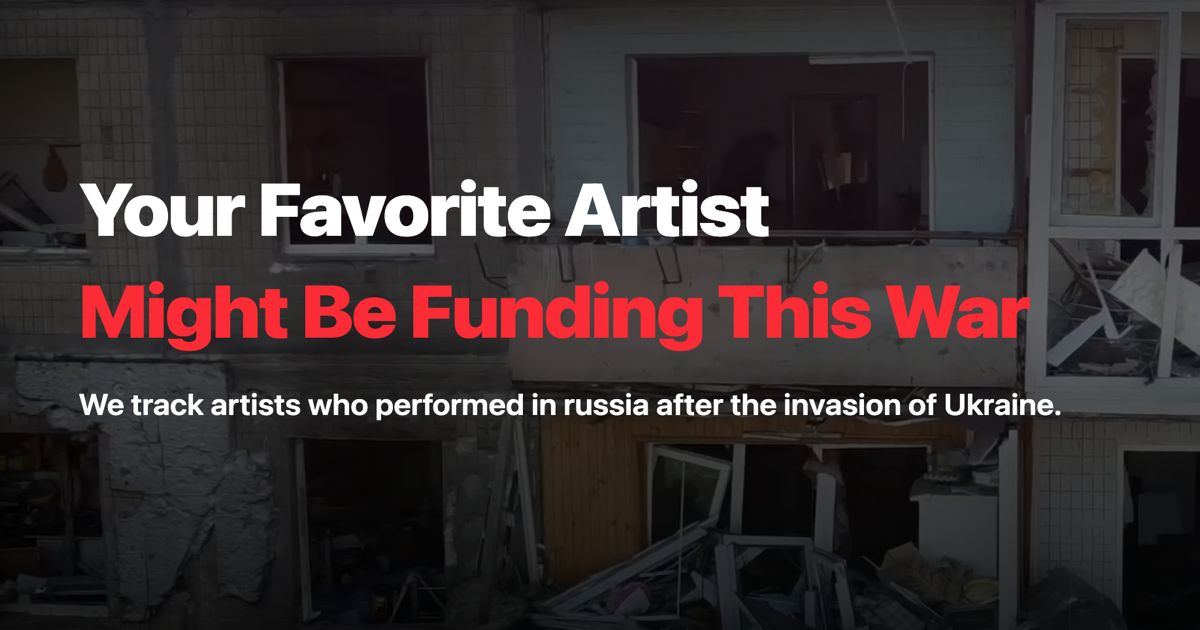
playedinrussia.com is a database tracking artists who performed in Russia after the invasion of Ukraine, helping you choose who to support.
What is playedinrussia.com?
Playedinrussia.com is a database that tracks artists who performed in Russia after the invasion of Ukraine. The site is designed to help readers evaluate which artists may still be performing there, so they can make informed decisions about who they support with their time and money.
The page frames the problem using publicly observable concert activity trends for Western artists (listed as the US, Canada, EU, Australia, and New Zealand). It presents the idea that a sustained decline in Western concert activity after February 2022 points toward a deliberate cultural boycott, while still noting that some artists continue to perform.
Key Features
- Tracks Western artists’ concert activity in Russia after the invasion, centered on the post-February 2022 period to support user research and comparisons.
- Provides a visible list of artists who continued to perform in Russia (e.g., DaBaby, Jason Derulo, Flo Rida, Akon, and others shown on the page), giving users concrete examples rather than general commentary.
- Includes a “Monthly concerts” visualization approach described as smoothed with a 3-month rolling average, supporting trend-level context for how concert frequency changed over time.
- Defines the geographic scope used for Western comparisons (US, Canada, EU, Australia, New Zealand) to clarify which artists the chart is referencing.
- Offers a “View Full Database” entry point so users can browse beyond the short list shown on the landing page.
How to Use playedinrussia.com
- Visit the site and use the database browsing link (“View Full Database”) to look up artists.
- Review whether an artist appears to have performed in Russia after the invasion, as indicated by the database and the page’s framing.
- Use the chart context (monthly concerts and the smoothing method) to understand broader trend shifts, then decide whether to support the artist.
Use Cases
- A music fan deciding whether to attend a show or purchase a recording from an artist who may have performed in Russia after the invasion.
- A journalist or researcher using the site as a starting point to identify artists referenced as continuing to perform, then verifying details through additional sources.
- A community organizer preparing an educational post about cultural boycotts, using the site’s chart context and the “View Full Database” list.
- A marketing or sponsorship reviewer assessing reputational risk by checking whether a given artist is listed among those who performed in Russia post-invasion.
- A reader trying to understand how concert activity for Western artists in Russia changed after February 2022, using the chart description and scope definitions.
FAQ
Is this site an official boycott campaign or a list of sanctions? The page describes the database as tracking artists who performed in Russia after the invasion and encourages informed support decisions; it does not state that it is an official sanctions authority.
What countries does the chart cover when discussing Western artist activity? The page specifies Western countries as the US, Canada, EU, Australia, and New Zealand.
How is the concert activity trend on the page calculated? The page states that monthly concerts are smoothed using a 3-month rolling average.
Does the site claim Russia’s concert activity returned to pre-pandemic levels? The page notes that Russia “has never recovered to pre-pandemic concert levels,” even after COVID restrictions were lifted globally, and it interprets the sustained decline after February 2022 as consistent with a deliberate cultural boycott.
Can I browse more than the examples shown on the homepage? Yes. The page includes a “View Full Database” link indicating a broader list is available.
Alternatives
- Artist tour databases and venue event listings: Instead of a curated post-invasion tracking database, you can search tour histories and venue schedules to assess whether an artist performed in Russia.
- General news and press archives about artist boycotts: Useful for contextual reporting and timelines, though typically less structured than a database focused on performances.
- Campaign or advocacy sites focused on cultural boycotts: These may provide guidance and arguments for boycotting, but may not offer the same artist-by-artist performance tracking workflow.
- Music platform or press kit pages (tour history sections): Some artists list past dates or tour summaries directly, which can complement research but may not reflect Russia-specific post-invasion activity without additional verification.
Alternatives

Struere
Struere is an AI-native operational system that replaces spreadsheet workflows with structured software—dashboards, alerts, and automations.

ClayHog
ClayHog tracks AI Search Visibility & GEO—see what ChatGPT, Gemini, Perplexity, Claude, and Google AI Overviews say about your brand, incl. citations and sentiment.

skills-janitor
Audit, track usage, and compare your Claude Code skills with skills-janitor—nine focused slash commands and zero dependencies.

PromptScout
PromptScout tracks how your brand is mentioned, which competitors are recommended, and what sources are cited in AI answers—plus website audits.

Lasso
Lasso is an AI-first PIM for ecommerce teams that enriches product attributes and descriptions, processes supplier data, and monitors competitors via app or API.

SaveMRR
SaveMRR scans Stripe billing data to find SaaS MRR leaks and help recover failed payments, save cancellations, and win back churn—60-sec Free Revenue Scan.