

SeaTicket AI
SeaTicket AI is a unified issue management platform for GitHub issues, forum threads, email, and support channels. Triages, tracks, and resolves software issues with AI agents, linked records, and reusable knowledge.
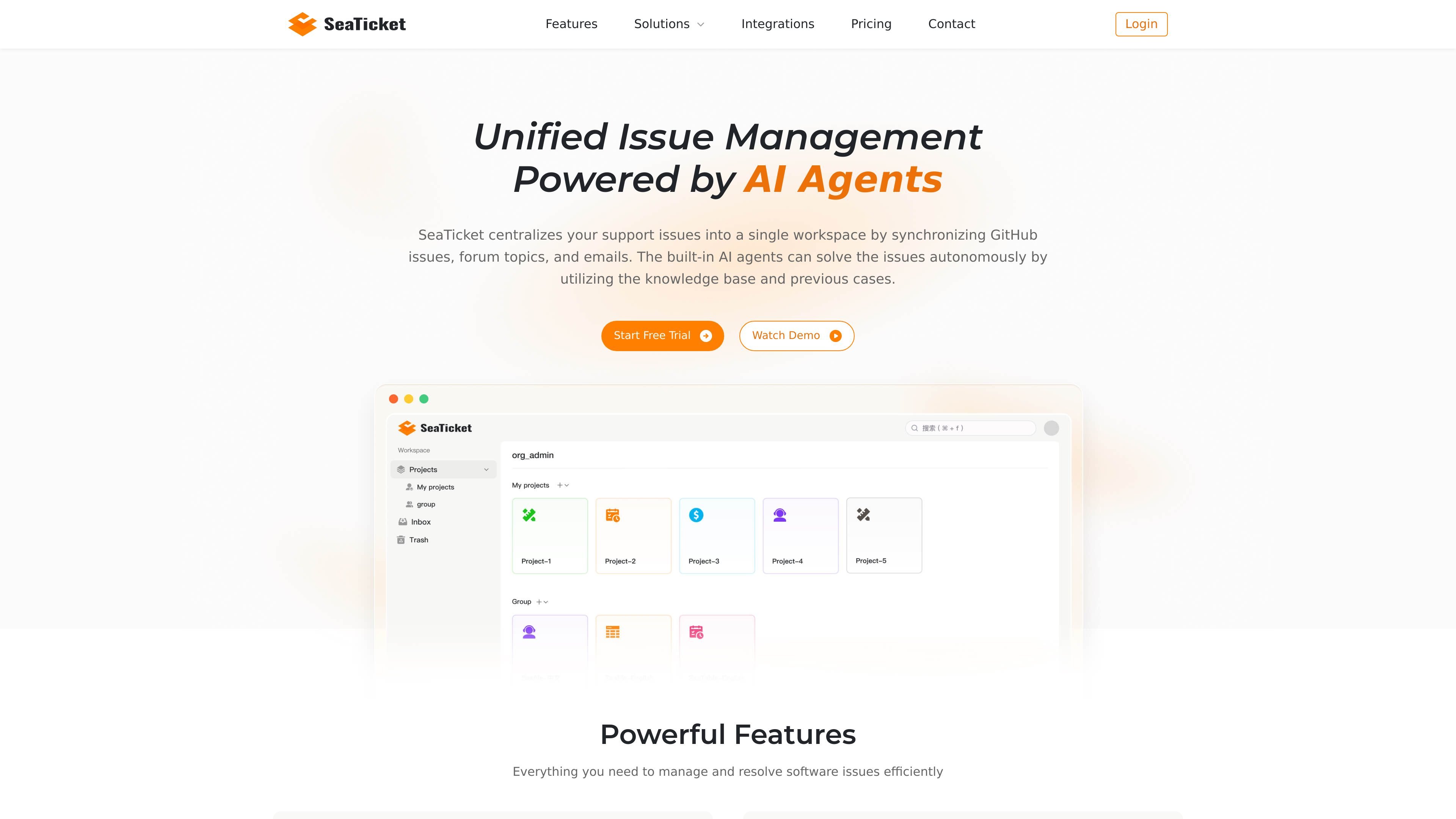
What is SeaTicket AI?
SeaTicket AI is a unified issue management platform that brings together support requests from GitHub issues, forum threads, email, website tickets, and other resources in one workspace. It is designed to help teams organize, triage, and resolve software issues without switching between separate channels.
The product uses built-in AI agents to analyze incoming issues, suggest solutions, and help resolve them using a knowledge base and previous cases. It also supports linking related records, turning unresolved items into trackable tickets, and reusing resolved issues as knowledge for future cases.
Key Features
- Syncs multiple issue sources into one workspace — brings GitHub issues, forum topics, email support, website tickets, and other resources into a single view for team handling.
- AI agent assistance — analyzes new issues and comments, then suggests possible solutions based on prior cases and the knowledge base.
- Ticket creation and resolution tracking — converts issues that need manual handling into trackable tickets with owners, internal collaboration, and progress tracking.
- Record linking — connects tickets, issues, tasks, and documents so related information stays associated.
- Cross-channel problem grouping — identifies recurring issues across GitHub, email, forums, and similar sources to help teams spot patterns.
- Reusable knowledge from resolved cases — turns solved issues into searchable knowledge that can be reused by the team and AI agents.
How to Use SeaTicket AI
Start by connecting the support sources you want to manage, such as GitHub, email, or forum channels. SeaTicket AI then syncs incoming items into one workspace where the team can review, assign, and respond.
From there, teams can let the AI agent suggest responses or resolutions, convert items into tickets when manual work is needed, and link related records to keep context together. As issues are resolved, the knowledge can be reused for future cases.
Use Cases
- Managing support across multiple channels — a team that receives reports through GitHub, email, and a forum can centralize them in one place instead of monitoring each channel separately.
- Handling repetitive bug reports — repeated issues can be grouped so the team can identify patterns and decide what to prioritize.
- Reducing manual triage — AI agents can analyze new submissions and propose a likely solution before a human takes over.
- Tracking unresolved cases — issues that require follow-up can be turned into tickets with an owner and progress status.
- Building a support knowledge base — once a case is resolved, the outcome can be stored and reused for similar future problems.
FAQ
Does SeaTicket AI only work with GitHub? No. The page also lists forum threads, email support, website tickets, and other resources as supported issue sources.
Can the AI resolve issues on its own? The source says the built-in AI agents can solve issues autonomously in some cases and suggest solutions for new issues or comments. It also supports handing items over to manual ticket tracking when needed.
Can teams collaborate inside the product? Yes. The page mentions team collaboration, including assigning owners and collaborating internally on tickets that need manual resolution.
Can resolved issues be reused later? Yes. Resolved issues can be turned into reusable, searchable knowledge for the team and AI agents.
Alternatives
- Shared inbox support tools — these focus on email-style ticket handling and are a better fit when the main workflow is human-managed support rather than AI-assisted issue resolution.
- Help desk platforms — these are built around ticket queues, assignments, and customer support operations, and may be more general-purpose than SeaTicket AI’s issue-centric workflow.
- Developer issue trackers — tools centered on engineering task and bug tracking can fit teams that mainly work inside a software development backlog rather than across support channels.
- Knowledge base and forum systems — these help capture answers and community discussion, but do not usually provide the same unified issue triage and resolution workflow.
Alternatives

Biji
Biji is a versatile platform designed to enhance productivity through innovative tools and features.

Falconer
Falconer is a self-updating knowledge platform for high-speed teams to write, share, and find reliable internal documentation and code context in one place.

BotBoard
Manage AI agents like a team with a shared backlog, structured context, and human review workflow to assign, track, and approve outputs.

Theneo
Theneo is an all-in-one developer portal for API docs, guides, changelogs, and private customer docs—built for real-time co-editing.
SignalLEMO
SignalLEMO helps teams and solo users organize, track, and share work in one place. It manages five data types, including signals.

Lasso
Lasso is an AI-first PIM for ecommerce teams that enriches product attributes and descriptions, processes supplier data, and monitors competitors via app or API.