
Browser editor and local workflow
Create and edit documentation in a browser-based editor, then use the CLI and deploy previews to develop and review changes locally before publishing.

Mintlify is an AI-native documentation platform for developer and internal knowledge sites, with docs authoring, API reference tools, search, analytics, and AI workflows.
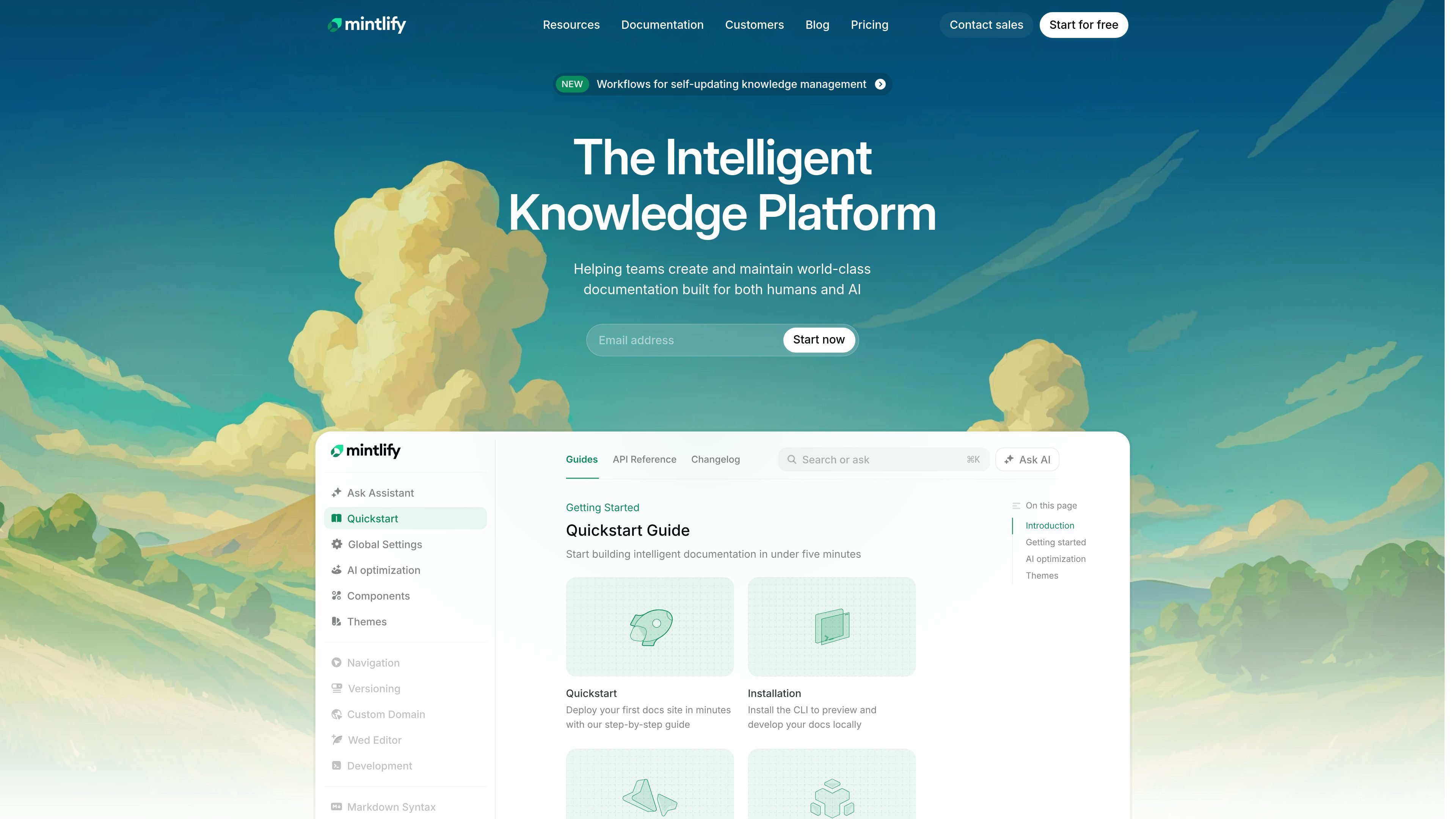
Mintlify is an AI-native documentation platform for developer-facing and internal knowledge sites. It combines a docs editor, CLI-based local development, Git sync, API documentation tools, search, analytics, and AI features such as an assistant, writing agent, workflows, and MCP support.
The product is positioned for teams that want to create, maintain, and publish documentation that serves both people and AI systems. The site also presents an enterprise path with SSO, role-based permissions, security review, legal review, migration support, and service options for larger organizations.
Create and edit documentation in a browser-based editor, then use the CLI and deploy previews to develop and review changes locally before publishing.
Support API documentation with an API playground, OpenAPI setup, complex data types, SDK examples, manual API pages, and async API setup for technical docs.
Connect docs work to source control with Git sync, GitHub and GitLab options, plus CI checks and monorepo support for larger engineering setups.
Add search, feedback, analytics, user feedback, agent feedback, and insights to understand how people use documentation and where it needs updates.
Use the assistant, writing agent, workflows, and context-aware agent tools to draft, update, and help users navigate documentation.
Deploy docs for products and teams with custom domains, SEO and GEO optimizations, white labeling, custom components, and scripts for branded sites.
Teams can build and publish developer documentation with API references, playgrounds, search, and version-controlled updates from Git-based workflows.
Product and support teams can turn documentation into a self-serve knowledge base with assistant-driven search and content that answers common questions.
Organizations can keep documentation aligned with fast-moving codebases by using agents, workflows, and CI-aware publishing rather than manual-only updates.
Large organizations can manage documentation with role-based permissions, SSO, migration support, and enterprise security and legal review processes.
Teams that need branded documentation sites can customize domains, components, CSS, scripts, SEO, and white-label presentation.
Mintlify provides a free trial and a Starter plan for individuals and small teams. The pricing page also offers an Enterprise path for larger organizations that want custom quoting and sales contact.
The docs site highlights support for a docs CLI, web editor, components, API playground, integrations, authentication setup, deploy previews, assistant, AI-native documentation features, and workflow tools such as agent and MCP-related pages.
The pricing page says the Starter plan includes Mintlify Auth only, while Enterprise adds password, OAuth, and JWT options.
Mintlify’s site says it supports AI features such as the assistant, agent, workflows, and MCP, and the FAQ list specifically asks how pricing works for those AI features and whether a hard credit limit can be set.
The enterprise page says Mintlify is compliant with SOC 2 and is in the process for ISO/27001 and GDPR compliance, and it mentions SAML-based SSO for secure access and provisioning.

Falconer is an AI-powered company brain that keeps internal docs accurate, searchable, and up to date by syncing with GitHub, Slack, and Linear.

Theneo is a developer portal and API documentation platform for publishing references, guides, changelogs, and private customer portals with collaborative editing and AI-ready docs.

Goldfish is an AI memory app for macOS that helps you reply, write, summarize, and continue with context already on your Mac. It stores memory locally and writes in your tone.

Lasso is an ecommerce product data platform for enriching catalog records, processing supplier files, generating product content, and tracking competitors. It includes a web app, REST API, SDK, and MCP server.

ArtDeck is a visual reference board app for iPhone, iPad, and Mac. Collect mixed references on one canvas and study them with ToolBox lenses. Offline, optional iCloud sync, one-time purchase.

Struere turns spreadsheet data into structured operational software with dashboards, alerts, and automations for teams replacing manual spreadsheet workflows.